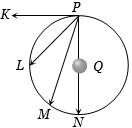
In the figure the charge $Q$ is at the centre of the circle. Work done is maximum when another charge is taken from point $P$ to
Easy


Download our appand get started for free
Experience the future of education. Simply download our apps or reach out to us for more information. Let's shape the future of learning together!No signup needed.*
Similar Questions
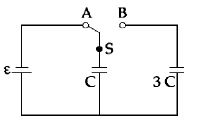
- 1In the figure shown, after the switch $‘S’$ is turned from position $‘A’$ to position $‘B’$, the energy dissipated in the circuit in terms of capacitance $‘C’$ and total charge $‘Q’$ isView Solution
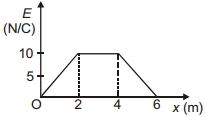
- 2Figure shows the variation of electric field intensity $E$ versus distance $x$. What is the potential difference between the points at $x=2 \,m$ and at $x=6 \,m$ from $O$ is ............. $V$View Solution
- 3The distance between the circular plates of a parallel plate condenser $40\,mm$ in diameter, in order to have same capacity as a sphere of radius $1\;metre$ is....$mm$View Solution
- 4An infinite non-conducting sheet has a surface charge density $\sigma = 0.10\, \mu C/m^2$ on one side. How far apart are equipotential surfaces whose potentials differ by $50\, V$View Solution
- 5Consider a spherical shell of radius $R$ with a total charge $+ Q$ uniformly spread on its surface (centre of the shell lies at the origin $x=0$ ). Two point charges $+q$ and $-q$ are brought, one after the other from far away and placed at $x=-a / 2$ and $x=+a / 2( < R)$, respectively. Magnitude of the work done in this process isView Solution
- 6View SolutionA parallel plate air-core capacitor is connected across a source of constant potential difference. When a dielectric plate is introduced between the two plates then :
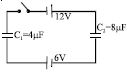
- 7In the circuit shown initially $C_1, C_2$ are uncharged. After closing the switchView Solution
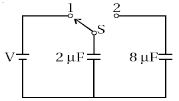
- 8A capacitor of $2\,\, \mu F$ is charged as shown in the diagram. When the switch $S$ is turned to position $2,$ the percentage of its stored energy dissipated is ......$\%$View Solution
- 9Aparallel-plate capacitor is connected to a cell. Its positive plate $A$ and its negative plate $B $ have charges $+Q$ and $-Q$ respectively. A third plate $C$, identical to $A$ and $B$, with charge $+Q$, is now introduced midway between $ A$ and $B$, parallel to them. Which of the following are correct?View Solution
- 10Three capacitors of capacitance $3\,\mu \,F$ are connected in a circuit. Then their maximum and minimum capacitances will beView Solution