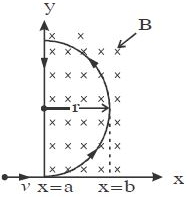
A particle of mass $m$ and charge $q$ moves with a constant velocity $v$ along the positive $x$ direction. It enters a region containing a uniform magnetic field $B$ directed along the negative $z$ direction, extending from $x = a$ to $x = b$. The minimum value of $v$ required so that the particle can just enter the region $x > b$ is
Medium


Download our appand get started for free
Experience the future of education. Simply download our apps or reach out to us for more information. Let's shape the future of learning together!No signup needed.*
Similar Questions
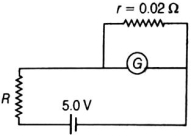
- 1In the circuit, shown the galvanometer $G$ of resistance $60\, \Omega$ is shunted by a resistance $r=0.02\, \Omega$. The current through $R$ (in $ohm$) is nearly $1\, A$. The value of resistance $R$ (in $ohm$) is nearly (in $\Omega$)View Solution
- 2The resistance of a galvanometer is $50\, ohm$ and the maximum current which can be passed through it is $0.002\, A$. What resistance must be connected to it in order to convert it into an ammeter of range $0 -0.5\, A$ ?....$ohm$View Solution
- 3A voltmeter having resistance of $50 × 10^3$ $Omega$ is used to measure the voltage in a circuit. To increase the range of measurement $3$ times the additional series resistance required isView Solution
- 4A particle of mass $0.6\, g$ and having charge of $25\, nC$ is moving horizontally with a uniform velocity ${\rm{1}}{\rm{.2}} \times {\rm{1}}{{\rm{0}}^{\rm{4}}}\,m{s^{ - 1}}$ in a uniform magnetic field, then the value of the magnetic induction is $(g = 10\,m{s^{ - 2}})$View Solution
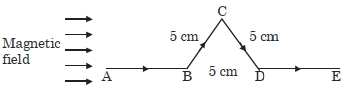
- 5A triangular shaped wire carrying $10 A$ current is placed in a uniform magnetic field of $0.5\,T$, as shown in figure. The magnetic force on segment $CD$ is $....N$ $($ Given $BC = CD = BD =5\,cm )$.View Solution
- 6A long straight wire with a circular crosssection having radius $R$, is carrying a steady current $I$. The current I is uniformly distributed across this cross-section. Then the variation of magnetic field due to current I with distance $r\;( r < R )$ from its centre will beView Solution
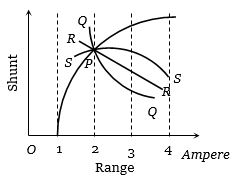
- 7The ammeter has range $1\, ampere$ without shunt. the range can be varied by using different shunt resistances. The graph between shunt resistance and range will have the natureView Solution
- 8Biot-Savart, law indicates that the moving electrons (velocity $v$) produce a magnetic field $B$ such thatView Solution
- 9View SolutionWhich of the following loop is in stable equallibrium
- 10A particle of mass $m$ carrying charge $q$ is accelerated by a potential difference $V$. It enters perpendicularly in a region of uniform magnetic field $B$ and executes circular arc of radius $R$, then $\frac{q}{m}$ equalsView Solution