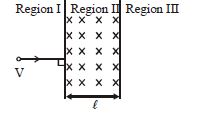
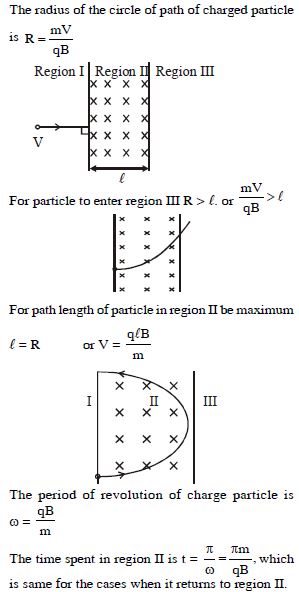
A particle of mass $m$ and charge $q$ , moving with velocity $V$ enters region $II$ normal to the boundary as shown in the figure. Region $II$ has a uniform magnetic field $B$ perpendicular to the plane of the paper. The length of the region $II$ is $l$ . Choose the not correct choice
Advanced
Download our app for free and get started

Download our appand get started for free
Experience the future of education. Simply download our apps or reach out to us for more information. Let's shape the future of learning together!No signup needed.*
Similar Questions
- 1${10^{ - 3}}amp$ is flowing through a resistance of $1000\,\Omega $. To measure the correct potential difference, the voltmeter is to be used of which the resistance should beView Solution
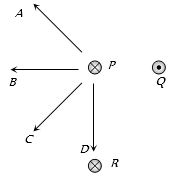
- 2In figure shows three long straight wires $P, Q$ and $R$ carrying currents normal to the plane of the paper. All three currents have the same magnitude. Which arrow best shows the direction of the resultant force on the wire $P$View Solution
- 3View SolutionThe magnetic field at the centre of current carrying coil is
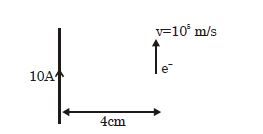
- 4An $e^-$ is moving parallel to a long current carrying wire as shown. Force on electron isView Solution
- 5View SolutionWhich of the following statement is correct :
- 6An electron and a proton enter region of uniform magnetic field in a direction at right angles to the field with the same kinetic energy. They describe circular paths of radius ${r_e}$ and ${r_p}$ respectively. ThenView Solution
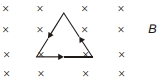
- 7A wire is bent in the form of an equilateral triangle of side $100 \,cm$ and carries a current of $2 \,A$. It is placed in a magnetic field of induction $2.0 \,T$ directed perpendicular into the plane of paper. The direction and magnitude of magnetic force acting on each side of the triangle will beView Solution
- 8View SolutionA beam of electrons and protons move parallel to each other in the same direction, then they
- 9In an ammeter $0.2\%$ of main current passes through the galvanometer. If resistance of galvanometer is $G,$ the resistance of ammeter will beView Solution
- 10A galvanometer having coil resistance $10 \ \Omega$ shows a full scale deflection for a current of $3 \mathrm{~mA}$. For it to measure a current of $8 \mathrm{~A}$, the value of the shunt should be:View Solution