MCQ
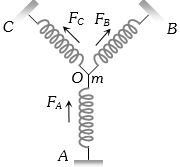
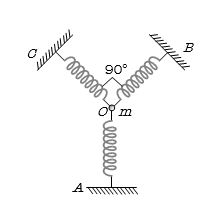
A particle of mass $m$ is attached to three identical springs $A, B$ and $C$ each of force constant $ k$ a shown in figure. If the particle of mass $m$ is pushed slightly against the spring $A$ and released then the time period of oscillations is
  • A
    $2\pi \sqrt {\frac{{2m}}{k}} $
  • $2\pi \sqrt {\frac{m}{{2k}}} $
  • C
    $2\pi \sqrt {\frac{m}{k}} $
  • D
    $2\pi \sqrt {\frac{m}{{3k}}} $

Answer

Correct option: B.
$2\pi \sqrt {\frac{m}{{2k}}} $
b
(b) When the particle of mass $m$ at $O$ is pushed by $y$ in the direction of $A$ The spring $A$ will be compressed by $y$ while spring $B$ and $C$ will be stretched by $y' = y\cos 45^\circ .$ So that the total restoring force on the mass $m $ along $ OA.$
${F_{net}} = {F_A} + {F_B}\cos 45^\circ + {F_C}\cos 45^\circ $
$ = ky + 2ky'\cos 45^\circ $$ = ky + 2k(y\cos 45^\circ )\cos 45^\circ $$ = 2ky$
Also ${F_{net}} = k'y$ ==> $k'y = 2ky$==> $k' = 2k$
$T = 2\pi \sqrt {\frac{m}{{k'}}} = 2\pi \sqrt {\frac{m}{{2k}}} $

Need a full question paper?

Generate a complete, print-ready paper with questions like this in minutes — across 16+ boards, with answer keys.

Start Generating Free

Similar questions

A body cools from ${60^o}C$ to ${50^o}C$ in $10$ minutes when kept in air at ${30^o}C$. In the next $10$ minutes its temperature will be
A lead bullet of $10\, g$ travelling at $300\, m/s$ strikes against a block of wood and comes to rest. Assuming $50\%$ of heat is absorbed by the bullet, the increase in its temperature is ........ $^oC$

$($Specific heat of lead $= 150\,J/kg, K)$

 A $10 \;N$ force is applied on a body produce in it an acceleration of $1 \;m / s ^{2} .$ The mass of the body is ...... $kg$
An inverted tube barometer is kept on a lift  with a moving downward with a deceleration $\alpha $ . The density of mercury is $\rho$ and acceleration due to gravity is $g$ . If the atmospheric pressure be $P_0$ then
A small body slips, subject to the force of friction, from point $A$ to point $B$ along two curved surfaces of equal radius, first along route $1,$ then along route $2$. Friction does not depend on the speed and the coefficient of friction on both routes is the same. In which case will the body’s speed at $B$ be greater?
A large horizontal surface moves up and down in $SHM$ with an amplitude of $1 \,cm$. If a mass of $10\, kg$ (which is placed on the surface) is to remain continually in contact with it, the maximum frequency of $S.H.M.$ will be ... $Hz$
A strap is passing over a wheel of radius $30\, cm.$ During the time the wheel moving with initial constant velocity of $2\, rev/sec.$ comes to rest the strap covers a distance of $25\, m.$ The deceleration of the wheel in $rad/s$$^2$ is
A body, whose momentum is constant, must have constant
A cricket ball of mass $150g$ has an initial velocity $\text{u}=(3\hat{\text{i}}+4\hat{\text{j}})\text{m s}^{-1}$ and a final velocity $\text{v}=-(3\hat{\text{i}}+4\hat{\text{j}})\text{m s}^{-1}$ after being hit. The change in momentum $($final momentum$-$initial momentum$)$ is $($in $kg m s^1):$
A body is projected at an angle of $30^{\circ}$ with the horizontal with momentum $p$. At its highest point, the magnitude of the momentum is