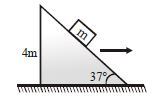
A body of mass $10\, kg$ is lying on a rough plane inclined at an angle of $30^o$ to the horizontal and the coefficient of friction is $0.5$. the minimum force required to pull the body up the plane is ........ $N$
Medium


Download our appand get started for free
Experience the future of education. Simply download our apps or reach out to us for more information. Let's shape the future of learning together!No signup needed.*
Similar Questions
- 1A body is sliding down an inclined plane (angle of inclination $45^o$). If the coefficient of friction is $0.5$ and $g = 9.8\, m/s^2$. then the acceleration of the body downwards in $m/s^2$ isView Solution
- 2A person with his hands in his pockets is skating on ice at the velocity of $10 \,m/s$ and describes a circle of radius $50\, m$. What is his inclination with verticalView Solution
- 3View SolutionA car accelerates on a horizontal road due to force exerted by
- 4Two bodies of equal masses revolve in circular orbits of radii ${R_1}$ and ${R_2}$ with the same period. Their centripetal forces are in the ratioView Solution
- 5Block of mass $10 \,kg$ is moving on inclined plane with constant velocity $10 \,m / s$. The coefficient of kinetic friction between incline plane and block is ...........View Solution

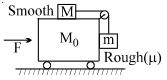
- 6Imagine $a$ situation in which the horizontal surface of block $M_0$ is smooth and its vertical surface is rough with $a$ coefficient of friction $\mu$ In above problem, the value $(s)$ of $F$ for which $M$ and $m$ are stationary with respect to $M_0 mg$View Solution
- 7A block of mass $2\,kg$ moving on a horizontal surface with speed of $4\,ms ^{-1}$ enters a rough surface ranging from $x =0.5\,m$ to $x =1.5\,m$. The retarding force in this range of rough surface is related to distance by $F =- kx$ where $k =12\,Nm ^{-1}$. The speed of the block as it just crosses the rough surface will be ........... $\,ms ^{-1}$View Solution
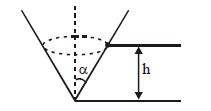
- 8A particle is describing circular motion in a horizontal plane in contact with the smooth inside surface of a fixed right circular cone with its axis vertical and vertex down. The height of the plane of motion above the vertex is $h$ and the semivertical angle of the cone is $\alpha $ . The period of revolution of the particleView Solution
- 9A block $A$ of mass $4\, kg$ is placed on another block $B$ of mass $5\, kg$, and the block $B$ rests on a smooth horizontal table. If the minimum force that can be applied on $A$ so that both the blocks move together is $12\, N$, the maximum force that can be applied to $B$ for the blocks to move together will be $..... N$View Solution
- 10If the coefficient of friction between block & wedge is $\mu $, then the maximum horizontal acceleration of the wedge for which block will remain at rest w.r.t. the wedge isView Solution