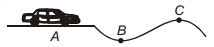
A vehicle is moving on a track with constant speed as shown in figure. The apparent weight of the vehicle is
Easy


Download our appand get started for free
Experience the future of education. Simply download our apps or reach out to us for more information. Let's shape the future of learning together!No signup needed.*
Similar Questions
- 1A coin placed on a rotating table just slips when it is placed at a distance of $1\,cm$ from the center. If the angular velocity of the table in halved, it will just slip when placed at a distance of from the centre $............\,cm$View Solution
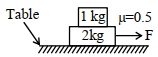
- 2The coefficient of static friction between two blocks is $0.5$ and the table is smooth. The maximum horizontal force that can be applied to move the blocks together is $\ldots \ldots . N$. (take $\left.g=10\, {ms}^{-2}\right)$View Solution
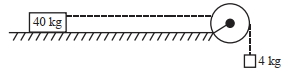
- 3A block of mass $40 \,kg$ slides over a surface, when a mass of $4 \,kg$ is suspended through an inextensible massless string passing over frictionless pulley as shown below. The coefficient of kinetic friction between the surface and block is $0.02$. The acceleration of block is ............ $ms ^{-2}$ (Given $g =10 \,ms ^{-2}$.)View Solution
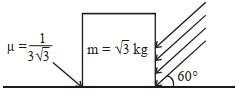
- 4As shown in the figure, a block of mass $\sqrt{3}\, kg$ is kept on a horizontal rough surface of coefficient of friction $\frac{1}{3 \sqrt{3}}$. The critical force to be applied on the vertical surface as shown at an angle $60^{\circ}$ with horizontal such that it does not move, will be $3 x$. The value of $3x$ will beView Solution
$\left[ g =10 m / s ^{2} ; \sin 60^{\circ}=\frac{\sqrt{3}}{2} ; \cos 60^{\circ}=\frac{1}{2}\right]$
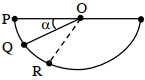
- 5A ball is released from rest from point $P$ of a smooth semi-spherical vessel as shown in figure. The ratio of the centripetal force and normal reaction on the ball at point $Q$ is $A$ while angular position of point $Q$ is $\alpha$ with respect to point $P$. Which of the following graphs represent the correct relation between $A$ and $\alpha$ when ball goes from $Q$ to $R$ ?View Solution
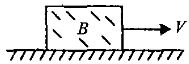
- 6A block $B$ is pushed momentarily along a horizontal surface with an initial velocity $V.$ If $\mu $ is the coefficient of sliding friction between $B$ and the surface, block $B$ will come to rest after a timeView Solution
- 7A block weighs $W$ is held against a vertical wall by applying a horizontal force $F$. The minimum value of $F$ needed to hold the block is $[\mu < 1]$View Solution
- 8On a rough horizontal surface, a body of mass $2 \,kg$ is given a velocity of $10 \,m/s$. If the coefficient of friction is $0.2$ and $g = 10\, m/{s^2}$, the body will stop after covering a distance of ........ $m$View Solution
- 9Put a uniform meter scale horizontally on your extended index fingers with the left one at $0.00 cm$ and the right one at $90.00 cm$. When you attempt to move both the fingers slowly towards the center, initially only the left finger slips with respect to the scale and the right finger does not. After some distance, the left finger stops and the right one starts slipping. Then the right finger stops at a distance $x_R$ from the center ( $50.00 cm$ ) of the scale and the left one starts slipping again. This happens because of the difference in the frictional forces on the two fingers. If the coefficients of static and dynamic friction between the fingers and the scale are $0.40$ and $0.32$ , respectively, the value of $x_R($ in $cm )$ is. . . . . . .View Solution
- 10View SolutionStatic friction between two surfaces