A particle of mass m is hanging vertically by an ideal spring of force constant K. If the mass is made to oscillate vertically, its total energy is
Easy
Download our app for free and get started
(d)In simple harmonic motion, energy changes from kinetic to potential and potential to kinetic but the sum of two always remains constant.

Download our appand get started for free
Experience the future of education. Simply download our apps or reach out to us for more information. Let's shape the future of learning together!No signup needed.*
Similar Questions
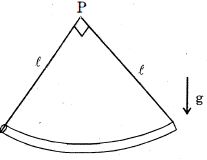
- 1A circular arc of mass $m$ is connected with the help of two massless strings as shown in the figuw in vertical plane. About point $P$, small oscillations are given in the plane of the arc. Time period of the oscillations of $SHM$ will beView Solution
- 2View SolutionA simple pendulum is vibrating in an evacuated chamber, it will oscillate with
- 3You are holding a shallow circular container of radius $R$, filled with water to a height $h ( h < < R )$. When yon walk with speed $v$, it is seen that water starts spilling over. This happens due to the resonance of the periodic impulse given to the container (due to walking) with the oscillation of the water in the container. If the time period of water oscillating in the container is inversely proportional to $\sqrt{ h }$, then $v$ is proportional toView Solution
- 4A particle is oscillating according to the equation $X = 7\cos 0.5\pi t$, where $t$ is in second. The point moves from the position of equilibrium to maximum displacement in time ..... $\sec$View Solution
- 5A simple pendulum of mass $m$ executes $S.H.M.$ with total energy $E$. If at an instant it is at one of extreme positions, then its linear momentum after a phase shift of $\frac{\pi}{3} \,rad$ will beView Solution
- 6If a Second's pendulum is moved to a planet where acceleration due to gravity is $4$ times, the length of the second's pendulum on the planet should be made .......... timesView Solution
- 7In the following questions, match column $-I$ with column $-II$ and choose the correct optionsView Solution
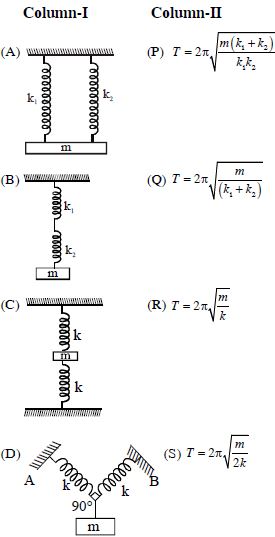
- 8A vibratory motion is represented by $x = 2\,A\,\cos \,\omega t + A\,\cos \,\left( {\omega t + \frac{\pi }{2}} \right) + A\,\cos \,\left( {\omega t + \pi } \right) + \frac{A}{2}\,\cos \,\left( {\omega t + \frac{{3\pi }}{2}} \right)$ The resultant amplitude of motion isView Solution
- 9The angular frequency of motion whose equation is $4\frac{{{d^2}y}}{{d{t^2}}} + 9y = 0$ is ($y =$ displacement and $t =$ time)View Solution
- 10A particle of mass $m$ oscillates with simple harmonic motion between points ${x_1}$ and ${x_2}$, the equilibrium position being $O$. Its potential energy is plotted. It will be as given below in the graphView Solution