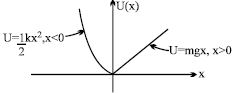
A particle of mass $m$ moves in the potential energy $U$ shown above. The period of the motion when the particle has total energy $E$ is
Advanced
Download our app for free and get started
As seen from graph, we can infer that for $x<0$ particle is in $SHM$ as in spring. and for $x>0$ particle is in influence of gravity i.e. thrown upwards with some initial velocity.
So we can divide the time period in two parts. first $T_{1}$ and second $T_{2}$
$T_{1}$ is half of the time period of a full SHM i.e. $T_{1}=\pi \sqrt{\frac{m}{k}}$
$E=\frac{1}{2} m v_{\max }^{2}$
$\Rightarrow v_{\max }=\sqrt{\frac{2 E}{m}}$
and $T_{2}$ is the time during which the particle remains in air when it is thrown upwards with velocity $v_{\max }=\sqrt{\frac{2 E}{m}}$
$0=\sqrt{\frac{2 E}{m}} t-\frac{1}{2} g t^{2} \quad$ since $s=u t-\frac{1}{2} g t^{2}$
$\Rightarrow T_{2}=2 \sqrt{2 E / m g^{2}}$
So total time time period $T=\pi \sqrt{\frac{m}{k}}+2 \sqrt{\frac{2 E}{m g^{2}}}$

Download our appand get started for free
Experience the future of education. Simply download our apps or reach out to us for more information. Let's shape the future of learning together!No signup needed.*
Similar Questions
- 1The amplitude of a damped oscillator becomes half in one minute. The amplitude after $3$ minute will be $\frac{1}{X}$ times the original, where $X$ isView Solution
- 2A particle performs $S.H.M.$ of amplitude $A$ with angular frequency $\omega$ along a straight line. Whenit is at a distance $\frac{{\sqrt 3 }}{2}$ $A$ from mean position, its kinetic energy gets increased by an amount $\frac{1}{2}m{\omega ^2}{A^2}$ due to an impulsive force. Then its new amplitude becomesView Solution
- 3A block of mass $m$ is suspended separately by two different springs have time period $t_1$ and $t_2$ . If same mass is connected to parallel combination of both springs, then its time period will beView Solution
- 4A pendulum bob has a speed of $3\, {m} / {s}$ at its lowest position. The pendulum is $50 \,{cm}$ long. The speed of bob, when the length makes an angle of $60^{\circ}$ to the vertical will be $ .......\,{m} / {s}$ $\left(g=10 \,{m} / {s}^{2}\right)$View Solution
- 5Two simple pendulums of length $0.5\, m$ and $2.0\, m$ respectively are given small linear displacement in one direction at the same time. They will again be in the phase when the pendulum of shorter length has completed .... oscillations.View Solution
- 6A particle executes simple harmonic oscillation with an amplitude $a.$ The period of oscillation is $T.$ The minimum time taken by the particle to travel half of the amplitude from the equilibrium position isView Solution
- 7Displacement-time equation of a particle executing $SHM$ is $x\, = \,A\,\sin \,\left( {\omega t\, + \,\frac{\pi }{6}} \right)$ Time taken by the particle to go directly from $x\, = \, - \frac{A}{2}$ to $x\, = \, + \frac{A}{2}$ isView Solution
- 8For a particle executing $S.H.M.$ the displacement $x$ is given by $x = A\cos \omega t$. Identify the graph which represents the variation of potential energy $(P.E.)$ as a function of time $t$ and displacement $x$View Solution

- 9View SolutionIn S.H.M. maximum acceleration is at
- 10What is the velocity of the bob of a simple pendulum at its mean position, if it is able to rise to vertical height of $10cm$ ......... $m/s$ (Take $g = 9.8\,m/{s^2})$View Solution