A particle of unit mass is moving along the $x$-axis under the influence of a force and its total energy is conserved. Four possible forms of the potential energy of the particle are given in column $I$ (a and $U _0$ are constants). Match the potential energies in column $I$ to the corresponding statement$(s)$ in column $II.$
| column $I$ | column $II$ |
| $(A)$ $U _1( x )=\frac{ U _0}{2}\left[1-\left(\frac{ x }{ a }\right)^2\right]^2$ | $(P)$ The force acting on the particle is zero at $x = a$. |
| $(B)$ $U _2( x )=\frac{ U _0}{2}\left(\frac{ x }{ a }\right)^2$ | $(Q)$ The force acting on the particle is zero at $x=0$. |
| $(C)$ $U _3( x )=\frac{ U _0}{2}\left(\frac{ x }{ a }\right)^2 \exp \left[-\left(\frac{ x }{ a }\right)^2\right]$ | $(R)$ The force acting on the particle is zero at $x =- a$. |
| $(D)$ $U _4( x )=\frac{ U _0}{2}\left[\frac{ x }{ a }-\frac{1}{3}\left(\frac{ x }{ a }\right)^3\right]$ | $(S)$ The particle experiences an attractive force towards $x =0$ in the region $| x |< a$. |
| $(T)$ The particle with total energy $\frac{ U _0}{4}$ can oscillate about the point $x=-a$. |
IIT 2015, Diffcult
Download our app for free and get started
Second Method
$(A)$ $\overrightarrow{ F }=-\frac{ dU }{ dx } \hat{ i }=-\frac{ U _0}{2} 2\left(1-\left(\frac{ x }{ a }\right)^2\right) \times\left[-2\left(\frac{ x }{ a }\right) \times \frac{1}{ a }\right] \hat{ i }=2 U _0\left[1-\left(\frac{ x }{ a }\right)^2\right]\left[\frac{ x }{ a ^2}\right] \hat{ i }$
If $x=0 \Rightarrow \vec{F}=\frac{ U _0}{2}[2(1) \times 0]=\overrightarrow{0}, U =\frac{ U _0}{2}$
If $x=a \Rightarrow \vec{F}=\overrightarrow{0}, \& U=0$
If $x=-a \Rightarrow \vec{F}=\overrightarrow{0}, \& U=0$
$(B)$ $\overrightarrow{ F }=-\frac{ U _0}{2} \times 2\left(\frac{ x }{ a }\right) \times \frac{1}{ a } \hat{ i }=-\frac{ U _0 x }{ a ^2} \hat{ i }$
If $x=0 \Rightarrow \overrightarrow{ F }=0$ and $U =0$
If $x = a \Rightarrow \overrightarrow{ F }=-\frac{ U _0}{ a } \hat{ i }$ and $U =\frac{ U _0}{2}$
If $x=-a \Rightarrow \vec{F}=+\frac{U_0}{a} \hat{i}$ and $U=\frac{U_0}{2}$
For $(C)$ and $(D)$, similarly we can solve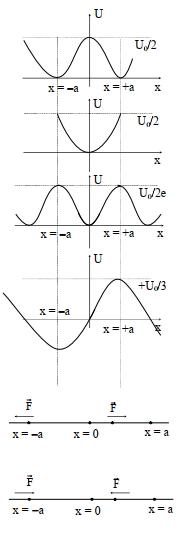

Download our appand get started for free
Experience the future of education. Simply download our apps or reach out to us for more information. Let's shape the future of learning together!No signup needed.*
Similar Questions
- 1If a spring has time period $T$, and is cut into $n$ equal parts, then the time period of each part will beView Solution
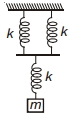
- 2A block of mass $m$ hangs from three springs having same spring constant $k$. If the mass is slightly displaced downwards, the time period of oscillation will beView Solution
- 3A particle of mass $10 \,g$ is undergoing $S.H.M.$ of amplitude $10 \,cm$ and period $0.1 \,s$. The maximum value of force on particle is about ............ $N$View Solution
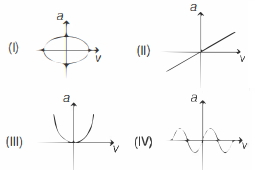
- 4If the speed $v$ of the bob in a simple pendulum is plotted against the tangential acceleration $a$, the correct graph will be represented byView Solution
- 5Time period of a particle executing $SHM$ is $8\, sec.$ At $t = 0$ it is at the mean position. The ratio of the distance covered by the particle in the $1^{st}$ second to the $2^{nd}$ second is :View Solution
- 6The time period of a seconds pendulum is $2\, sec$. The spherical bob which is empty from inside has a mass $50\; gram$, this now is replaced by another solid of same radius but have different mass of $100\; gram$. The new time period will be ..... $\sec$View Solution
- 7The displacement of a particle along the $x-$ axis is given by $x=asin^2$$\omega t$ . The motion of the particle corresponds toView Solution
- 8A body oscillates with a simple harmonic motion having amplitude $0.05\, m .$ At a certain instant, its displacement is $0.01\, m$ and acceleration is $1.0 \,m / s ^{2} .$ The period of oscillation isView Solution
- 9The displacement of an oscillator is given by $x = a\, \sin \, \omega t + b\, \cos \, \omega t$. where $a, b$ and $\omega$ are constant. Then :-View Solution
- 10A bead of mass $m$ is attached to the mid-point of a tant, weightless string of length $l$ and placed on a frictionless horizontal table.Under a small transverse displacement $x$, as shown in above figure. If the tension in the string is $T$, then the frequency of oscillation isView Solution