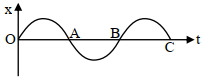
The displacement of an oscillator is given by $x = a\, \sin \, \omega t + b\, \cos \, \omega t$. where $a, b$ and $\omega$ are constant. Then :-
Medium


Download our appand get started for free
Experience the future of education. Simply download our apps or reach out to us for more information. Let's shape the future of learning together!No signup needed.*
Similar Questions
- 1The distance covered by a particle undergoing $SHM$ in one time period is (amplitude $= A$)View Solution
- 2The period of oscillation of a simple pendulum of constant length at earth surface is $T$. Its period inside a mine isView Solution
- 3The length of a simple pendulum is increased by $1\%$. Its time period willView Solution
- 4The force constants of two springs are ${K_1}$ and ${K_2}$. Both are stretched till their elastic energies are equal. If the stretching forces are ${F_1}$ and ${F_2}$, then ${F_1}:{F_2}$ isView Solution
- 5The variation of displacement with time of a particle executing free simple harmonic motion is shown in the figure. The potential energy ${U}({x})$ versus time $({t})$ plot of the particle is correctly shown in figure:View Solution
- 6A trolley of mass $m_1$ is placed on horizontal rigid pair of rails at same height. A mass $m_2$ is suspended to the trolley vertically by me ans of a ideal massless rope. The rope hangs between rails without touching them. Trolley can move along smooth rails but can't move in any other direction. Suspended mass is given small oscillation and perform $SHM$ after displacing small from stable equilibrium position in two ways, first perpendicular to the rails and second parallel to the rails. The ratio of time period of these (second case to first case) two $SHM's$ isView Solution
- 7A simple pendulum of length $1\, m$ is oscillating with an angular frequency $10\, rad/s$. The support of the pendulum starts oscillating up and down with a small angular frequency of $1\, rad/s$ and an amplitude of $10^{-2}\, m$. The relative change in the angular frequency of the pendulum is best given byView Solution
- 8View SolutionWhich of the following statements is not true ? In the case of a simple pendulum for small amplitudes the period of oscillation is
- 9View SolutionIn S.H.M. maximum acceleration is at
- 10One-forth length of a spring of force constant $K$ is cut away. The force constant of the remaining spring will beView Solution