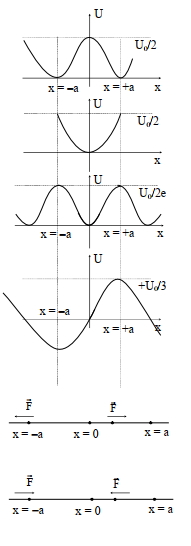
A particle of unit mass is moving along the $x$-axis under the influence of a force and its total energy is conserved. Four possible forms of the potential energy of the particle are given in column $I$ (a and $U _0$ are constants). Match the potential energies in column $I$ to the corresponding statement$(s)$ in column $II.$
| column $I$ | column $II$ |
| $(A)$ $U _1( x )=\frac{ U _0}{2}\left[1-\left(\frac{ x }{ a }\right)^2\right]^2$ | $(P)$ The force acting on the particle is zero at $x = a$. |
| $(B)$ $U _2( x )=\frac{ U _0}{2}\left(\frac{ x }{ a }\right)^2$ | $(Q)$ The force acting on the particle is zero at $x=0$. |
| $(C)$ $U _3( x )=\frac{ U _0}{2}\left(\frac{ x }{ a }\right)^2 \exp \left[-\left(\frac{ x }{ a }\right)^2\right]$ | $(R)$ The force acting on the particle is zero at $x =- a$. |
| $(D)$ $U _4( x )=\frac{ U _0}{2}\left[\frac{ x }{ a }-\frac{1}{3}\left(\frac{ x }{ a }\right)^3\right]$ | $(S)$ The particle experiences an attractive force towards $x =0$ in the region $| x |< a$. |
| $(T)$ The particle with total energy $\frac{ U _0}{4}$ can oscillate about the point $x=-a$. |
IIT 2015, Diffcult


Download our appand get started for free
Experience the future of education. Simply download our apps or reach out to us for more information. Let's shape the future of learning together!No signup needed.*
Similar Questions
- 1A ball suspended by a thread swings in a vertical plane so that its magnitude of acceleration in the extreme position and lowest position are equal. The angle $(\theta)$ of thread deflection in the extreme position will be :View Solution
- 2$Assertion :$ For a particle performing $SHM$, its speed decreases as it goes away from the mean position.View Solution
$Reason :$ In $SHM$, the acceleration is always opposite to the velocity of the particle. - 3$y = 2\, (cm)\, sin\,\left[ {\frac{{\pi t}}{2} + \phi } \right]$ what is the maximum acceleration of the particle doing the $S.H.M.$View Solution
- 4Two particles are executing $SHM$ in a straight line. Amplitude $'A'$ and time period $'T'$ of both the particles are equal. At time $t = 0$ one particle is at displacement $x_1 = +A$ and other at ${x_2} = \frac{{ - A}}{2}$ and they are approaching towards each other. Time after which they will cross each other isView Solution
- 5The kinetic energy of a particle executing $S.H.M.$ is $16\, J$ when it is in its mean position. If the amplitude of oscillations is $25\, cm$ and the mass of the particle is $5.12\, kg$, the time period of its oscillation isView Solution
- 6The displacement of a particle executing $SHM$ is given by $y=0.25 \sin 200 t$ $cm$. The maximum speed of the particle is $.........cm s^{-1}$View Solution
- 7A particle executes $S.H.M.$ with amplitude $'a'$ and time period $V$. The displacement of the particle when its speed is half of maximum speed is $\frac{\sqrt{ x } a }{2} .$ The value of $x$ is $\ldots \ldots \ldots$View Solution
- 8View SolutionIf the metal bob of a simple pendulum is replaced by a wooden bob, then its time period will
- 9A circular disc of mass $10 \;kg$ is suspended by a wire attached to its centre. The wire is twisted by rotating the disc and released. The period of torsional oscillations is found to be $1.5 \;s$. The radius of the disc is $15\; cm .$ Determine the torsional spring constant of the wire in $N\;m\;rad^{-1}$. (Torsional spring constant $\alpha$ is defined by the relation $J=-\alpha \theta,$ where $J$ is the restoring couple and $\theta$ the angle of twist).View Solution
- 10Assume that a tunnel is dug along a chord of the earth, at a perpendicular distance $( R / 2)$ from the earth's centre, where $'R'$ is the radius of the Earth. The wall of the tunnel is frictionless. If a particle is released in this tunnel, it will execute a simple harmonic motion with a time periodView Solution