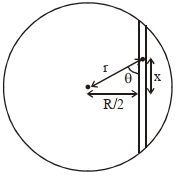
Assume that a tunnel is dug along a chord of the earth, at a perpendicular distance $( R / 2)$ from the earth's centre, where $'R'$ is the radius of the Earth. The wall of the tunnel is frictionless. If a particle is released in this tunnel, it will execute a simple harmonic motion with a time period
JEE MAIN 2021, Diffcult


Download our appand get started for free
Experience the future of education. Simply download our apps or reach out to us for more information. Let's shape the future of learning together!No signup needed.*
Similar Questions
- 1The displacement of an object attached to a spring and executing simple harmonic motion is given by $ x= 2 \times 10^{-9}$ $ cos$ $\;\pi t\left( m \right)$ .The time at which the maximum speed first occurs isView Solution
- 2A pendulum suspended from the ceiling of a train has a period $T$ when the train is at rest. When the train travels same distance per unit time, the period of oscillation isView Solution
- 3A particle executes $S.H.M.,$ the graph of velocity as a function of displacement is :-View Solution
- 4A particle executing a simple harmonic motion of period $2\ s$ . When it is at its extreme displacement from its mean position, it receives an additional energy equal to what it had in its mean position. Due to this , in its subsequent motion,View Solution
- 5A spring of force constant $k$ is cut into lengths of ratio $1:2:3$ . They are connected in series and the new force constant is $k'$ . Then they are connected in parallel and force constant is $k''$ . Then $k':k''$ isView Solution
- 6A damped harmonic oscillator has a frequency of $5$ oscillations per second. The amplitude drops to half its value for every $10$ oscillations. The time it will take to drop to $\frac{1}{1000}$ of the original amplitude is close to .... $s$View Solution
- 7Time period of a particle executing $SHM$ is $8\, sec.$ At $t = 0$ it is at the mean position. The ratio of the distance covered by the particle in the $1^{st}$ second to the $2^{nd}$ second is :View Solution
- 8A particle executes $S.H.M.$ and its position varies with time as $x=A$ sin $\omega t$. Its average speed during its motion from mean position to mid-point of mean and extreme position isView Solution
- 9Two simple harmonic waves having equal amplitudes of $8\,cm$ and equal frequency of $10\,Hz$ are moving along the same direction. The resultant amplitude is also $8\,cm$. The phase difference between the individual waves is $..................$ degree.View Solution
- 10Find the ratio of time periods of two identical springs if they are first joined in series $\&$ then in parallel $\&$ a mass $m$ is suspended from them :View Solution