The kinetic energy of a particle executing $S.H.M.$ is $16\, J$ when it is in its mean position. If the amplitude of oscillations is $25\, cm$ and the mass of the particle is $5.12\, kg$, the time period of its oscillation is
Easy


Download our appand get started for free
Experience the future of education. Simply download our apps or reach out to us for more information. Let's shape the future of learning together!No signup needed.*
Similar Questions
- 1For any $S.H.M.$, amplitude is $6\, cm$. If instantaneous potential energy is half the total energy then distance of particle from its mean position is .... $cm$View Solution
- 2Two springs have spring constants ${K_A}$ and ${K_B}$ and ${K_A} > {K_B}$. The work required to stretch them by same extension will beView Solution
- 3View SolutionA simple pendulum is taken from the equator to the pole. Its period
- 4A particle of mass $4 \,kg$ moves simple harmonically such that its $P E(U)$ varies with position $x$, as shown. The period of oscillations is ............View Solution
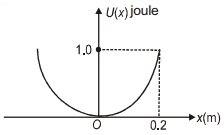
- 5A mass $M$ is suspended from a spring of negligible mass. The spring is pulled a little and then released so that the mass executes simple harmonic oscillations with a time period $T$. If the mass is increased by m then the time period becomes $\left( {\frac{5}{4}T} \right)$. The ratio of $\frac{m}{{M}}$ isView Solution
- 6View SolutionA graph of the square of the velocity against the square of the acceleration of a given simple harmonic motion is
- 7The phase (at a time $t$) of a particle in simple harmonic motion tellsView Solution
- 8If a spring of stiffness $k$ is cut into two parts $A$ and $B$ of length $l_{A}: l_{B}=2: 3$, then the stiffness of spring $A$ is given byView Solution
- 9The maximum velocity of a particle, executing simple harmonic motion with an amplitude $7\ mm$, is $4.4\ m/s$. The period of oscillation is .... $sec$View Solution
- 10In $SHM,$ acceleration versus displacement (from mean position) graph :View Solution