Question
A particle on a stretched string supporting a travelling wave, takes 5.0ms to move from its mean position to the extreme position. The distance between two consecutive particles, which are at their mean positions, is 2.0cm. Find the frequency, the wavelength and the wave speed.
Answer

Time period, $\text{T}=4\times5\text{ms}$$=20\times10^{-3}$
$=2\times10^{-2}\text{s}$
$\Rightarrow\lambda=2\times2\text{cm}$
$=4\text{cm}$
Frequency, $\text{f}=\frac{1}{\text{T}}$$=\frac{1}{(2\times10^{-2})}=50\text{s}^{-1}$
$=50\text{Hz}$
Wave speed = $\lambda\text{f}=4\times50\text{m/s}$$=2000\text{m/s}$
$=2\text{m/s}$

Need a full question paper?

Generate a complete, print-ready paper with questions like this in minutes — across 16+ boards, with answer keys.

Start Generating Free

Similar questions

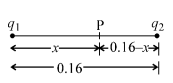
Two charges of$5 \times 10^{-8} C$ and $-3 \times 10^{-8}$ are located at a distance of 16 cm apart. At what point on the line joining the two charges is the electric potential zero? Take the potential at infinity to be zero.
Image
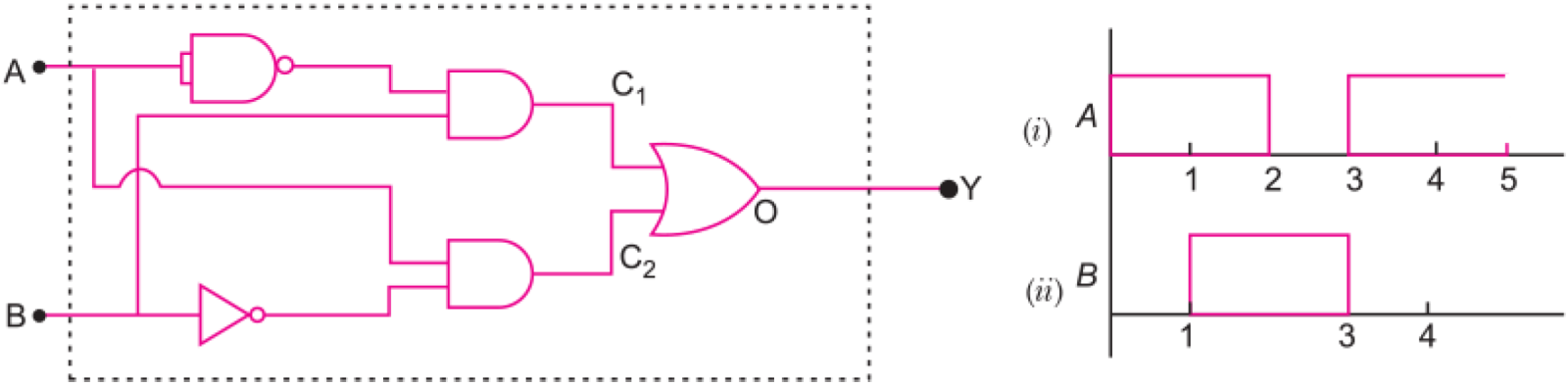
Input signals $A$ and $B$ are applied to the input terminals of the ‘dotted box’ set$-$up shown here. Let $Y$ be the final output signal from the box.
Draw the wave forms of the signals labelled as $C_1$ and $C_2$ within the box, giving $($in brief$)$ the reasons for getting these wave forms. Hence draw the wave form of the final output signal $Y$. Give reasons for your choice.
What can we state $($in words$)$ as the relation between the final output signal $Y$ and the input signals $A$ and $B$?
A bulb with rating $250V, 100W$ is connected to a power supply of $220V$ situated $10m$ away using a copper wire of area of cross$-$section $5\ mm^2.$ How much power will be consumed by the connecting wires? Resistivity of copper $1.7\times10^{-8}\Omega-\text{m}$.
A gun of mass M fires a bullet of mass m with a horizontal speed V. The gun is fitted with a concave mirror of focal length f facing tpwards the receding bullet. Find the speed of separation of the bullet and the image just after the gun was fired.
Two convex lenses, each of focal length $10\ cm,$ are placed at a separation of $15\ cm$ with their principal axes coinciding,
  1. Show that a light beam coming parallel to the principal axis diverges as it comes out of the lens system.
  2. Find the location of the virtual image formed by the lens system of an object placed far away.
  3. Find the focal length of the equivalent lens.
$($Note that the sign of the focal length is positive although the lens system actually diverges a parallel beam incident on it$)$.
Explain ac voltage applied on a series LCR circuit and give its analytical solution.
A vessel of volume $V_0$ contains an ideal gas at pressure $P_0$ and temperature $T$ Gas is continuously pumped out of this vessel at a constant volume$-$ rate $dV\  I\  dt = r$ keeping the temperature constant. The pressure of the gas being taken out equals the pressure inside the vessel. Find, $(1)$ the pressure of the gas as a function of time. $(2)$ the time taken before half the original gas is pumped out.
A $100$ turn closely wound circular coil of radius $10 \ cm$ carries a current of $3.2 A. \ (a)$ What is the field at the centre of the coil? $(b)$ What is the magnetic moment of this coil?
The coil is placed in a vertical plane and is free to rotate about a horizontal axis which coincides with its diameter. A uniform magnetic field of $2 T$ in the horizontal direction exists such that initially the axis of the coil is in the direction of the field. The coil rotates through an angle of $90^{\circ}$ under the influence of the magnetic field. $(c)$ What are the magnitudes of the torques on the coil in the initial and final position?
$(d)$ What is the angular speed acquired by the coil when it has rotated by $90^{\circ}$ ? The moment of inertia of the coil is $0.1 \ kg m ^2$.
The current in a discharging LR circuit without the battery drops from 2.0A to 1.0A in 0.10s.
  1. Find the time constant of the circuit.
  2. If the inductance of the circuit is 4.0H, what is its resistance?
$4 \times 10^{23}$ tritium atoms are contained in a vessel. The half-life of decay tritium nuclei is $12.3y.$ Find:
  1. The activity of the sample.
  2. The number of decay in the next $10$ hours.
  3. The number of decays in the next $6.15y.$