Question
Explain ac voltage applied on a series LCR circuit and give its analytical solution.

Answer

SELF

Need a full question paper?

Generate a complete, print-ready paper with questions like this in minutes — across 16+ boards, with answer keys.
Start Generating Free

Similar questions

Figure shows two blocks $A$ and $B,$ each having a mass of $320g$ connected by a light string passing over a smooth light pulley. The horizontal surface on which the block $A$ can slide is smooth. The block $A$ is attached to a spring of spring constant $40N/m$ whose other end is fixed to a support $40\ cm$ above the horizontal surface. Initially, the spring is vertical and unstretched when the system is released to move. Find the velocity of the block $A$ at the instant it breaks off the surface below it. Take $g = 10m/s^2.$
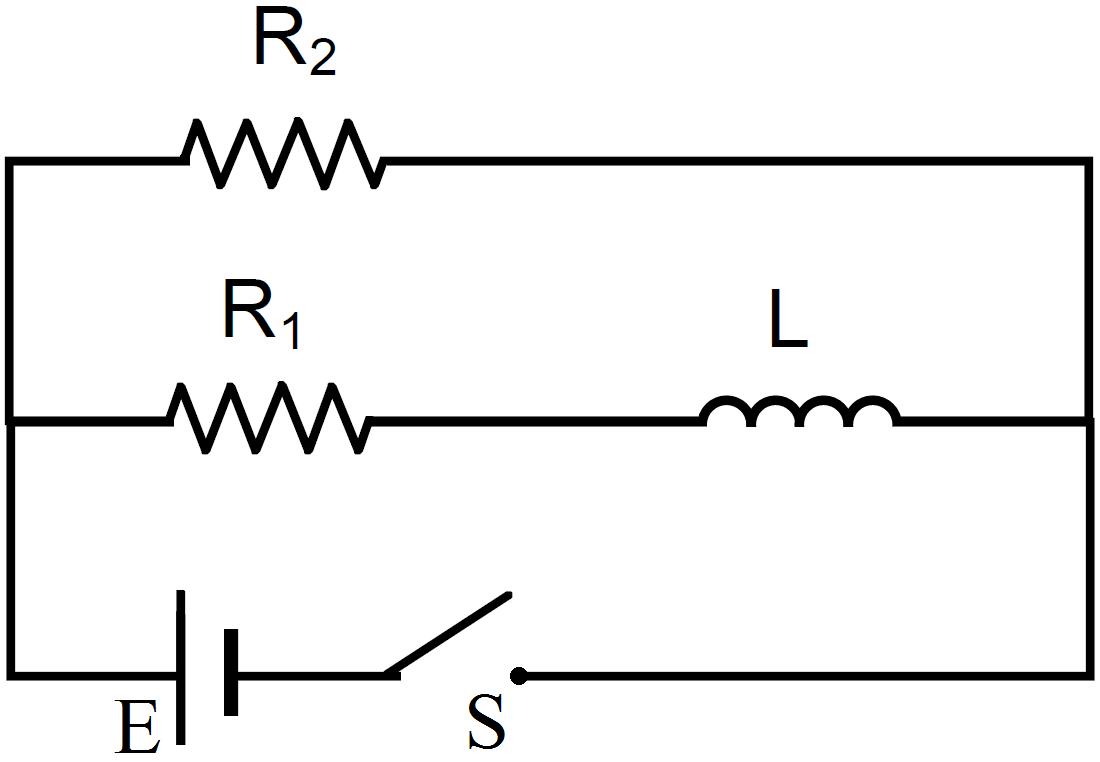
Consider the circuit shown in figure:
  1. Find the current through the battery a long time after the switch S is closed.
  2. Suppose the switch is again opened at $t = 0$. What is the time constant of the discharging circuit?
  3. Find the current through the inductor after one time constant.
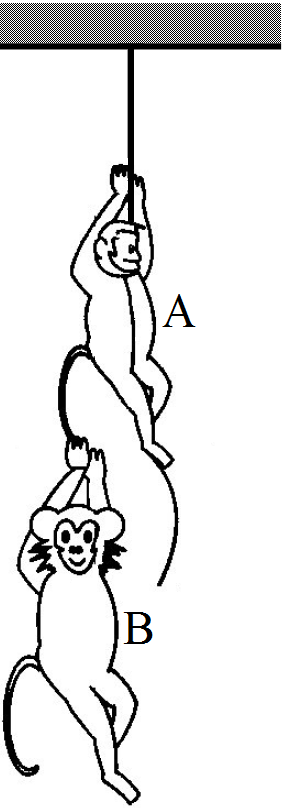
The monkey $B$ shown in figure is holding on to the tail of the monkey A which is climbing up a rope. The masses of the monkeys $A$ and $B$ are $5\ kg$ and $2\ kg$ respectively. If $A$ can tolerate a tension of $30N$ in its tail, what force should it apply on the rope in order to carry the monkey $B$ with it? Take $ g = 10m/s^2$​​​​​​​
A charge Q is uniformly distributed on a thin spherical shell. What is the field at the centre of the shell? If a point charge is brought close to the shell, will the field at the centre change? Does your answer depend on whether the shell is conducting or nonconducting?
Deutrium was discovered in $1932$ by Harold Urey by measuring the small change in wavelength for a particular transition in $1H$ and $2H$. This is because, the wavelength of transition depend to a certain extent on the nuclear mass. If nuclear motion is taken into account then the electrons and nucleus revolve around their common centre of mass. Such a system is equivalent to a single particle with a reduced mass $\mu ,$ revolving around the nucleus at a distance equal to the electron $-$ nucleus separation. Here $\mu=\frac{\text{m}_\text{e}\text{M}}{\text{m}_\text{e}+\text{M}}$ where $M$ is the nuclear mass and me is the electronic mass. Estimate the percentage difference in wavelength for the $1^{st}$ line of the Lyman series in $1H$ and $2H. ($Mass of $1H$ nucleus is $1.6725 \times 10^{-27}kg,$ Mass of $2H$ nucleus is $3.3374 \times 10^{-27}kg$, Mass of electron $= 9.109 \times 10^{-31}kg).$
A parallel$-$plate capacitor has plate area $20\ cm^2,$ plate separation $1.0\ mm$ and a dielectric slab of dielectric constant $5.0$ filling up the space between the plates. This capacitor is joined to a battery of emf $6.0V$ through a $100\text{k}\Omega$ resistor. Find the energy of the capacitor $8.9\mu\text{s}$ after the connections are made.
A body starts slipping down an incline and moves half meter in half second. How long will it take to move the next half meter?
A point object is placed at a distance of $15\ cm$ from a convex lens. The image is formed on the other side at a distance of $30\ cm$ from the lens. When a concave lens is placed in contact with the convex lens, the image shifts away further by $30\ cm$. Calculate the focal lengths of the two lenses.
Show that the magnetic field $B$ at a point in between the plates of a parallel$-$plate capacitor during charging is $\frac{\epsilon_0{\mu}_\text{r}}{2}\frac{\text{dE}}{\text{dt}} ($symbols having usual meaning$).$
A thin prism of angle $6.0^\circ,\omega=0.07$ and $\mu_\text{y}=1.50$ is combined with another thin prism having $\omega=0.08$ and $\mu_\text{y}=1.60.$ The combination produces no deviation in the mean ray.
  1. Find the angle of the second prism.
  2. Find the net angular dispersion produced by the combination when a beam of white light passes through it.
  3. If the prisms are similarly directed, what will be the deviation in the mean ray
  4. Find the angular dispersion in the situation described in (c).