Question
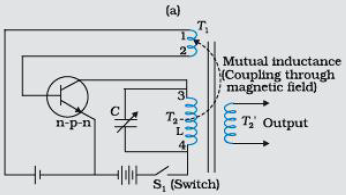
  1. Explain briefly the principle on which a transistor-amplifier works as an oscillator. Draw the necessary circuit diagram and explain its working.
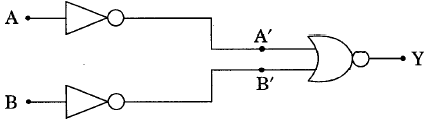
  2. Identify the equivalent gate for the following circuit and write its truth table.
Answer

  1. Principle: A portion of the output power is returned back (feedback) to the input in phase with the starting power. (This process is termed as positive feedback)


Working:

As the switch $S_1$ is put on, a surge of collector current flows in the transistor. This current flows through the coil $T_2$. The inductive coupling between coil $T_2$ and coil $T_1$ now causes a current to flow in theemitter circuit.As a result of thispositive feed back, the emitter current also increases. When the current in $T_2$ becomes saturated, it stops increasing. Now emitter current begins to fall and becomes minimum. The whole process keeps on repeating itself.
  1. AND Gate:
A B Y = A.B
0 0 0
0 1 0
1 0 0
1 1 1

Need a full question paper?

Generate a complete, print-ready paper with questions like this in minutes — across 16+ boards, with answer keys.
Start Generating Free

Similar questions

A uniform chain of length L and mass M overhangs a horizontal table with its two third part on the table. The friction coefficient between the table and the chain is $\mu.$ Find the work done by the friction during the period the chain slips off the table.
The plates of a parallel plate capacitor have an area of $90cm^2$ each and are separated by 2.5mm. The capacitor is charged by connecting it to a 400V supply.
  1. How much electrostatic energy is stored by the capacitor?
  2. View this energy as stored in the electrostatic field between the plates, and obtain the energy per unit volume u. Hence arrive at a relation between u and the magnitude of electric field E between the plates.
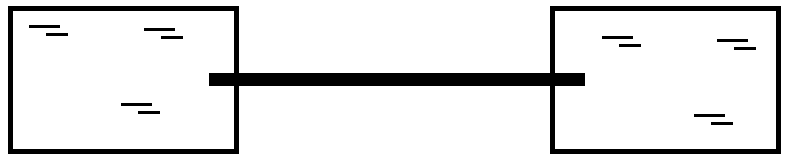
Figure, shows two adiabatic vessels, each containing a mass m of water at different temperatures. The ends of a metal rod of length L, area of cross section A and thermal conductivity K, are inserted in the water as shown in the figure. Find the time taken for the difference between the temperatures in the vessels to become half of the original value. The specific heat capacity of water is s. Neglect the heat capacity of the rod and the container and any loss of heat to the atmosphere.
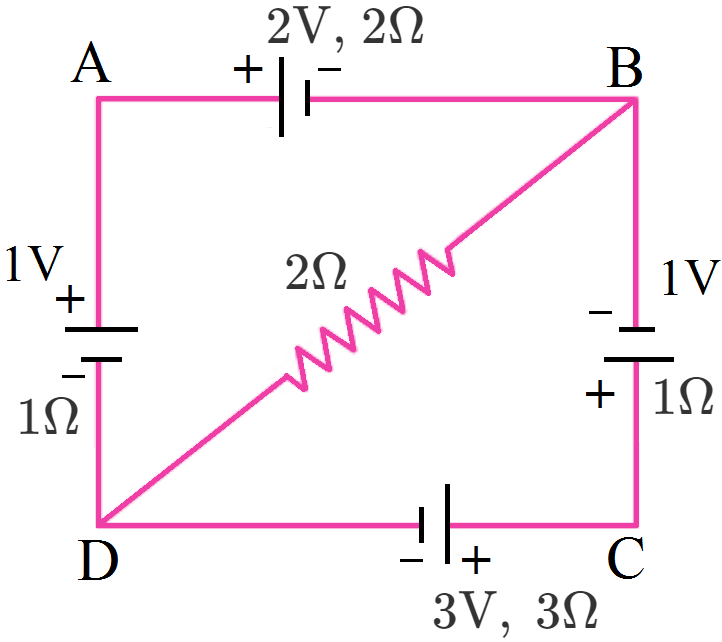
For the circuit shown here, calculate the potential difference between points B and D.
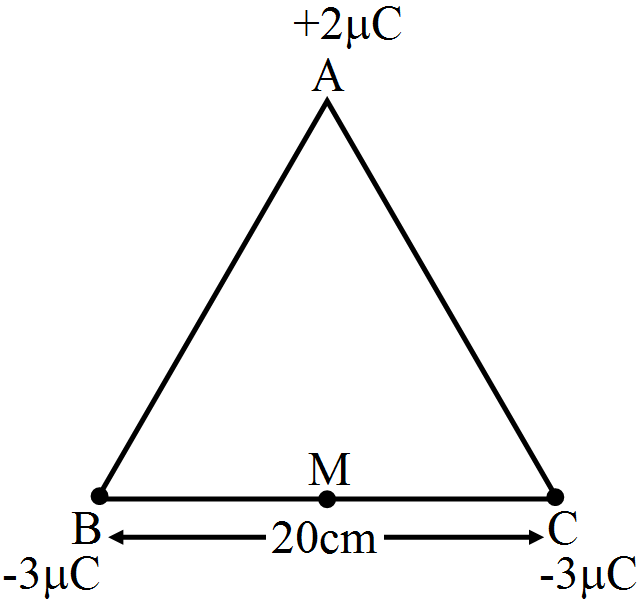
Three point charges of $+2\mu\text{C}, -3\mu\text{C}$ and $-3\mu\text{C}$ are kept at the vertices A, B and C respectively of an equilateral triangle of side 20cm as shown in figure. What should be the sign and magnitude of charge to be placed at the midpoint M of side BC so that charge at A remains in equilibrium?
$\text{ }^{212}_{33}\text{Bi}$ can disintegrate either by emitting an $\alpha$-particle of by emitting a $\beta^-$-particle.
  1. Write the two equations showing the products of the decays.
  2. The probabilities of disintegration $\alpha$ and $\beta$ -decays are in the ratio $\frac{7}{13}.$ The overall half-life of $^{212}Bi$ is one hour. If 1g of pure $^{212}Bi$ is taken at 12.00 noon, what will be the composition of this sample at 1P.m. the same day?
A long wire carrying a current i is bent to form a plane angle $\alpha.$ Find the magnetic field B at a point on the bisector of this angle situated at a distance x from the vertex.
A capacitor of capacitance $10\mu\text{F}$ is connected to a battery of emf 2V. It is found that it takes 50ms for the charge of the capacitor to become $12.6\mu\text{C}.$ Find the resistance of the circuit.
An electric bulb is designed to consume 55W when operated at 110 volts. It is connected to a 220V, 50Hz line through a choke coil in series. What should be the inductance of the coil for which the bulb gets correct voltage?
A proton and an α-particle are accelerated, using the same potential difference. How are the de-Broglie wavelengths $\lambda _p$ and $\lambda _a$​​​​​​​ related to each other?