MCQ
A particle released at a large distance from a planet reaches the planet only under gravitational attraction and passes through a smooth tunnel through its centre. If $v_e$ is the escape velocity of a body at the planet, then the particle's speed at the centre of the planet is 
  • $\sqrt{1.5} v _{ e }$
  • B
    $v _{ e }$
  • C
    $1.5 v _{ e }$
  • D
    $2 v _{ e }$

Answer

Correct option: A.
$\sqrt{1.5} v _{ e }$
a
Taking the potential at a large distance from the planet as zero, the potential at the centre of the planet $=-3 GM / 2 R$

$K_A+U_A=K_O+U_O$

$0+0=\frac{1}{2} v^2+m V_O$

$=\frac{1}{2} m v^2+m\left(-\frac{3 G M}{2 R}\right)$

$v=\sqrt{\frac{3 G M}{R}}=\sqrt{\frac{3}{2}} \cdot \sqrt{\frac{2 G M}{R}}$

$v=\sqrt{1.5}{ v_e}$

Need a full question paper?

Generate a complete, print-ready paper with questions like this in minutes — across 16+ boards, with answer keys.

Start Generating Free

Similar questions

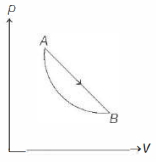
An ideal gas is made to undergo a cycle depicted by the $p-V$ diagram given below. The curved line from $A$ to $B$ is an adiabat.Then,
Consider the situation of the previous problem. The force on the central charge due to the shell is:
The mass of a neutral carbon atom in ground state is:
Two identical samples of a gas are allowed to expand $(i)$ isothermally $(ii)$ adiabatically. Work done is
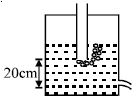
A tube is attached as shown in closed vessel containing water. The velocity of water coming out from a small hole is :
In a resonance tube, the first resonance is obtained when the level of water in the tube is at $16\,cm$ from the open end. Neglecting end correction, the next resonance will be obtained when the level of water from the open end is .... $cm$
The coefficient of superficial expansion of a solid is $2 \times 10^{-5} {°C^{-1}}$. It's coefficient of linear expansion is
A clamped string is oscillating in $n^{th}$ harmonic, then
A spring of spring constant $ 5 \times 10^3$ $ N/m$  is stretched initially by $5\,cm$ from the unstretched position. Then the work required to stretch it further by another $5\,cm$ is .............. $\mathrm{N-m}$
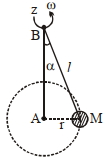
A mass $M$ hangs on a massless rod of length $l$ which rotates at a constant angular frequency. The mass $M$ moves with steady speed in a circular path of constant radius. Assume that the system is in steady circular motion with constant angular velocity $\omega .$ The angular momentum of $M$ about point $A$ is $L _{ A }$ which lies in the positive $z$ direction and the angular momentum of $M$ about $B$ is $L _{ B }$. The correct statement for this system is