MCQ
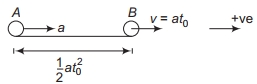
A particle starts moving from rest in a straight line with constant acceleration. After time $t_0$, acceleration changes its sign (just opposite to the initial direction), remaining the same in magnitude. Determine the time from the beginning of motion in which the particle returns to the initial position.
  • A
    $2 t_0$
  • $(2+\sqrt{2}) t_0$
  • C
    $3 t_0$
  • D
    $(2-\sqrt{2}) t_0$

Answer

Correct option: B.
$(2+\sqrt{2}) t_0$
b
(b)

Taking, $s=u t+\frac{1}{2} a t^2$, from point $B$ onwards we have,$-\frac{1}{2} a t_0^2=\left(a t_0\right) t-\frac{1}{2} a t^2$

$\therefore \quad t^2-2 t_0 t-t_0^2=0$

$\therefore \quad t=\frac{2 t_0 \pm \sqrt{4 t_0^2+4 t_0^2}}{2}=\left(t_0+\sqrt{2} t_0\right)$

$\therefore \quad \text { Total time }=t_{A B}+t=(2+\sqrt{2}) t_0$

Need a full question paper?

Generate a complete, print-ready paper with questions like this in minutes — across 16+ boards, with answer keys.

Start Generating Free

Similar questions

The work function of a metal is $2.3\, eV$ and the maximum kinetic energy of photo electrons is $0.3\, eV$ when photon is incident on it. Find the wavelength of incident photon.............. $\mathop {\rm{A}}\limits^o $
When a wave travelling in medium is reflected from the boundary of a denser medium, which of the following will not change?
An infinite number of electric charges each equal to $5\, nC$ (magnitude) are placed along $X$-axis at $x = 1$ $cm$, $x = 2$ $cm$ , $x = 4$ $cm$ $x = 8$ $cm$ ………. and so on. In the setup if the consecutive charges have opposite sign, then the electric field in Newton/Coulomb at $x = 0$ is $\left( {\frac{1}{{4\pi {\varepsilon _0}}} = 9 \times {{10}^9}\,N - {m^2}/{c^2}} \right)$
Given below are two statements:

Statement $I:$ A truck and a car moving with same kinetic energy are brought to rest by applying brakes which provide equal retarding forces. Both come to rest in equal distance.

Statement $II:$ A car moving towards east takes a turn and moves towards north, the speed remains unchanged. The acceleration of the car is zero.

In the light of given statements, choose the most appropriate answer from the options given below.

A proton and an electron have the same de Broglie wavelength. If $K_p$ and $K_e$ be the kinetic energies of proton and electron respectively. Then choose the correct relation :
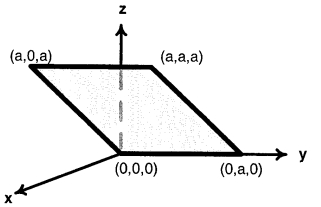
Consider an electric field $\vec{E}=E_0 \hat{x}$, where $E_0$ is a constant. The flux through the shaded area (as shown in the figure) due to this field is
The equation $\left( {P + \frac{a}{{{V^2}}}} \right)$ $(V - b)$ constant. The units of $a$ are
Three equal charges $+q$ are placed at the three vertices of an equilateral triangle centred at the origin. They are held in equilibrium by a restoring force of magnitude $F(r)=k r$ directed towards the origin, where $k$ is a constant. What is the distance of the three charges from the origin?
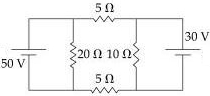
In the circuit shown, current (in $A$) through $50\; V$ and $30\; V$ batteries are, respectively
A $10 H.P. $ motor pumps out water from a well of depth $20m$ and fills a water tank of volume $22380 $ $litres $ at a height of $ 10m$  from the ground. the running time of the motor to fill the empty water tank is ........... $\mathrm{minutes}$ $(g = 10m{s^{ - 2}}$)