- A$2 t_0$
- ✓$(2+\sqrt{2}) t_0$
- C$3 t_0$
- D$(2-\sqrt{2}) t_0$
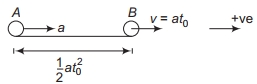
Taking, $s=u t+\frac{1}{2} a t^2$, from point $B$ onwards we have,$-\frac{1}{2} a t_0^2=\left(a t_0\right) t-\frac{1}{2} a t^2$
$\therefore \quad t^2-2 t_0 t-t_0^2=0$
$\therefore \quad t=\frac{2 t_0 \pm \sqrt{4 t_0^2+4 t_0^2}}{2}=\left(t_0+\sqrt{2} t_0\right)$
$\therefore \quad \text { Total time }=t_{A B}+t=(2+\sqrt{2}) t_0$
Generate a complete, print-ready paper with questions like this in minutes — across 16+ boards, with answer keys.
$\lambda_\text{e}=\lambda_\text{p}.$
$\lambda_\text{e}<\lambda_\text{p}.$
$\lambda _\text{e}>\lambda_\text{p}.$
The relation between
(Given, initial temperature of the bullet $=127^{\circ} C$,
Melting point of the bullet $=327^{\circ} C$,
Latent heat of fusion of lead $=2.5 \times 10^{4} \,J Kg ^{-1}$,
Specific heat capacity of lead $=125 \,J / kg K$ )