The time period of a charged particle undergoing a circular motion in a uniform magnetic field is independent of its
AIEEE 2002, Easy


Download our appand get started for free
Experience the future of education. Simply download our apps or reach out to us for more information. Let's shape the future of learning together!No signup needed.*
Similar Questions
- 1A charged particle is moving in a uniform magnetic field in a circular path. Radius of circular path is $R$. When energy of particle is doubled, then new radius will beView Solution
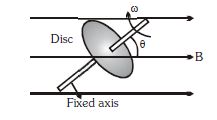
- 2A disc of radius $r$ and carrying positive charge $q$ is rotating with an angular speed $l$ in a uniform magnetic field $B$ about a fixed axis as shown in figure, such that angle made by axis of disc with magnetic field is $\theta $. Torque applied by axis on the disc isView Solution
- 3The magnetic induction due to an infinitely long straight wire carrying a current $i$ at a distance $r$ from wire is given byView Solution
- 4A fixed horizontal wire carries a current of $200\, A$. Another wire having a mass per unit length ${10^{ - 2}}\,kg/m$ is placed below the first wire at a distance of $2\, cm$ and parallel to it. How much current must be passed through the second wire if it floats in air without any support? What should be the direction of current in itView Solution
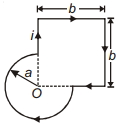
- 5The magnetic field intensity at the point $O$ of a loop with current $i$, whose shape is illustrated below isView Solution
- 6View SolutionA small cylindrical soft iron piece is kept in a galvanometer so that
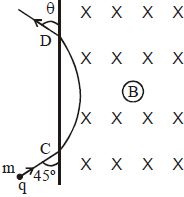
- 7A particle of mass $m = 1.67 \times 10^{-27}\, kg$ and charge $q = 1.6 \times 10^{-19} \, C$ enters a region of uniform magnetic field of strength $1$ $tesla$ along the direction shown in the figure. If the direction of the magnetic field is along the outward normal to the plane of the paper, then the time spent by the particle in the region of the magnetic field after entering it at $C$ is nearly :-......$ns$View Solution
- 8View SolutionA negative charge is coming towards the observer. The direction of the magnetic field produced by it will be (as seen by observer)
- 9An electron with energy $0.1\,ke\,V$ moves at right angle to the earth's magnetic field of $1 \times 10^{-4}\,Wbm ^{-2}$. The frequency of revolution of the electron will be. (Take mass of electron $=9.0 \times 10^{-31}\,kg$ )View Solution
- 10View SolutionEnergy in a current carrying coil is stored in the form of