A uniform magnetic field $B$ exists in the region between $x=0$ and $x=\frac{3 R}{2}$ (region $2$ in the figure) pointing normally into the plane of the paper. A particle with charge $+Q$ and momentum $p$ directed along $x$-axis enters region $2$ from region $1$ at point $P_1(y=-R)$. Which of the following option(s) is/are correct?
$[A$ For $B>\frac{2}{3} \frac{p}{QR}$, the particle will re-enter region $1$
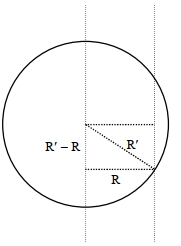
$[B]$ For $B=\frac{8}{13} \frac{\mathrm{p}}{QR}$, the particle will enter region $3$ through the point $P_2$ on $\mathrm{x}$-axis
$[C]$ When the particle re-enters region 1 through the longest possible path in region $2$ , the magnitude of the change in its linear momentum between point $P_1$ and the farthest point from $y$-axis is $p / \sqrt{2}$
$[D]$ For a fixed $B$, particles of same charge $Q$ and same velocity $v$, the distance between the point $P_1$ and the point of re-entry into region $1$ is inversely proportional to the mass of the particle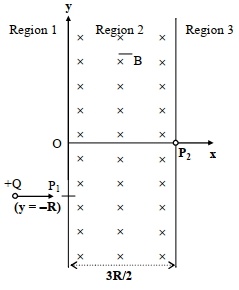
IIT 2017, Advanced


Download our appand get started for free
Experience the future of education. Simply download our apps or reach out to us for more information. Let's shape the future of learning together!No signup needed.*
Similar Questions
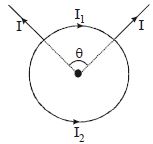
- 1Assertion : The magnetic field at the centre of the circular coil in the following figure due to the currents $I_1$ and $I_2$ is zero.View Solution
Reason : $I_1 = I_2$ implies that the fields due to the current $I_1$ and $I_2$ will be balanced.
- 2An element $d l=d x \hat{l}$ (where, $d x=1\, cm$ ) is placed at the origin and carries a large current $i=10 A$. What is the magnetic field on the $Y$ -axis at a distance of $0.5\, m$ ?View Solution
- 3A long solenoid has a radius $a$ and number of turns per unit length is $n$. If it carries a current $i$, then the magnetic field on its axis is directly proportional toView Solution
- 4View SolutionParticles having positive charges occasionally come with high velocity from the sky towards the earth. On account of the magnetic field of earth, they would be deflected towards the
- 5A single turn current loop in the shape of a right angle triangle with sides $5\,cm , 12\,cm , 13\,cm$ is carrying a current of $2\,A$. The loop is in a uniform magnetic field of magnitude $0.75\,T$ whose direction is parallel to the current in the $13\,cm$ side of the loop. The magnitude of the magnetic force on the $5\,cm$ side will be $\frac{ x }{130}\,N$. The value of $x$ is $..........$View Solution
- 6A proton of mass $1.67\times10^{-27}\, kg$ and charge $1.6\times10^{-19}\, C$ is projected with a speed of $2\times10^6\, m/s$ at an angle of $60^o$ to the $X-$ axis. If a uniform magnetic field of $0.104\, tesla$ is applied along the $Y-$ axis, the path of the proton isView Solution
- 7Current $I$ is flowing in conductor shaped as shown in the figure. The radius of the curved part is $r$ and the length of straight portion is very large. The value of the magnetic field at the centre $O$ will beView Solution
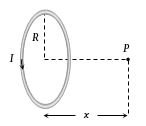
- 8A coil having $N$ $turns$ carry a current $I$ as shown in the figure. The magnetic field intensity at point $P$ isView Solution
- 9View SolutionIf an electron enters a magnetic field with its velocity pointing in the same direction as the magnetic field, then
- 10A current of $0.1\, A$ circulates around a coil of $100$ $turns$ and having a radius equal to $5\,cm$. The magnetic field set up at the centre of the coil is ($\mu_0 = 4\pi \times 10^{-7} weber/amp-metre$)View Solution