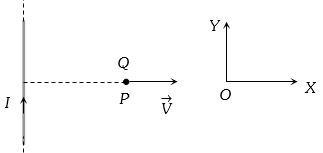
A very long straight wire carries a current $I$. At the instant when a charge $ + Q$ at point $P$ has velocity $\overrightarrow V $, as shown, the force on the charge is
AIPMT 2005, Easy
Download our app for free and get started
(d) Magnetic field produced by wire at the location of charge is perpendicular to the paper inwards. Hence by applying Fleming's left hand rule, force is directed along $OY$.

Download our appand get started for free
Experience the future of education. Simply download our apps or reach out to us for more information. Let's shape the future of learning together!No signup needed.*
Similar Questions
- 1A particle having the same charge as of electron moves in a circular path of radius $0.5View Solution
\,cm$ under the influence of a magnetic field of $0.5\,T.$ If an electric field of $100\,V/m$ makes it to move in a straight path, then the mass of the particle is (given charge of electron $= 1.6 \times 10^{-19}\, C$ ) - 2A proton (or charged particle) moving with velocity $v$ is acted upon by electric field $E$ and magnetic field $B$. The proton will move undeflected ifView Solution
- 3This questions has Statement $I$ and Statement $II$ Of the four choices given after the Statements, choose the one that best describes into two Statements.View Solution
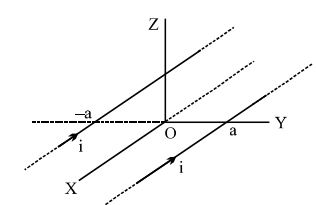
Statement$-I$ : Higher the range, greater is the resistance of ameter.
Statement$-II$ : To increase the range of ammeter, additional shunt needs to be used across it. - 4View SolutionIf a charged particle enters perpendicularly in the uniform magnetic field then
- 5The current sensitivity of moving coil galvanometer is increased by $25 \%$. This increase is achieved only by changing in the number of turns of coils and area of cross section of the wire while keeping the resistance of galvanometer coil constant. The percentage change in the voltage sensitivity will be $...........\%$View Solution
- 6The dimension of the magnetic field intensity $B$ isView Solution
- 7Two circular coils $P$ and $Q$of $100$ turns each have same radius of $\pi \mathrm{cm}$. The currents in $\mathrm{P}$ and $\mathrm{R}$ are $1 \mathrm{~A}$ and $2 \mathrm{~A}$ respectively. $\mathrm{P}$ and $\mathrm{Q}$ are placed with their planes mutually perpendicular with their centers coincide. The resultant magnetic field induction at the center of the coils is $\sqrt{\mathrm{x}} \mathrm{mT}$, where X=___.View Solution
$\left[\text { Use } \mu_0=4 \pi \times 10^{-7} \mathrm{TmA}^{-1}\right]$
- 8A current of $200\ \mu \mathrm{A}$ deflects the coil of a moving coil galvanometer through $60^{\circ}$. The current to cause deflection through $\frac{\pi}{10}$ radian is:View Solution
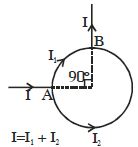
- 9A current $I$ enters a circular coil of radius $R$, branches into two parts and then recombines as shown in the circuit diagram. The resultant magnetic field at the centre of the coil isView Solution
- 10Two long thin, parallel conductors carrying equal currents in the same direction are fixed parallel to the $x$-axis, one passing through $y = a$ and the other through $y = -a$. The resultant magnetic field due to the two conductors at any point is $B$. Which of the following are correct?View Solution