MCQ
A pendulum clock keeps correct time at $0°C$. Its mean coefficient of linear expansions is $\alpha /^\circ C$, then the loss in seconds per day by the clock if the temperature rises by $t°C$ is
  • A
    $\frac{{\frac{1}{2}\alpha \,t \times 864000}}{{1 - \frac{{\alpha \,t}}{2}}}$
  • $\frac{1}{2}\alpha \,t \times \,86400$
  • C
    $\frac{{\frac{1}{2}\alpha \,t \times 86400}}{{{{\left( {1 - \,\frac{{\alpha \,t}}{2}} \right)}^2}}}$
  • D
    $\frac{{\frac{1}{2}\alpha \,t \times 86400}}{{1 + \frac{{\alpha \,t}}{2}}}$
Answer

Correct option: B.
$\frac{1}{2}\alpha \,t \times \,86400$
b
(b) Loss in time per second $\frac{{\Delta T}}{T} = \frac{1}{2}\alpha \Delta \theta = \frac{1}{2}\alpha \,(t - 0)$

$\Rightarrow$ loss in time per day

$\Delta t = \left( {\frac{1}{2}\alpha t} \right)\,t = \frac{1}{2}\alpha t \times (24 \times 60 \times 60) = \frac{1}{2}\alpha t \times 86400$

Need a full question paper?

Generate a complete, print-ready paper with questions like this in minutes — across 16+ boards, with answer keys.

Start Generating Free

Similar questions

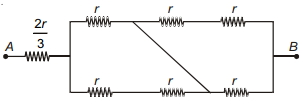
The effective resistance of the network between points $A$ and $B$ is
A bus travelling the first one-third distance at a speed of $10\; km/h$, the next one-third at $20\; km/h$ and at last one-third at $60\; km/h$. The average speed of the bus is ........ $km/h$
A vessel contains $1$ mole of $O_2$ gas (molar mass $32$) at a temperature $T$. The pressure of the gas is $P$. An identical vessel containing one mole of $He$ gas (molar mass $4$) at a temperature $2T$ has a pressure of
Two persons pull a wire towards themselves. Each person exerts a force of $200 \mathrm{~N}$ on the wire. Young's modulus of the material of wire is $1 \times 10^{11} \mathrm{~N} \mathrm{~m}^{-2}$. Original length of the wire is $2 \mathrm{~m}$ and the area of cross section is $2 \mathrm{~cm}^2$. The wire will extend in length by . . . . . . . .$\mu \mathrm{m}$.
In thermodynamics, heat and work are
A particle covers $50\, m$ distance when projected with an initial speed. On the same surface it will cover a distance, when projected with double the initial speed ......... $m$
If a particle under S.H.M. has time period 0.1 sec and amplitude $2 \times 10^{-3}$. It has maximum velocity
Conductivity of a photodiode starts changing only if the wavelength of incident light is less than $660 \mathrm{~nm}$. The band gap of photodiode is found to be $\left(\frac{x}{8}\right) \mathrm{eV}$. The value of $x$ is :

(Given, $\mathrm{h}=6.6 \times 10^{-34} \mathrm{Js}, \mathrm{e}=1.6 \times 10^{-19} \mathrm{C}$ )

The trajectory of a projectile in a vertical plane is $y =\alpha x -\beta x ^{2},$ where $\alpha$ and $\beta$ are constants and $x \& y$ are respectively the horizontal and vertical distances of the projectile from the point of projection. The angle of projection $\theta$ and the maximum height attained $H$ are respectively given by :-
$10$ resistors, each of resistance $R$ are connected in series to a battery of $emf$ $E$ and negligible internal resistance. Then those are connected in parallel to the same battery, the current is increased $n$ times. The value of $n$ is :