Question
A pendulum has a frequency of 5 vibrations per second. An observer starts the pendulum and fires a gun simultaneously. He hears echo from the cliff after 8 vibrations of the pendulum. If the velocity of sound in air is 340 m s-1, find the distance between the cliff and the observer.
Answer

5 vibrations by pendulum in 1 sec
So 8 vibrations in 8/5 seconds = 1.6 sec
Velocity = 2 × D/ time
340 = 2 × D/ 1.6
D = 340 × 1.6 / 2 = 272 m

Need a full question paper?

Generate a complete, print-ready paper with questions like this in minutes — across 16+ boards, with answer keys.

Start Generating Free

Similar questions

Differentiate between the forced and resonant vibrations.
(a) What do you understand by the term electric energy?
(b) Name and define the smallest commercial unit of electric energy.
(c) Name and define the standard commercial unit of electric energy.
When a gun is fired at a distance, why is it that the flash is seen almost instantaneously while the sound is heard a little later?
At what voltage is the electric power from the generating station transmitted? Give reason to your answer.
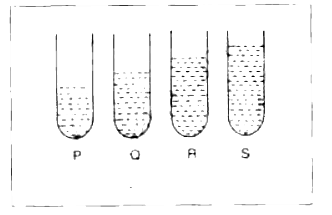
In fig. , P, Q, R and S represent test tubes each of height 20 cm which are filled with water upto heights of 10 cm, 14 cm, 16 cm and 18 cm respectively. If a vibrating tuning fork is placed over the mouth of test tube Q, a loud sound is heard.
(i) Describe the observations with the tubes P, R and S.
(ii) Give the reason for your observation in each case.
(iii) State the principle illustrated by the above experiment.
Study the diagram alongside carefully and calculate the magnitude of resistance offered by resistor $x$.
When four hydrogen nuclei combine to form a helium nucleus in the interior of sun, the loss in mass is 0.0265 a.m.u. How much energy is released ?
Why do bottled soft drinks get cooled, more quickly by the ice cubes than by the iced water, both at 0℃?
A combination consists of three resistors in series. Four similar sets are connected in parallel. If the resistance of each resistor is 2 ohm, find the resistance of the combination.
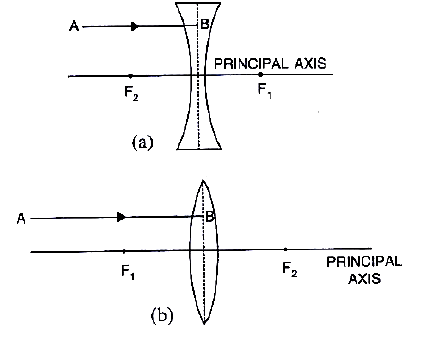
In following figure ,, F1 and F2 are the positions of the two foci of the thin lenses shown in diagram (a) and (b) draw accurately the path taken by the light ray AB after it emerges from the lens in each diagram (a) and (b).