Question
Differentiate between the forced and resonant vibrations.

Answer

Forced Vibrations Resonant vibrations
These are vibrations of a body under an external periodic force of frequency different than the natural frequency of the body. These are vibrations of a body under an external periodic force of frequency exactly equal to the natural frequency of the body.
The amplitude of the vibration is usually small. The amplitude of vibration is very large.

Need a full question paper?

Generate a complete, print-ready paper with questions like this in minutes — across 16+ boards, with answer keys.
Start Generating Free

Similar questions

What is the composition of α , β and γ -radiations?
Explain the meaning of the terms e.m.f.., terminal voltage, and internal resistance of a cell.
Name the phenomenon involved in tuning your radio set to a particular station and define it.
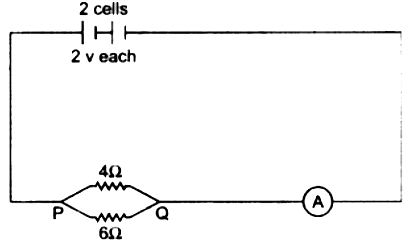
With reference to the diagram shown below calculate:

(i) The equivalent resistance between $P$ and $Q.$
(ii) The reading of ammeter.
(iii) The electrical power between $P$ and $Q.$
 A rifle shot is fired in a valley between two parallel walls. The echo from one wall is heard in 3 s and the echo from the other wall is heard 3 s later. If the velocity of sound at 00 c is $330 ms^{-1}$ and the temperature in the valley is 100 c , calculate the width of the valley. For every 10 c rise in temperature, the velocity of sound increase by $0.61 ms^{-1}$.
A boy standing in front of a wall at a distance $17 \ m$ produces $10$ claps per second. He notices that the sound of his clapping coincides with the echo. Echo is heard only once when clapping is stopped. Calculate the speed of sound.
Ice cream appears coder to the mouth than water at 0℃. Give reason.
State the principle of a transformer.
Calculate the quantity of heat that will be produced in a coil of resistance $75 \Omega$ if a current of 2 A is passed through it for $2$ minutes.
A ray of light, after refraction through a concave lens emerges parallel to the principal axis. (a) draw a ray diagram to show the incident ray and its corresponding emergent ray. (b) The incident ray when produces meets the principal axis at a point. Name the point.