Question
A perfect Carnot engine utilizes an ideal gas. The source temperature is $500K$ and sink temperature is $375K$. If the engine takes $600K$ cal per cycle from the source, compute:
  1. The efficiency of the engine.
  2. Work done per cycle.
  3. Heat rejected to the sink per cycle.

Answer

Here $T_1 = 500K$ $T_2 = 375K Q_1 =$ Heat absorbed per cycle $= 600\  kcal$
  1.  
$\therefore$ Using the relation,
$\eta=1-\frac{\text{T}_2}{\text{T}_1},$ we get
$\eta=\frac{\text{T}_1-\text{T}_2}{\text{T}_1}$
$=\frac{500-375}{500}$
$=\frac{125}{500}=0.25$
$\eta\%=0.25\times100$
$=25\%$
  1. Let $W =$ work done per cycle
$\therefore$ Using the relation
$\eta=\frac{\text{W}}{\text{Q}_1},$ we get
$\text{W}=\eta\text{Q}_1=0.25\times600\text{ kcal}=150\text{ kcal}$
$=150\times10^3\times4.2\text{J}$
$=6.3\times10^5\text{J}$
  1. Let $Q_2 =$ Heat rejected to the sink
$\therefore$ Using the relation
$\text{W}=\text{Q}_1-\text{Q}_2,$ we get
$\text{Q}_2=\text{Q}_1-\text{W}$
$=600-150=450\text{ kcal}$

Need a full question paper?

Generate a complete, print-ready paper with questions like this in minutes — across 16+ boards, with answer keys.

Start Generating Free

Similar questions

A mass m displaces in a straight line, guided by a machine delivering constant power. Prove that the displacement (x) is proportional to $\text{t}^\frac{3}{2}$
The moon takes about 27.3 days to revolve round the earth in a nearly circular orbit of radius $3.84 \times 10^5km$. Calculate the mass of the earth from these data.
Does the force on a charge due to another charge depend on the charges present nearby?
How does the velocity-time graph for uniform motion give a geometrical way of calculating the displacement covered during a given time t?
Given a + b + c + d = 0, which of the following statements are correct: The magnitude of a can never be greater than the sum of the magnitudes of b, c, and d.
A particle of mass $0.2kg$ attached to a massless string is moving in a vertical circle of radius $1.2m$. It is imparted a speed of $8ms^{-1}$ at the lowest point of its circular path. Does the particle complete the vertical circle? What is the change is tension in the string when the particle moves from the position where the string is vertical to the position where the string is horizontal?
A capacitor of capacitance $10\mu\text{F}$ is connected across a battery of emf 6.0V through a resistance of $20\text{k}\Omega$ for 4.0s. The battery is then replaced by a thick wire. What will be the charge on the capacitor 4.0s after the battery is disconnected?
Prove that the path of a projectile is a parabola.
The nearest star to our solar system is $4.29$ light years away. How much is this distance in terms of parsecs? How much parallax would this star (named Alpha Centauri) show when viewed from two locations of the Earth six months apart in its orbit around the Sun?
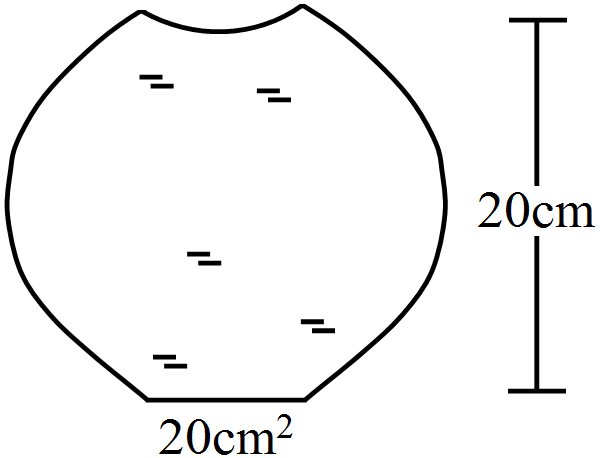
A glass full of water has a bottom of area $20\ cm^2$, top of area $20\ cm^2$, height $20\ cm$ and volume half a litre.
  1. Find the force exerted by the water on the bottom.
  2. Considering the equilibrium of the water, find the.
Resultant force exerted by the sides of the glass on the water. Atmospheric pressure $= 1.0 \times 10^5N/m^2$. Density of water $= 1000\ kg/m^3$ and $g = 10m/s^2$. Take all numbers to be exact.​​​​​​​