MCQ
A perfectly dimagnetic sphere has a small spherical cavity at its centre, which is filled with a paramagnetic substance. The whole system is placed in a uniform magnetic field $\overrightarrow{ B }$. Then the field inside the paramagnetic substance is:
  • $Zero$
  • B
    $\overrightarrow{ B }$
  • C
    much large than $|\overrightarrow{ B }|$ but opposite to $\overrightarrow{ B }$
  • D
    much large than $|\overrightarrow{ B }|$ and parallel to $\overrightarrow{ B }$
Answer

Correct option: A.
$Zero$
a
A perfect diamagnetic substance will completely expel the magnetic field. Therefore, there will be no magnetic field inside the cavity of sphere. Hence the paramagnetic substance kept inside the cavity will experience no force.

Need a full question paper?

Generate a complete, print-ready paper with questions like this in minutes — across 16+ boards, with answer keys.

Start Generating Free

Similar questions

Consider the two idealised systems: (i) a parallel plate capacitor with large plates and small separation and (ii) a long solenoid of length L > > R, radius of cross-section. In (i), E is ideally treated as a constant between plates and zero outside. In (ii), magnetic field is constant inside the solenoid and zero outside. These idealised assumptions, however, contradict fundamental laws as below:
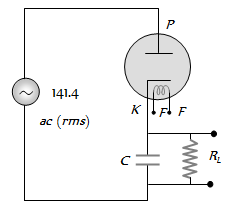
An alternating voltage of 141.4V (rms) is applied to a vacuum diode as shown in the figure. The maximum potential difference across the condenser will be.
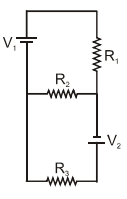
Two ideal batteries of emf $V _1$ and $V _2$ and three resistances $R _1, R _2$ and $R _3$ are connected as shown in the figure.

The current in resistance $R _2$ would be zero if

$(A)$ $V_1=V_2$ and $R_1=R_2=R_3$

$(B)$ $V_1=V_2$ and $R_1=2 R_2=R_3$

$(C)$ $V_1=2 V_2$ and $2 R_1=2 R_2=R_3$

$(D)$ $2 V _1= V _2$ and $2 R _1= R _2= R _3$

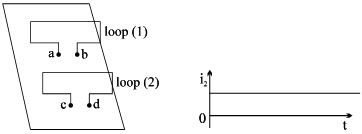
An electric current $i_1$ can flow either direction through loop $(1)$ and induced current $i_2$ in loop $(2)$. Positive $i_1$ is when current is from $'a'$ to $'b'$ in loop $(1)$ and positive $i_2$ is when the current is from $'c'$ to $'d'$ in loop $(2)$ In an experiment, the graph of $i_2$ against time $'t'$ is as shown below Which one $(s)$ of the following graphs could have caused $i_2$ to behave as give above.
The oscillating electric and magnetic vectors of an electromagnetic wave are oriented along:
Two plates are $2\,cm$ apart, a potential difference of $10\;volt$ is applied between them, the electric field between the plates is.........$N/C$
The valence band and conduction band of a solid overlap at low temperature, the solid may be
A paramagnetic material is kept in a magnetic field. The field is increased till the magnetization becomes constant. If the temperature is now decreased, the magnetization
Assertion : Through the same current flows through the line wires and the filament of the bulb but heat produced in the filament is much higher then that in line wires.
Reason : The filament of bulbs is made of a material of high resistance and high melting point.
${ }_{92}^{238} A \rightarrow{ }_{90}^{234} B +{ }_2^4 D + Q$

In the given nuclear reaction, the approximate amount of energy released will be $.....\,MeV$

$\text { [Given, mass of }{ }_{92}^{238} A =238.05079 \times 931.5\,MeV / c ^2$

$\text { mass of }{ }_{90}^{234} B =234.04363 \times 931.5\,MeV / c ^2$

$\text { mass of } \left.{ }_2^4 D =4.00260 \times 931.5\,MeV / c ^2\right]$