Question
A permanent magnet(a) Attracts all substances(b) Attracts only magnetic substances(c) Attracts magnetic substances and repels all non-magnetic substances(d) Attracts non-magnetic substances and repels magnetic substances


Answer

(b) Attracts only magnetic substances

Need a full question paper?

Generate a complete, print-ready paper with questions like this in minutes — across 16+ boards, with answer keys.
Start Generating Free

Similar questions

A rectangular tank of depth 8 meter is full of water (μ = 4/3), the bottom is seen at the depth(a) 6 m (b) 8/3 m(c) 8 cm(d) 10 cm
       
In the position of minimum deviation when a ray of yellow light passes through the prism, then its angle of incidence is(a) Less than the emergent angle(b) Greater than the emergent angle(c) Sum of angle of incidence and emergent angle is 90°(d) Equal to the emergent angle


A lens of power + 2 diopters is placed in contact with a lens of power – 1 diopoter.  The combination will behave like(a) A divergent lens of focal length 50 cm(b) A convergent lens of focal length 50 cm(c) A convergent lens of focal length 100 cm(d) A divergent lens of focal length 100 cm


A proton (mass m and charge +e) and an α - particle (mass 4m and charge +2e) are projected with the same kinetic energy at right angles to the uniform magnetic field. Which one of the following statements will be true(a) The α -  particle will be bent in a circular path with a small radius that for the proton(b) The radius of the path of the α - particle will be greater than that of the proton(c) The α -  particle and the proton will be bent in a circular path with the same radius(d) The α -  particle and the proton will go through the field in a straight line


A convex mirror of focal length f forms an image which is $\frac{1}{n}$ times the object. The distance of the object from the mirror is
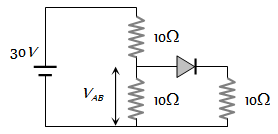
Find $V_{AB}$
A body at rest breaks into two pieces of equal masses. The parts will move
  1. In same direction.
  2. Along different lines.
  3. In opposite directions with equal speeds.
  4. In opposite directions with unequal speeds.
A conductor with a positive charge (a) Is always at +ve  potential(b) Is always at zero potential(c) Is always at negative potential(d) May be at +ve, zero or -ve potential
   
   
The magnetic field of the earth can be modelled by that of a point dipole placed at the centre of the earth. The dipole axis makes an angle of 11.3° with the axis of the earth. At Mumbai, declination is nearly zero. Then,
The electric potential is measured in: