Question
A person is able to see objects clearly only when these are lying at distance between 50cm and 300cm from his eyes.

Answer

The person is suffering from both myopia and Hypermetropia. The far point of the person is 300cm that’s less than infinity hence myopic.The near point of the person is 50cm that is more than 25cm hence the person is suffering from Hypermetropia.
The person requires bi-focal lenses to increase his range of vision. The upper part of the bi-focal lens is a concave lens which facilitates distant vision while the lower part is a convex lens which provides near vision.

Need a full question paper?

Generate a complete, print-ready paper with questions like this in minutes — across 16+ boards, with answer keys.
Start Generating Free

Similar questions

A p.d. of 10V is needed to make a current of 0.02A flow through a wire. What p.d. is needed to make a current of 250mA flow through the same wire?
With the help of ciliary muscles, the human eye can change its curvature and thus alter the focal length of its lens. State the changes that occur in the curvature and focal length of the eye lens while viewing,
  1. a distance object
  2. nearby objects.
Explain, why a normal eye is not able to see distinctly the objects placed closer than 25 cm, without putting any strain on the eye.
What would your image look like if you stood dose to a large:
  1. Convex mirror?
  2. Concave mirror?
Give reasons for your answer.
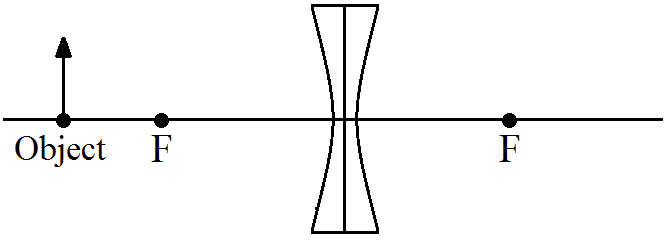
A small object is placed 150mm away from a diverging lens of focal length 100mm:
  1. Copy the figure below and draw rays to show how an image is formed by the lens.


  1. Calculate the distance of the image from the lens by using the lens formula.
An electric iron is connected to the mains power supply of 220V. When the electric iron is adjusted at ‘minimum heating’ it consumes a power of 360W but at ‘maximum heating’ it takes a power of 840W. Calculate the current and resistance in each case.
A ray of light travelling in air is incident on a rectangular glass block and emerges out into the air from the opposite face. Draw a labelled ray diagram to show the complete path of this ray of light. Mark the two points where the refraction of light takes place. What can you say about the final direction of ray of light?
At what distance from a concave mirror of focal length 10cm should an object 2cm long be placed in order to get an erect image 6cm tall?
State the important precautions which should be observed in the use of electricity.
You are provided with two lenses of focal length 20cm and 30cm, respectively. Which lens will you use to obtain more convergent light?
A person suffering from the eye-defect myopia (short-sightedness) can see clearly only up to a distance of 2 metres. What is the nature and power of lens required to rectify this defect?