Questions · Page 1 of 2

Answer the questions.[Phy-3M]

🎯

Test yourself on this topic

50 questions · timed · auto-graded

Question 13 Marks
Explain why the planets do not twinkle.
Answer
Planets being close to earth appear larger in size. A planet can be Considered as a collection of large number of small sized objects. Twinkling effect Of these objects cancel each other. so, planets do not appear to twinkle.
View full question & answer
Question 23 Marks
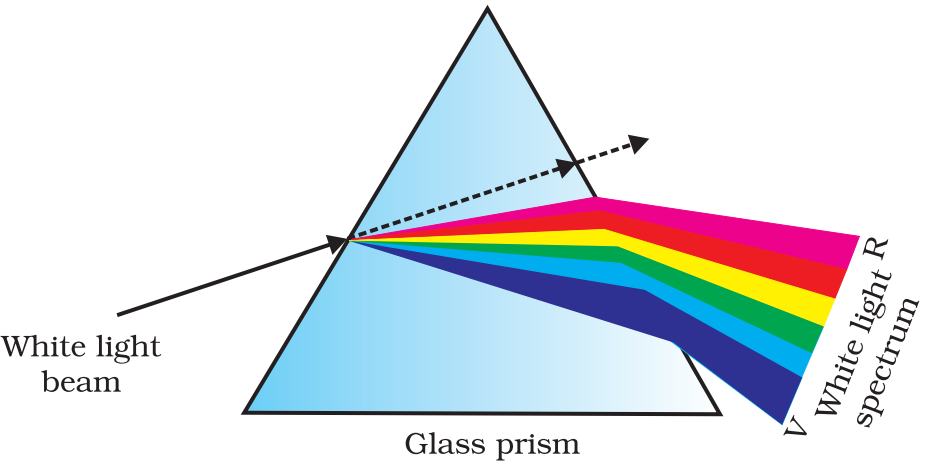
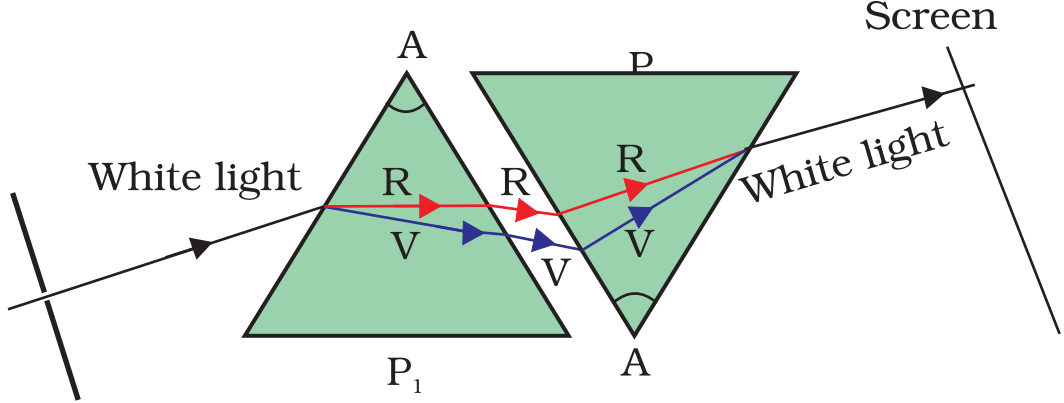
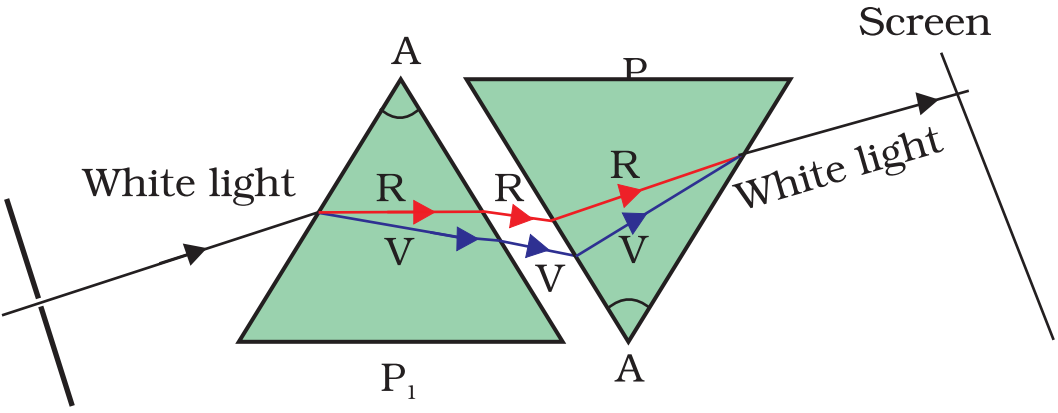
What is ‘‘dispersion of white light’’? Draw a labelled diagram to illustrate the recombination of the spectrum of white light. Why is it essential that the two prisms used for the purpose should be identical and placed in an inverted position with respect to each other?
Answer
Different colors’ of light bend through different angles with respect to the incident ray as they pass through a prism. The red light bends the least, while the violet bends the most. Thus, the rays of each colour emerge along different paths and thus become distinct. This is the cause of dispersion of white light passing through a glass prism.
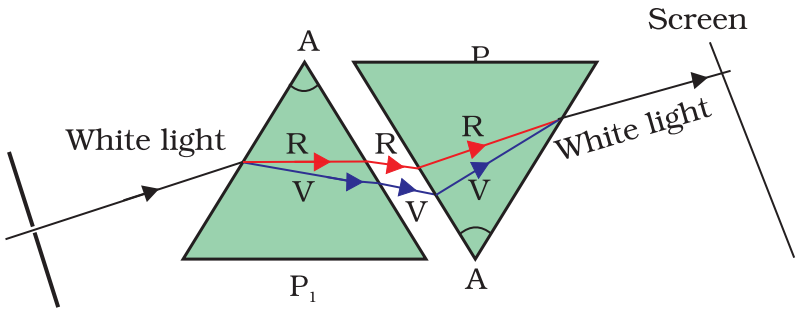
Isaac Newton used two glass prisms, with one prism in inverted position to show that white light of the Sun contains seven colors’.

The set-up has been shown below:

When white light of the Sun passes through the first prism, it gets dispersed into seven colors’. When all the seven colors’ of the spectrum were passed through the second prism, Newton found a beam of white light emerging from the other side of the second prism. This observation gave Newton the idea that the sunlight is made up of seven colors’.
View full question & answer
Question 33 Marks
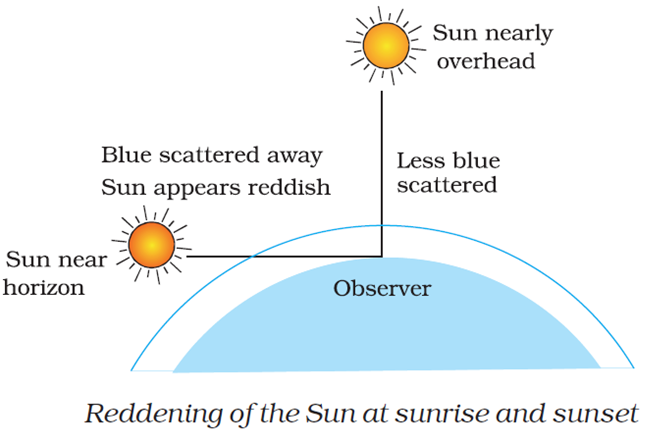
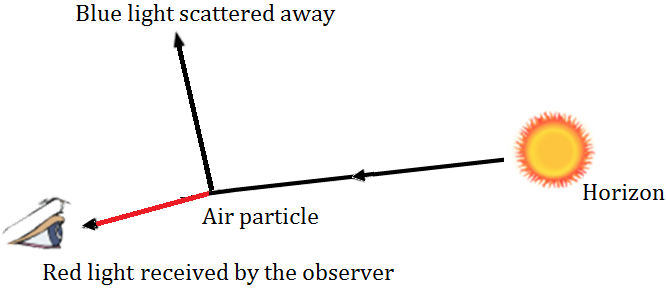
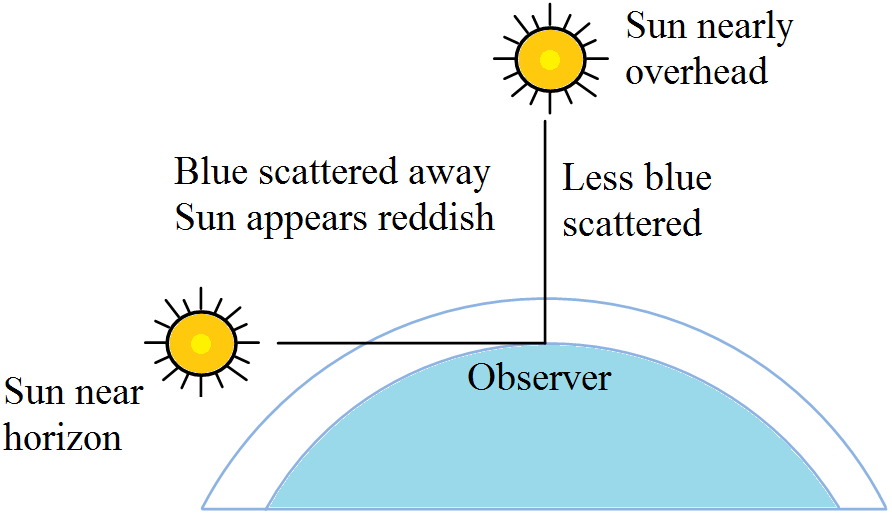
With the help of scattering of light, explain the reason for the difference in colours of the sun as it appears during sunrise/ sunset and noon.
Answer
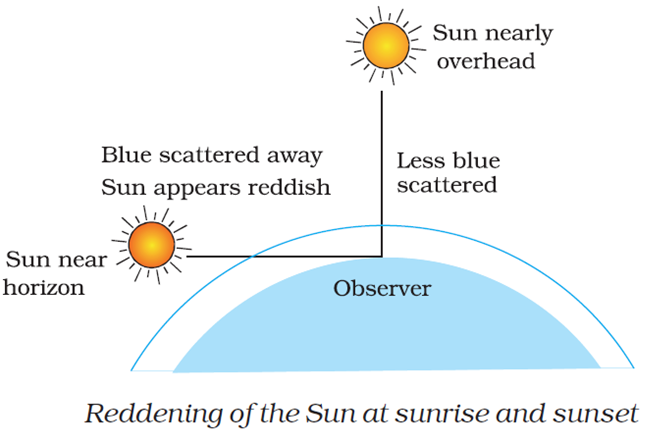
Scattering of light is more pronounced when the size of the scattered is comparable to the wavelength of the light. At sunrise, the Sun is located near the horizon. Hence, the light has to travel a long distance through the Earth’s atmosphere. At the time of sunrise or sunset, when white sunlight falls on the suspended atmospheric particles, the blue colour light scatters out more in the atmosphere because the size of the atmospheric particles are comparable to the wavelength of the blue color light, while the red color light scatters less because it has larger wavelength than the blue color light. So, the red color light reaches the eyes of the observer on the surface of the Earth. Hence, when this less scattered red light reaches the eyes of the observer, the Sun and its surroundings appear reddish. At noon, the sun is nearly overhead and the light from the Sun travels a relatively shorter distance. Therefore, at noon, only a little of the blue and violet color lights are scattered, making the Sun appears nearly white at noon.
View full question & answer
Question 43 Marks
What is ‘dispersion of white light’? State its cause. Draw a ray diagram to show the dispersion of white light by a glass prism.
Answer
  1. The splitting up of white light into seven colors’ on passing through a transparent medium like a glass prism is called dispersion of light.


  1. The dispersion of white light occurs because the angle of refraction of lights of different colors’ is different when passing through the glass prism.
View full question & answer
Question 53 Marks
State the cause of dispersion of white light by a glass prism. How did Newton, using two identical glass prisms, show that white light is made of seven colours ? Draw a ray diagram to show the path of a narrow beam of white light, through a combination of two identical prisms arranged together in inverted position with respect to each other, when it is allowed to fall obliquely on one of the faces of the first prism of the combination.
Answer
Different colors’ of light bend through different angles with respect to the incident ray as they pass through a prism. The red light bends the least, while the violet bends the most. Thus, the rays of each colour emerge along different paths and thus become distinct. This is the cause of dispersion of white light passing through a glass prism.
Isaac Newton used two glass prisms, with one prism in inverted position to show that white light of the Sun contains seven colors’. The set-up has been shown below:

When white light of the Sun passes through the first prism, it gets dispersed into seven colors’. When all the seven colors’ of the spectrum were passed through the second prism, Newton found a beam of white light emerging from the other side of the second prism. This observation gave Newton the idea that the sunlight is made up of seven colors’.
View full question & answer
Question 63 Marks
What is meant by scattering of light? Use this phenomenon to explain why the clear sky appears blue or the sun appears reddish at sunrise.
Answer
The sun appears reddish early morning because at that time it is located near to the horizon and light has to pass thick layers of air and travel larger distances before reaching us. Thus, the blue rays having shorter wavelength are scattered and the red rays of longer wavelength reaches our eyes giving sun appearance a reddish color. Thus, it can be stated that the color of sun that appears to us depends on the position of sun and the distance its rays have to travel. If the rays have to travel longer distances then the shorter wavelength colors get scattered away and longer wavelength color appears. This phenomenon will not be observed by an observer on the moon because there is no atmosphere on the moon to scatter light,
View full question & answer
Question 73 Marks
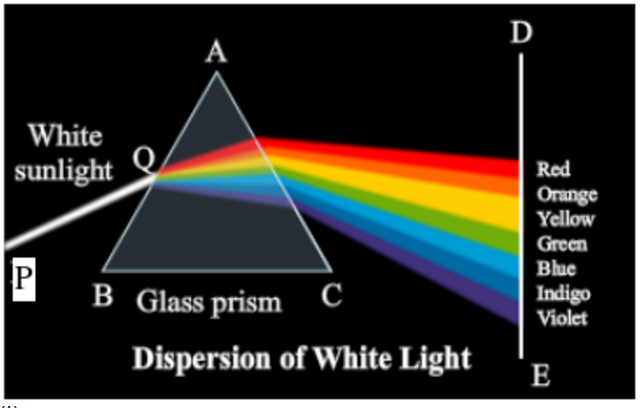
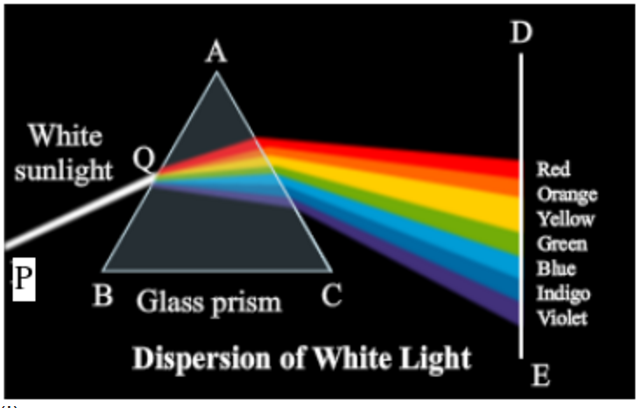
A narrow beam PQ of white light is passing through a glass prism ABC as shown in the diagram.

Trace it on your answer sheet and show the path of the emergent beam as observed on the screen DE.
  1. Write the name and cause of the phenomenon observed.
  2. Where else in nature is this phenomenon observed?
  3. Based on this observation, state the conclusion which can be drawn about the constituents of white light.
Answer


  1. The phenomenon of the splitting up of the white light into its constituent colours is called dispersion of light.

Dispersion of light is caused because different constituent colours of light offer different refractive indexes to the material of the prism.

  1. The formation of rainbow is caused by the dispersion of the white sunlight into its constituent colours.
  2. Based on the dispersion of white light into its constituent colours, we can conclude that:
  1. The white light consists of seven colours.
  2. The violet light suffers maximum deviation and the red light suffers minimum deviation.
View full question & answer
Question 83 Marks
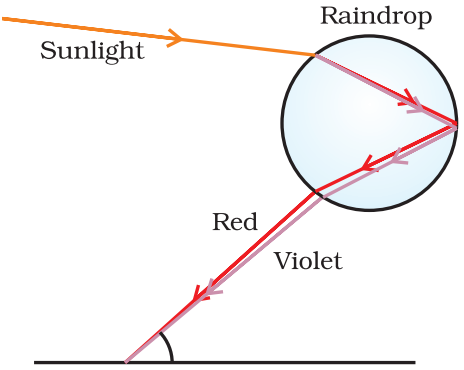
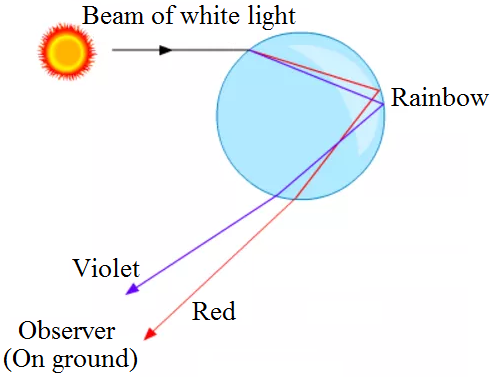
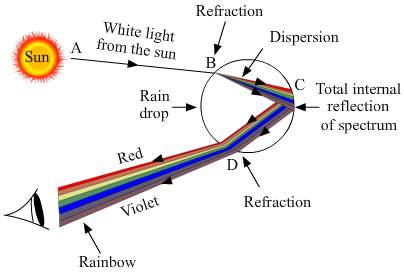
When and where do we see a rainbow? How is a rainbow formed? Draw a labelled diagram to illustrate the formation of a rainbow.
Answer
Rainbow is defined as the natural phenomenon in which due to dispersion of white light, an arch of seven colors is formed. We see rainbow in the sky only after rainfall due to dispersion of sunlight by the tiny water droplets of rain present in the atmosphere. The water droplets act like small prisms. The rain drops are refracted, dispersed and reflected internally and then refracted again. Due to these phenomena's, we see a rainbow in the sky after rainfall.
View full question & answer
Question 93 Marks
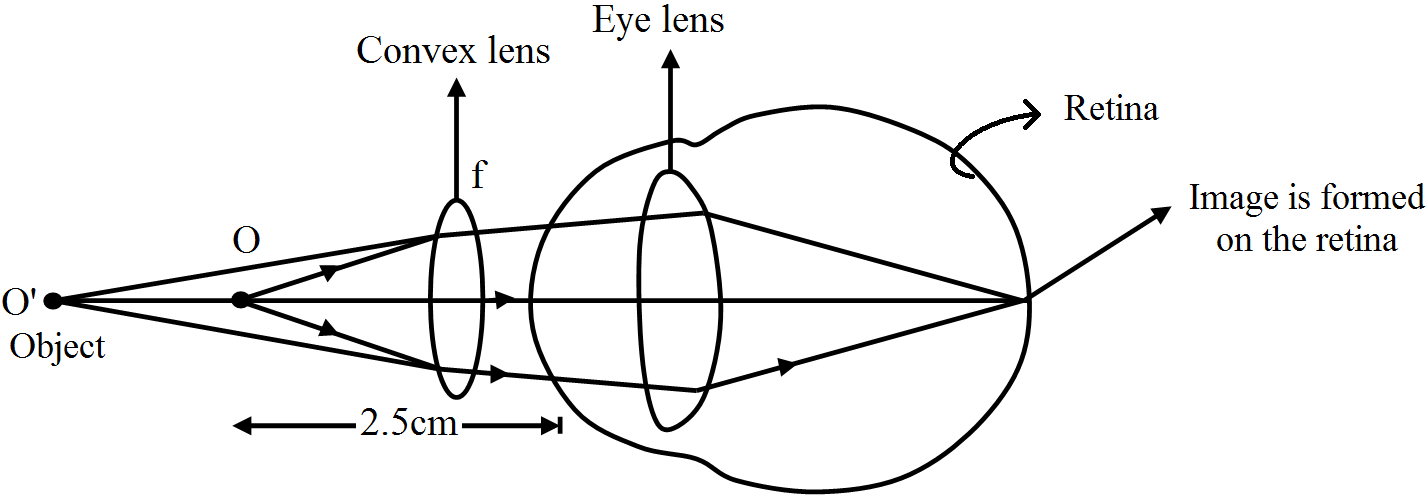
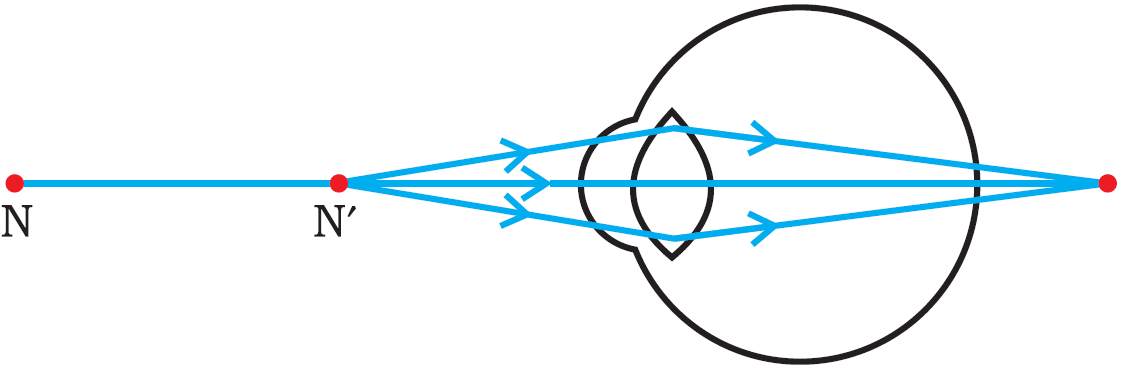
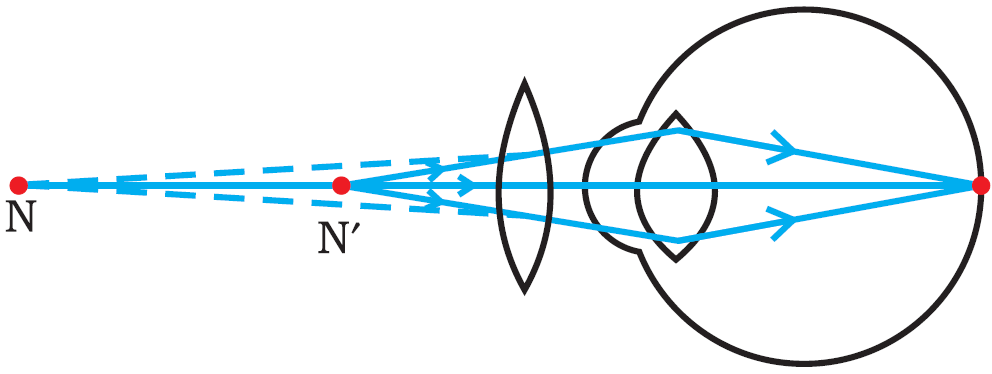
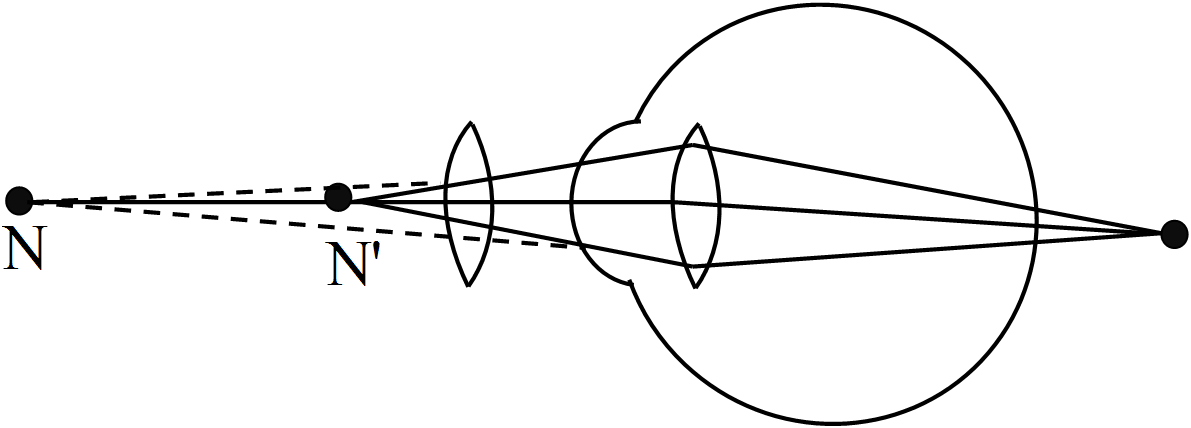
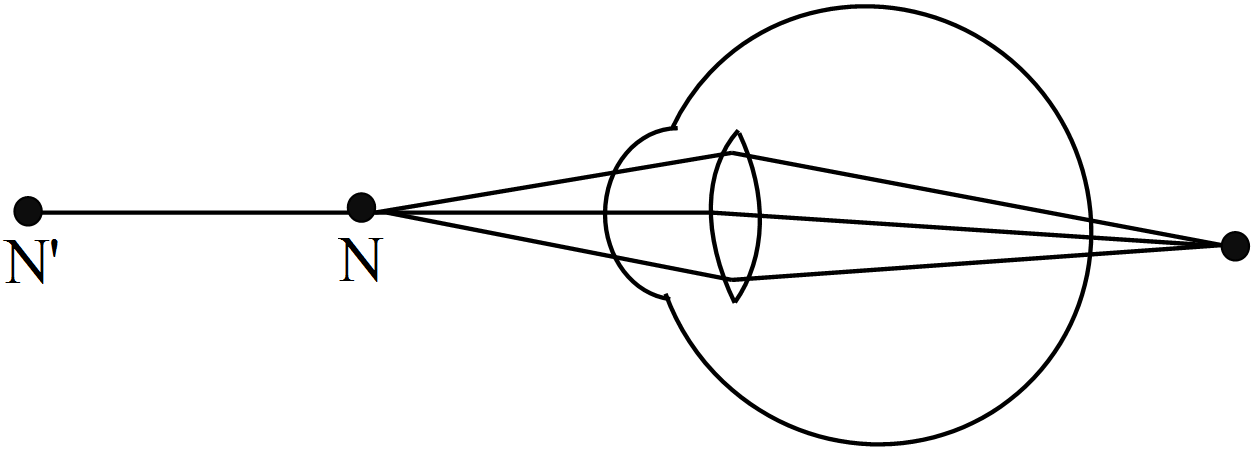
An old man cannot see objects closer than 1 m from the eye clearly. Name the defect of vision he is suffering from. How can it be corrected? Draw ray diagram for the,
  1. Defect of vision and also.
  2. For its correction.
Answer
When a person cannot see objects closer than 1 m from the eye, he is suffering from presbyopia. Presbyopia is also a special kind of hypermetropia.Presbyopia is a common defect of vision, which generally occurs at old age. A person suffering from this type of defect of vision cannot see nearby objects clearly and distinctively. A presbyopic eye has its near point greater than 25cm and it gradually increases as the eye becomes older. Presbyopia can be corrected by using a convex lens of appropriate power.

Ray diagram showing presbyopia is as shown below:


View full question & answer
Question 103 Marks
What eye defect is myopia? Describe with a neat diagram how this defect of vision can be corrected by using a suitable lens.
Answer
Myopia is a defect in which, an eye can see nearby objects clearly but cannot see distant objects distinctly. Myopia is also known as short-sightedness or near sightedness.
Myopia is caused by:
  1. The eyeball gets elongated along its axis so that the distance between the eye lens and the retina becomes larger.
  2. Due to excessive curvature of the cornea, the focal length of the eye lens becomes too small.
Myopia can be corrected using concave lens.

View full question & answer
Question 113 Marks
Using the phenomenon of scattering of light, explain why there is a difference in the colour of the sun as it appears during sunrise and at noon.
Answer
At noon, the sun is at the top and the light rays coming from it have to travel less distance in the atmosphere of earth. Hence, all colors’ get scattered very less, even blue.
In evening, the sun is not at the top and the light rays from sun have to travel more distance in the earth's atmosphere. The difference is nearly of 150kms. In this long run, blue colour and all its shades get scattered the most whereas red, orange, yellow get scattered the least. That's why we see the sun reddish in the evening.
View full question & answer
Question 123 Marks
What is scattering of light? Use this phenomenon to explain why the clear sky appears blue and the sun appears reddish at sunrise.
Answer
The scattering of light is the phenomenon by which a beam of light is redirected in different directions on interacting with the particles present in the medium. The scattered light's colour depends on the size of the scattering particles. The particles of very small size scatter mainly blue light whereas the particles of larger size scatter lights of longer wavelengths. The sky appears blue because the fine particles in the atmosphere scatter blue light the most among all the components of white light. At sunrise, the Sun is located near the horizon. Hence, the light has to travel a long distance through the Earth’s atmosphere. At the time of sunrise or sunset, when white sunlight falls on suspended atmospheric particles, the blue colour light scatters out in the atmosphere, while the red colour light scatters less and reaches the eyes of the observer on the surface of the Earth. Hence, when this less scattered red light reaches eyes of the observer, the Sun and its surroundings appear reddish.
View full question & answer
Question 133 Marks
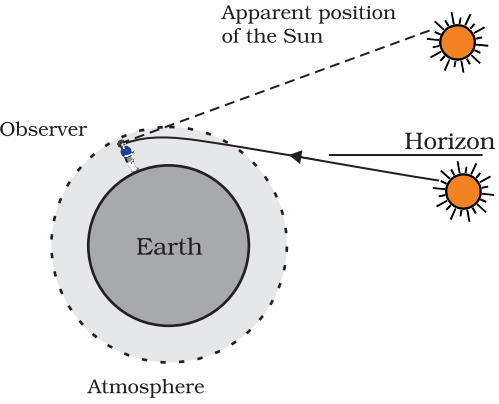
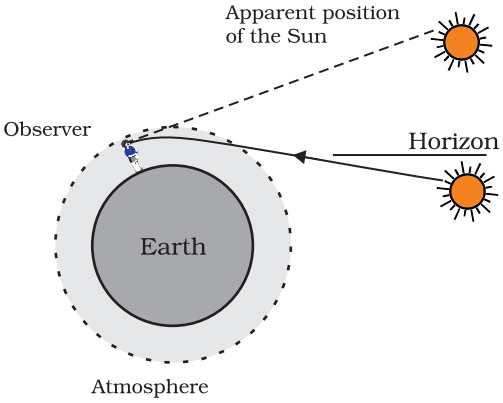
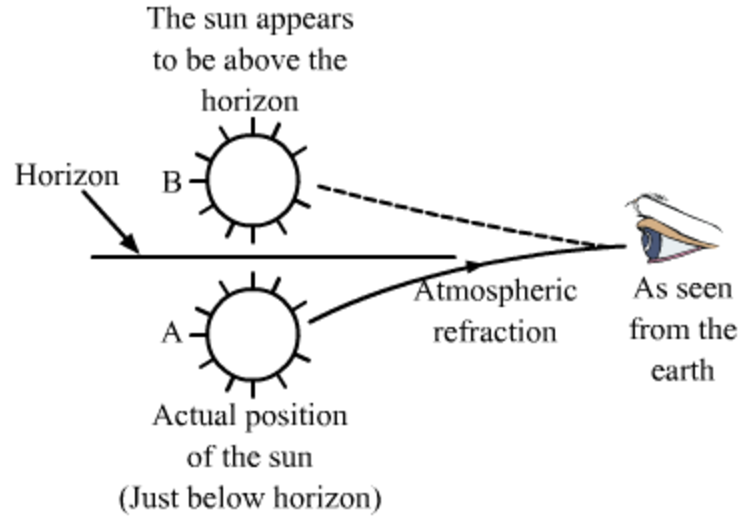
With the help of a diagram, explain how atmospheric refraction is responsible for the advance sunrise and delayed sunset. How much time difference does it cause on the duration of day on the Earth?
Answer
Advanced sunrise and delayed sunset are phenomena caused due to atmospheric refraction. In this the Sun appears to rise early by 2 minutes and set late by 2 minutes.
The diagram below shows this phenomenon.

When the rays from the Sun hit the atmosphere they get refracted. Due to this the Sun appears to be at an apparent position which suggests that it has already risen. The same happens when the Sun sets. After setting the Sun still appears in the sky due to the same refraction phenomenon.
This entire sequence is a result of difference in the refractive index of atmosphere.
View full question & answer
Question 143 Marks
Explain in brief the reason for each of the following:
  1. Advanced sun-rise.
  2. Delayed sun-set.
  3. Twinkling of stars.
Answer
  1. Advanced sun-rise: When the sun is slightly below the horizon light rays coming from the sun travel from the rarer to denser medium layers of air because of atmospheric refraction of light, light appears to come from a higher position above the horizon. Thus the sun appeared earlier than actual sun rise.

  2. Delayed sun-set: Same reason as similar fraction occurs at the sunset.


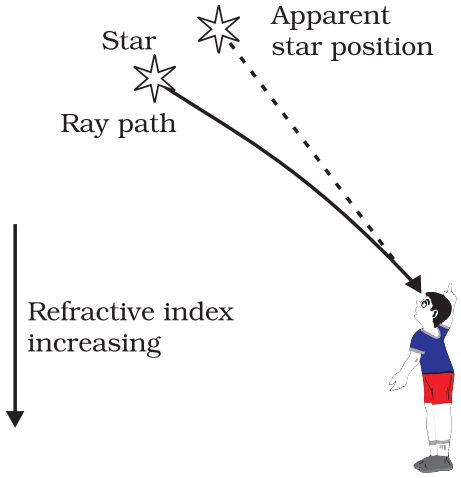
  1. Twinkling of stars: The light coming from the stars gets refracted several times before reaching the observer's eye. Due to a change in physical condition, of the atmosphere the, light sometimes reaches the observer and sometimes it doesn't, hence they appear to twinkle.
View full question & answer
Question 153 Marks
Write about power of accommodation of human eye. Explain why the image distance in the eye does not change when we change the distance of an object from the eye?
Answer
  • Ability of the eye lens to focus nearby as well as distant objects on the retina by changing the curvature / focal length of the eye lens.
  • Image distance in the eye is the distance between the eye lens and the retina and it is fixed.
  • As the object approaches from infinity towards the eye, the focal length of the eye lens decreases (or vice a versa) so as to maintain the same image distance.
View full question & answer
Question 163 Marks
State the cause of dispersion of white light passing through a glass prism. How did Newton show that white light of sun contains seven colours using two identical glass prisms. Draw a ray diagram to show the path of light when two identical glass prisms are arranged together in inverted position with respect to each other and a narrow beam of white light is allowed to fall obliquely on one of the focus of the first prism.
Answer
Different colors of light bend through different angles with respect to the incident ray as they pass through a prism. The red light bends the least, while the violet bends the most. Thus, the rays of each colour emerge along different paths and thus become distinct. This is the cause of dispersion of white light passing through a glass prism.
Isaac Newton used two glass primes, with one prism in inverted position to show that white light of the Sun contains seven colors. The set-up has been shown below:

When white light of the Sun passes through the first prism, it gets dispersed into seven colors. When all the seven colors of the spectrum were passed through the second prism, Newton found a beam of white light emerging from the other side of the second prism. This observation gave Newton the idea that the sunlight is made up of seven colors.
View full question & answer
Question 173 Marks
With the help of a labelled diagram, explain why the sun appears reddish at the sunrise and the sun-set.
Answer
The sun appears reddish early morning because at that time it is located near to the horizon and light has to pass thick layers of air and travel larger distances before reaching us. Thus, the blue rays having shorter wavelength are scattered and the red rays of longer wavelength reaches our eyes giving sun appearance a reddish color. Thus, it can be stated that the color of sun that appears to us depends on the position of sun and the distance its rays have to travel. If the rays have to travel longer distances then the shorter wavelength colors get scattered away and longer wavelength color appears. This phenomenon will not be observed by an observer on the moon because there is no atmosphere on the moon to scatter light.

View full question & answer
Question 183 Marks
Explain with the help of a labelled diagram, the cause of twinkling of stars.
Answer
Twinkling of Stars The twinkling of a star is due to atmospheric refraction of star light. The atmospheric refraction occurs in a medium of gradually changing refractive 'index. Since the atmosphere bends star light towards, the normal, the apparent position of the star is slightly different from the actual position. This apparent position of the star is not stationary, but keeps on changing slightly as the physical conditions of the earth's atmosphere are not stationary. Since the stars are very distant, they act as point-sized sources of light As the path of rays of light coming from the star goes varying slightly, the apparent position of the star fluctuates and the amount of light entering the eye flickers-the star sometimes appears brighter and at other times appears fainter, which is the twinkling effect.

View full question & answer
Question 193 Marks
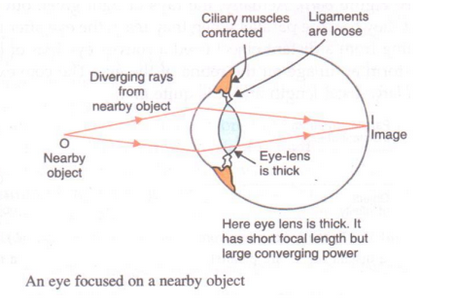
With the help of ciliary muscles, the human eye can change its curvature and thus alter the focal length of its lens. State the changes that occur in the curvature and focal length of the eye lens while viewing,
  1. a distance object
  2. nearby objects.
Explain, why a normal eye is not able to see distinctly the objects placed closer than 25 cm, without putting any strain on the eye.
Answer
  1. When we see distant object, the ciliary muscles relax/ expand to decrease the curvature and thereby increase the focal length of the lens. Hence, the lens becomes thin. This enables us to see the distant object clearly. Thus, the focal length of the eye lens increases while seeing distant objects.


  1. To see the nearby objects clearly, the focal length of the lens should be shorter. For this, the ciliary muscles contract to increase the curvature and thereby decrease the focal length of the lens. Hence, the lens becomes thick. This enables you to see the nearby objects clearly. 


A normal eye is not able to see distinctly the objects placed closer than 25cm, without putting any strain on the eye. This is because the ciliary muscles of eyes are unable to contract beyond a certain limit. If the objects are placed at a distance of less than 25cm from the eye, then the objects appear blurred because light rays coming from the object meet beyond the retina.

View full question & answer
Question 203 Marks
What is meant by scattering of light? The sky appears blue and the sun appears reddish at sunrise and sunset. Explain these phenomena with reason.
Answer
The phenomenon in which a part of the light incident on a particle is redirected in different directions is called the scattering of light.
The molecules of air and other fine particles in the atmosphere have a size smaller than the wavelength of visible light. So, they are more effective in scattering light of shorter wavelengths at the blue end than light of longer wavelengths at the red end. Thus, when sunlight passes through the atmosphere, the fine particles in the air scatter blue colour (shorter wavelengths) more strongly than red. The scattered blue light enters our eyes,
and hence, the clear sky appears blue.
At the time of sunrise and sunset, when the Sun is near the horizon, sunlight travels a greater distance through the atmosphere to reach us. During this, most of the shorter wavelengths present in it are scattered away from our line of sight by the molecules of air and other fine particles in the atmosphere. So, light reaching us directly from the rising or setting Sun consists mainly of the longer wavelength red colour because of which the Sun appears red. Thus, at sunrise and sunset, the Sun as well as the surrounding sky appears red.
View full question & answer
Question 213 Marks
Why does the sun seem to rise two minutes before the actual sunrise and set two minutes after the actual sunset? Explain with the help of labelled diagram.
Answer


The Sun is visible to us two minutes before the sunrise and two minutes after the sunset because of the bending of the light due to atmospheric refraction. The actual sunrise takes place when the Sun is just above the horizon. But due to atmospheric refraction of light, we see the Sun about two minutes before it is actually above the horizon.
When the Sun is slightly below the horizon, its light moves from less dense air to more dense air and gets refracted towards the normal. Because of this atmospheric refraction, the Sun appears to be above the horizon when it is actually slightly below the horizon. It is also due to atmospheric refraction that we can still see the Sun for about two minutes even after it has set below the horizon.
View full question & answer
Question 223 Marks
Due to gradual weakening of ciliary muscles and diminishing flexibility of the eye lens a certain defect of vision arises. Write the name of this defect. Name the type of lens required by such persons to improve the vision. Explain the structure and function of such a lens.
Answer
The defect caused due to gradual weakening of ciliary muscles and diminishing flexibility of the eye lens is presbyopia.
Presbyopia is the defect of eye in which a person cannot see nearby objects comfortably and distinctly without corrective eye-glasses. A presbyopic eye has its near point greater than 25 cm and it gradually increases as the eye becomes older.
The type of lens required by such person to improve the vision is bifocal lens.
A bifocal lens consists of both convex lens and concave lenses. The convex lens used in bifocal lens is used to correct hypermetropia (far sightedness) and concave lens is used to correct myopia (short sightedness).
View full question & answer
Question 233 Marks
Why does the sun appear reddish early in the morning? Will this phenomenon be observed by an observer on the moon? Justify your answer with a reason.
Answer


The sun is located near the horizon of the earth, during sunrise and hence, light travels a longer distance through the Earth's atmosphere. The particles that are suspended in the atmosphere have a wavelength similar to that of the wavelength of blue light. When sunlight falls on the atmosphere, the blue light is scattered out by these atmospheric particles. The light that reaches the surface of the Earth is predominantly red. Therefore, sun and its surrounding appear reddish, when the less scattered red light reaches our eyes.
The same phenomenon will not be observed in the moon because of the absence of atmosphere on the surface of the moon. Hence, there will not be any scattered light and will appear dark.
View full question & answer
Question 243 Marks
Explain giving reason why the sky appears blue to an observer from the surface of the earth? What will the colour of the sky be for an astronaut staying in the international space station orbiting the earth? Justify your answer giving reason.
Answer
Sky appears blue: The molecules of air and other fine particles in the atmosphere have a size smaller than the wavelength at the blue end than light of longer wavelengths at the red end. When the scattered blue light enters our eyes, it gives us the feeling of a blue sky.

Colour of sky to an astronaut: There is no atmosphere containing air in space to scatter sunlight. As there is no scattering of light in space, the scattered light does not reach the eyes and the sky appears dark instead of blue to an astronaut in outer space.

View full question & answer
Question 253 Marks
State the difference in colors of the sun observed during sunrise/ sunset and noon. Give explanation for each.
Answer
Differences in colors of the sun at sunrise/sunset and at noon are as follows:

  1. Sunrise/sunset: Reddish in colour.

Reason: Sunlight travels longer distance at t`his time of the day, so the short wavelength colors get scattered away and the sunlight is left with only longer wavelength lights which is reddish or orange. So the sun appears reddish in colour.

  1. Noon: while in colour.

Reason: Sunrays travel shorter distance at noon and contains all the wavelengths of light which combine to form white colour. This makes the colour of sun white.

Alternate Answer

During sunrise and sunset, Sun is red in color while at noon, the Sun appears white.

At the time of sunrise and sunset, the Sun is near the horizon. The rays from the Sun have to travel a much larger part of the atmosphere to reach an observer on earth. So, most of the blue light is scattered away. The red colour which has the largest wavelength is scattered the least and enters into our eyes. Hence, the Sun appears red at the time of sunrise and sunset.

At noon, the sun is nearly overhead. The sunlight has to pass through much smaller portion of Earth's atmosphere. The scattering is much less and the Sun looks white.

View full question & answer
Question 263 Marks
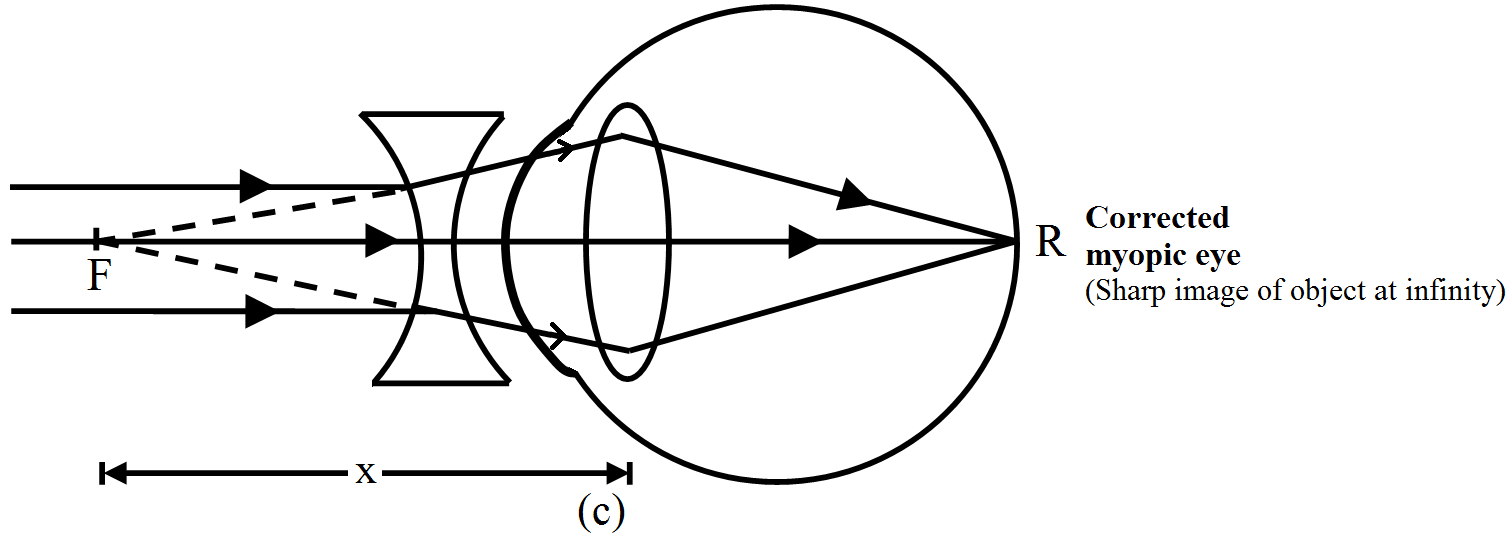
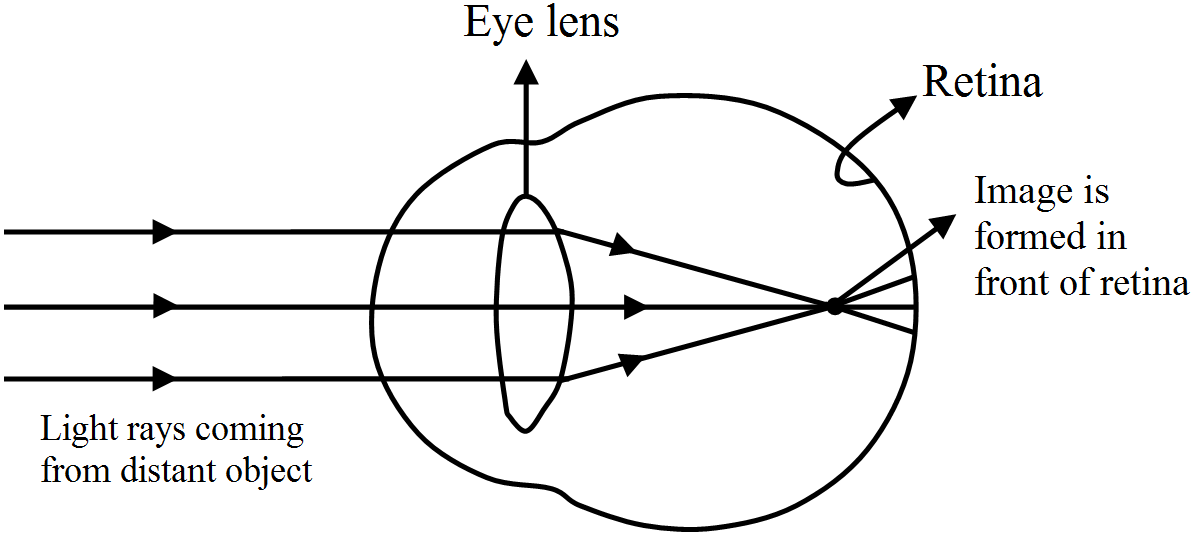
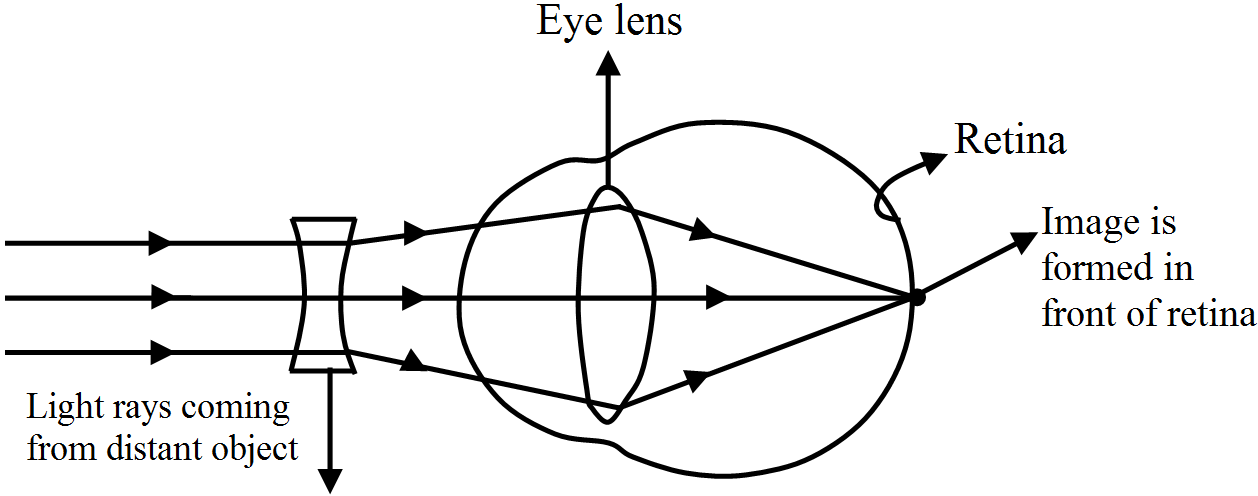
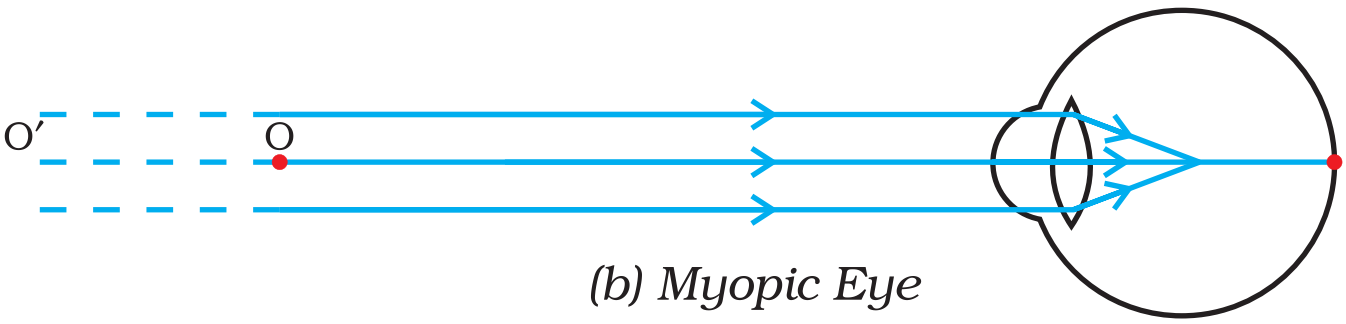
A student can not see chart hanging on wall placed at a distance of 3 m from him. Name the defect of vision he is suffering from. How can it be corrected? Draw ray diagrams for the,
  1. Defect of vision and also.
  2. For its correction.
Answer
When a person cannot see the distant objects distinctly, the person is suffering from myopia. Here, the student is suffering from the same defect. It can be corrected using a concave lens of suitable power. The figures below illustrate the defect and its correction.
  1. Defect of vision:


  1. Correction of myopic defect:

View full question & answer
Question 273 Marks
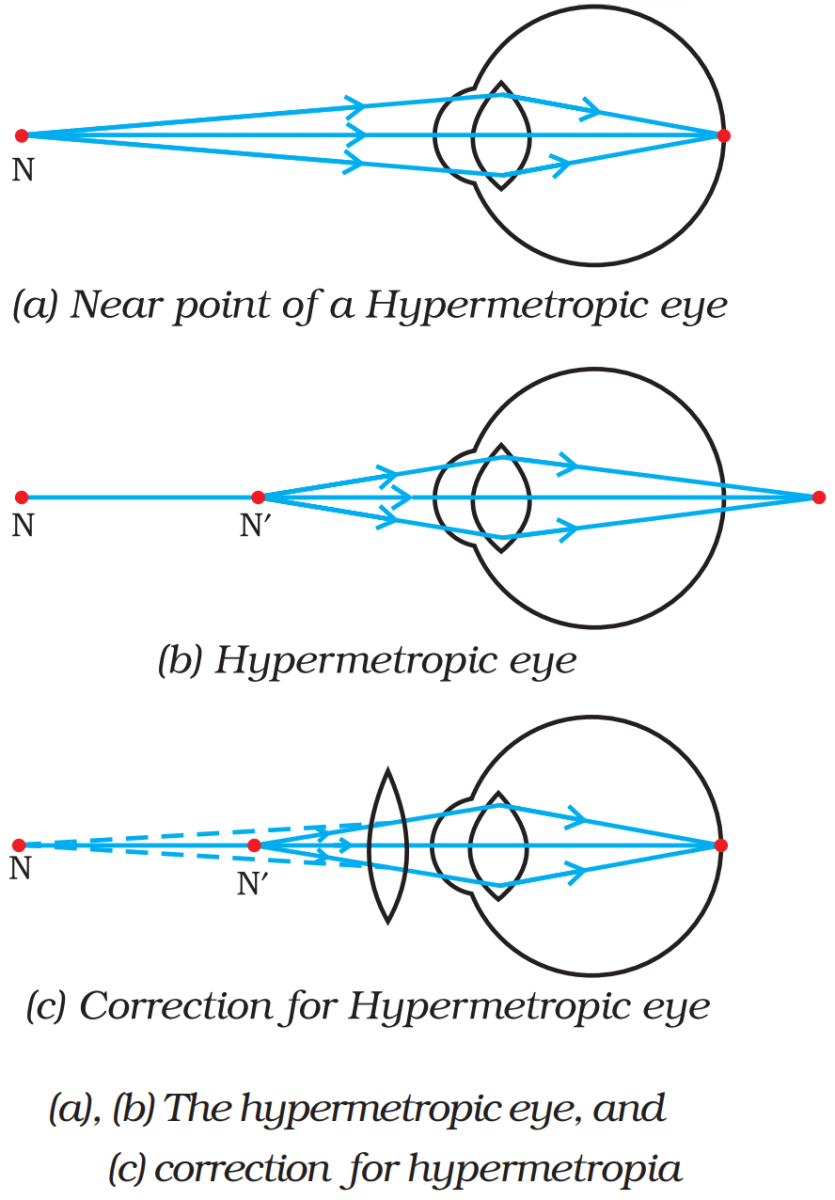
What eye defects hypertrophies? Describe with ray diagram how this defect of vision can be corrected by using an appropriate lens?
Answer
When a person cannot see the nearby objects distinctly but, can see the distant objects clearly then the person is suffering from hypermetropia. This defect can be corrected by using a convex lens of appropriate power.
The below ray diagram illustrates the correction of this defect.
View full question & answer
Question 283 Marks
What is hypermetropia? State the two causes of hypermetropia. With the help of ray diagrams, show:
  1. The eye-defect hypermetropia.
  2. Correction of hypermetropia by using a lens.
Answer
Hypermetropia: Hypermetropia is also known as long-sightedness. In this defect, a person can see the distant objects clearly but cannot see the nearby objects clearly.

Cause of hypermetropia:

  1. The eyeball becomes too small along its axis so that the distance between the eye lens and the retina is reduced.
  2. The focal length of the eye lens becomes too large resulting in the low converging power of the eye lens.
  1.  

  1.  

View full question & answer
Question 293 Marks
  1. Draw a diagram to show the formation of image of a distant object by a myopic eye. How can such an eye defect be remedied?
  2. State two reasons due to which this eye defect may be caused.
  3. A person with a myopic eye cannot see objects beyond a distance of 1.5 m. What would be the power of the corrective lens used to restore proper vision?
Answer
  1.  
  1.  


  1. Using a concave lens.
  1. Causes:
  1. The eyeball gets elongated along its axis so that the distance between the eyelens and the retina becomes larger.
  2. Due to excessive curvature of the cornea, the focal length of the eyelens becomes too small.
  1. $\text{v}=-1.5\text{m}=-\frac{15}{10}\times100=-150\text{cm}$

$\text{u}=-\alpha,\ \text{f}=?$

$\frac{1}{\text{f}}=\frac{1}{\text{v}}-\frac{1}{\text{u}}\Rightarrow\frac{1}{\text{f}}=\frac{1}{-150}-\frac{1}{-\infty}$

$\Rightarrow\frac{1}{\text{f}}=-\frac{1}{150}+\frac{1}{\infty}=-\frac{1}{150}$

$\text{f}=-150\text{cm}=-1.5\text{m}$

$\therefore\ \text{P(Power of corrective lens)}=\frac{1}{\text{f}}=\frac{1}{1.5}\\=\frac{-10}{15}=-0.67\text{D}$

View full question & answer
Question 303 Marks
Why is Tyndall effect shown by colloidal particles? State four instances of observing the Tyndall effect.
Answer
Colloidal particle show Tyndall effect as they scatter light. Small sized colloidal particles cannot be seen with naked eyes but they are big enough to scatter a beam of light.
  • When a fine beam of light enters a smoke-filled dark room through a small hole.
  • When sunlight passes through a canopy of dense forest in foggy/ misty conditions.
  • Blue colour of sky.
  • Red colour of the sun during sunrise or sunset.
View full question & answer
Question 313 Marks
What is a rainbow? Draw a labelled diagram to show the formation of a rainbow.
Answer
The rainbow is a natural phenomenon in which white sunlight splits into beautiful colours by water droplets, which remain suspended in air after the rain.
Formation of a rainbow​:
View full question & answer
Question 323 Marks
Trace the sequence of events which occur when a bright light is focused on your eyes.
Answer
When bright light is focussed on our eyes, then it goes to the brain, the brain reverts back the message by motor neuron which contracts the pupil. The sequence of events which occur is:
Receptor → Sensory neuron → Brain → Motor Neuron → Eye → Eye muscle contracts
View full question & answer
Question 333 Marks
Draw a labelled diagram to show:
  1. Reddish appearance of the sun at the sunrise or the sunset.
  2. White appearance of the sun at noon when it is overhead.
Answer
  1. When the sun is at horizon, it appears to be reddish because as the light passes through the atmosphere, it enters slant and due to this large amount of scattering takes place. The blue light gets scattered more as compared to red light and the sun appears red.


  1. At noon, the sun appears white, not red, as only a little of the blue and violet colors are scattered because light from the Sun overhead would travel a relatively shorter distance.
View full question & answer
Question 343 Marks
Why should there be equitable distribution of resources? List three forces that would be working against an equitable distribution of our resources.
Answer
  • Need for equitable distribution of resources :

So that all and not just a handful of rich and powerful people benefit from the development of these resources/ all living beings have a birthright to the available resources.

  • Forces against equitable distribution of resources : 
  1. Industrialists who work for their own benefit/ profit.
  2. When environmental laws/ rules are not implemented properly.
  3. Mismanagement in the distribution of natural resources or any other relevant answer.
View full question & answer
Question 353 Marks
What is feedback mechanism of hormonic regulation. Take the example of insulin to explain this phenomenon.
Answer
Feedback mechanism: Mechanism by which the amount of any chemical increases or decreases resulting in secretion of the related hormone.
Example - when sugar level rises, insulin secretion increases.
When sugar level falls, insulin secretion reduces.
View full question & answer
Question 363 Marks
Differentiate between a glass slab and a glass prism. What happens when a narrow beam of:
  1. A monochromatic light.
  2. White light passes through.
  1. Glass slab.
  2. Glass prism?
Answer
Glass slab
Glass prism
In the case of a glass slab, the two interfaces the light ray has to pass are parallel to each other.
In the case of a prism, the two interfaces the light ray has to pass are not parallel to each each other and are inclined at an angle.
In this case the emergent ray is also a white light because the constituents of white light which are refracted at different angles at the first interface recombine at the second interface and emerge as a single white light.
In this case, the effects of the first interface are not reversed and the colours separated at that first interface continue along different paths upon leaving the glass at the second interface. Hence we observe a spectrum on the other side.
  1. A Monochromatic light passes through the glass slab and refracts and emerged out. But we can observe the same color throughout. Even after emerging out.
  2. When it is passed through a glass prism, it refracts and the refracted ray is parallel to one side of a prism. Here also, the color of the light doesn't change.
  1. White light refracts and simultaneously, dispersion happens and it gets split into its constituent colours.
  2. Refraction happens and also dispersion happens and its constituent colours.
View full question & answer
Question 373 Marks
Why we have two eyes to view the objects?
Answer
We have two eyes to view objects because.

  1. Two eyes give a wider view.

The horizontal field of view having one eye is 150 degree while having both eyes is 180 degree. This means that with two eyes open we can see a wider area.

  1. Two eyes enable in judging the distance more accurately.

Our two eyes are a few centimeters apart from each other, due to this both the eyes see the same object from two slightly different angles and send two slightly different images of the same object to the brain. The brain combines these two slightly different images to create a three dimensional picture of objects which enable us to judge the distance of objects clearly.

View full question & answer
Question 383 Marks
Why is the colour of the clear sky blue?
Answer
When sunlight enters the earth’s atmosphere, the atoms or molecules of the gases present in the atmosphere scatter this light. Since wavelength of red colour is larger than the wavelengths of other colours in sunlight, so red colour is scattered least. Violet colour is scattered the most followed by blue, green, yellow, orange and red colours respectively. Our eye is more sensitive to the blue light than the violet light. Therefore, scattered light in the sky contains blue colour in plenty and hence the clear sky appears blue.
Note: Sky appears greyish over cities having industrial units. The smoke and dust particles in the atmosphere over such cities scatter red, orange and yellow colours more than other colours of small wavelengths. Hence, the sky appears greyish.
View full question & answer
Question 393 Marks
Why do stars twinkle on a clear night?
Answer
The light coming from a star undergoes atmospheric refraction due to varying optical densities of air at various altitudes. The continuously changing atmosphere refracts the light from the star by different amounts from one moment to the next. Thus, the star-light reaching our eyes increases and decreases continuously and the star appears to twinkle.
View full question & answer
Question 403 Marks
When is a person said to have developed cataract in his eye ? How is the vision of a person having cataract restored?
Answer
Presbyopia is that defect of vision due to which an old person cannot see the nearby objects clearly due to loss of power of accommodation of the eye. Causes: Gradual weakening of the ciliary muscles and diminishing flexibility of the eye lens. It can be corrected by using convex lenses.
View full question & answer
Question 413 Marks
When is a person said to have developed cataract in his eye ? How is the vision of a person
having cataract restored?
Answer
A person is said to have developed cataract when the eye lens becomes progressively cloudy resulting in blurred vision. The vision of a person having cataract can be restored after getting surgery done on the eye having cataract. The opaque lens is removed from the eye by surgical operation and a new artificial lens is inserted in its place.
View full question & answer
Question 423 Marks
What will be the angle of deviation through a prism and 60°, when angles of incidence and emergence are 45° each?
Answer
Given: 
Angle of prism, A = 60o
Angle of incidence, i = 45o
Angle of emergence e = 45o
To find: 
Angle of deviation = D
We know,
A + D = i + e
So,
D = i + e - A
D = 45o + 45o – 60o
= 30o
Hence angle of deviation is 30o
View full question & answer
Question 433 Marks
What is meant by dispersion of white light? Describe the formation of rainbow in the sky with the help of a diagram.
Answer
The splitting up of light into seven colours on passing through a transparent medium like a glass prism is callad dispersion of light formation of rainbow:

The raindrops act like small prisms,when sunlight enters and leaves these raindrops, the vaious coloured rays in ehite light are refracted by different amounts due to which an arc of seven colours called rainbow is formed.
View full question & answer
Question 443 Marks
What is a rainbow? What are the two conditions necessary for the formation of a rainbow in the sky?
Answer
Rainbow is an arch of seven colours visible in the sky which is produced by the dispersion of sun’s light by raindrops in the atmosphere. A rainbow is formed in the sky when the sun is shining and it is raining at the same time.
View full question & answer
Question 453 Marks
What change is made in the eye to enable it to focus on objects situated at different distances? Illustrate your answer with the help of diagrams.
Answer
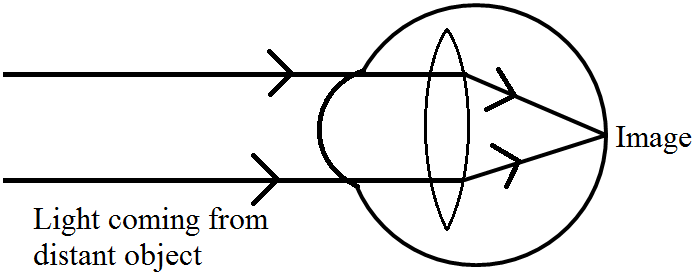
To focus on distant objects, the ciliary muscles of the eye get fully relaxed and pull the suspensory ligaments attached to the eye-lens tightly. This, in turn, stretches the eye-lens and the eye-lens becomes thin.

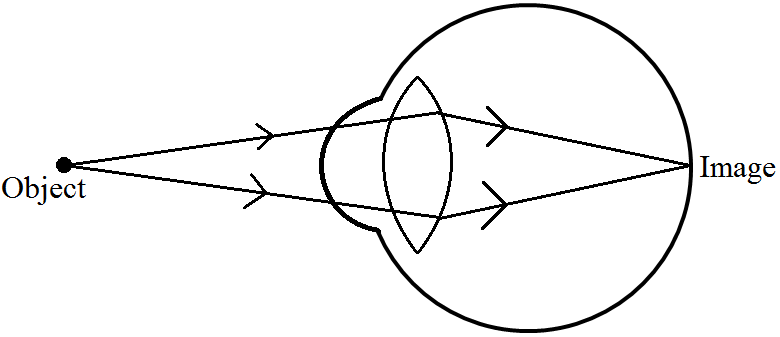
To focus on nearby objects, the ciliary muscles of the eyes contract and make the suspensory ligaments loose. The ligaments then stop pulling the eye-lens. The eye-lens bulges under itsown elasticity and becomes thick.
View full question & answer
Question 463 Marks
There are two types of light-sensitive cells in the human eye: 
  1. Where are they found?
  2. What is each type called?
  3. To what is each type of cell sensitive?
Answer
  1. The two types of light-sensitive cells are found in the retina.
  2. They are called rods and cones.
  3. Rods are sensitive to dim light and cones are sensitive to bright light and colours.
View full question & answer
Question 473 Marks
The near-point of a person suffering from hypermetropia is at 50cm from his eye. What is the nature and power of the lens needed to correct this defect ? (Assume that the near-point of the normal eye is 25cm).
Answer
The person needs a convex lens to rectify this defect.

Calculation of power of the the lens.

This hypermetropic eye can see the nearby object kept at 25cm clearly if the image is formed at its own near point i.e 50cm.

Object distance, u = -25cm

Image distance, v = -50cm

$\frac{1}{\text{v}}-\frac{1}{\text{u}}=\frac{1}{\text{f}}$

$\frac{1}{-50}-\frac{1}{-25}=\frac{1}{\text{f}}$

$\text{f}=50\text{cm}$

$\text{p}=\frac{100}{\text{f}}=\frac{100}{50}=2\text{D} $

View full question & answer
Question 483 Marks
The near point of a long-sighted person is 50cm from the eye:
  1. Can she see clearly an object at:
  1. A distance of 20 cm?
  2. At infinity?
  1. To read a book held at a distance of 25cm, will she need converging or diverging spectacle lenses?
Answer
  1.  
  1. A long-sighted person who has a near point of 50cm from the eye cannot clearly see an object kept at a distance of 20cm. She can see an object only if it is kept at her near point of 50cm in front of the eye.
  2. As the person is long-sighted, she cannot see nearby objects, but can see distant objects, clearly. Therefore, she can clearly see the object kept at in
  1. To read a book held at a distance of 25cm, the person, who is long-sighted, will need converging lenses.
View full question & answer
Question 493 Marks
The minimum power of the eye lens is 40D. If the far point of the normal eye is infinity. Find the size of the eye ball.
Answer
Size of the eyeball would indicate the distance between the eye lens and the retina. As the image is formed on the retina, the size of the eyeball would be equal to the image distance(v).
Now, as the object distance is infinite, we know that the image will be formed on the focus.

So,

here v = f (focal length)

$\text{P}=\frac{1}{\text{f}}$

$\text{P}=40\text{D}$

$40=\frac{1}{\text{f}}$

$\text{f}=\frac{1}{\text{40}}$

$\text{f}=0.025\ \text{meters}=2.5\text{cm}$

focal length $=2.5\text{cm}$

the radius of curvature of the lens $=2\text{f}$

$=5\text{cm}$

View full question & answer
Question 503 Marks
Study the diagram given below, and answer the questions that follow it.

  1. Identify the defect of vision. Give reason for your answer.
  2. State two possible causes of this defect.
  3. How can we rectify this defect? Explain with a diagram.
Answer
  1. Hypermetropia.
  2.  
  1. A focal length of the eye lens is too long.
  2. The eyeball becomes too small.
  1. Diagram for correction of the above defect:

View full question & answer