MCQ
A person running horizontally observes that rain is falling on his head vertically with speed $10\,m/s$. He stops and observes that rain is coming at an angle $30^o$ with vertical., find the speed with which man was running
  • A
    $20\,m/s$
  • B
    $\frac{{20}}{{\sqrt 3 }}\,m/s$
  • C
    $10\sqrt 3\,m/s $
  • $\frac{{10}}{{\sqrt 3 }}\,m/s$

Answer

Correct option: D.
$\frac{{10}}{{\sqrt 3 }}\,m/s$
d
$\mathrm{V}_{\mathrm{m}}=\mathrm{V}_{\mathrm{r}} \sin 30^{\circ}$

$=\frac{20}{\sqrt{3}} \times \frac{1}{2}=\frac{10}{\sqrt{3}} \mathrm{m} / \mathrm{s}$

Need a full question paper?

Generate a complete, print-ready paper with questions like this in minutes — across 16+ boards, with answer keys.

Start Generating Free

Similar questions

An electron and proton have the same de-Broglie wavelength. Then the kinetic energy of the electron is
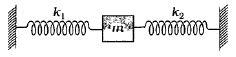
Two springs, of force constants $k_1$ and $k_2$ are connected to a mass $m$ as shown. The frequency of oscillation of the mass is $f$ If both $k_1$ and $k_2$ are made four times their original values, the frequency of oscillation becomes
The specific heat of a gas in an isothermal process is
The ripple factor in a half wave rectifier is
A solid sphere of radius $R_1$ and volume charge density $\rho  = \frac{{{\rho _0}}}{r}$ is enclosed by a hollow sphere of radius $R_2$ with negative surface charge density $\sigma $, such that the total charge in the system is zero. $\rho_0$ is a positive constant and $r$ is the distance from the centre of the sphere. The ratio $R_2/R_1$ is
Consider a carnot's cycle operating between $T_1 = 500\,K$ and $T_2 = 300\,K$ producing $1\,kJ$ of mechanical work per cycle. Find the heat transferred to the engine by the reservoirs  .... $J$
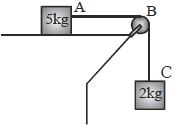
A trolley of mass $5\,kg$ on a horizontal smooth surface is pulled by a load of mass $2\,kg$ by means of uniform rope $ABC$ of length $2\,m$ and mass $ 1\,kg.$ As the load falls from $BC = 0$ to $BC = 2\,m,$ its acceleration in $m/s^2$ changes from
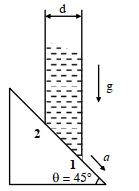
A cylindrical tube, with its base as shown in the figure, is filled with water. It is moving down with a constant acceleration $a$ along a fixed inclined plane with angle $\theta=45^{\circ} . P_1$ and $P_2$ are pressures at points 1 and 2 , respectively, located at the base of the tube. Let $\beta=\left(P_1-P_2\right) /(\rho g d)$, where $\rho$ is density of water, $d$ is the inner diameter of the tube and $g$ is the acceleration due to gravity. Which of the following statement($s$) is(are) correct?

$(A)$ $\beta=0$ when $a= g / \sqrt{2}$

$(B)$ $\beta>0$ when $a= g / \sqrt{2}$

$(C)$ $\beta=\frac{\sqrt{2}-1}{\sqrt{2}}$ when $a= g / 2$

$(D)$ $\beta=\frac{1}{\sqrt{2}}$ when $a= g / 2$

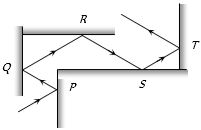
Following figure shows the multiple reflections of a light ray along a glass corridor where the walls are either parallel or perpendicular to one another. If the angle of incidence at point $P$ is $30^o $, what are the angles of reflection of the light ray at points $Q, R, S$ and $T$ respectively
Snow is more heat insulating than ice, because