Question
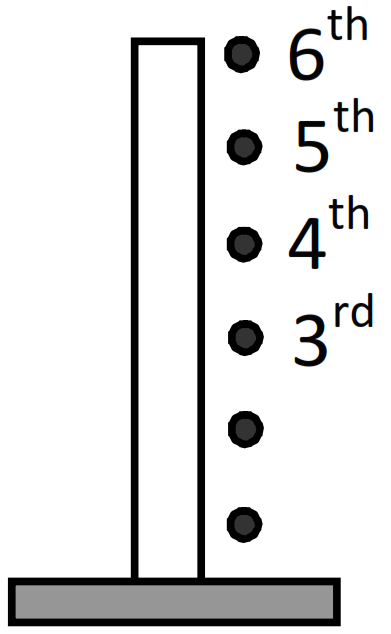
A person sitting on the top of a tall building is dropping balls at regular intervals of one second. Find the positions of the $3^{rd}, 4^{th}$ and $5^{th}$ ball when the $6^{th}$ ball is being dropped.
Answer

For every ball, $u = 0, a = g = 9.8m/s^2$
$\therefore 4^{th}$ ball move for $2 \sec$, $5^{th}$ ball $1 \sec$ and $3^{rd}$ ball $3 \sec$ when $6^{th}$ ball is being dropped.
For $3^{rd}$ ball t = 3 sec$\text{S}_3=\text{ut}+\frac{1}{2}\text{at}^2=0+\frac{1}{2}(9.8)3^2=4.9\text{m}$ below the top.
For $4^{th}$ ball, t = 2 sec$\text{S}_2=0+\frac{1}{2}\text{ gt}^2=\frac{1}{2}(9.8)2^2=19.6\text{m}$ below the top (u = 0)
For $5^{th}$ ball, t = 1 sec$\text{S}_3=\text{ut}+\frac{1}{2}\text{at}^2=0+\frac{1}{2}(9.8)\text{t}^2=4.98\text{m}$ below the top.

Need a full question paper?

Generate a complete, print-ready paper with questions like this in minutes — across 16+ boards, with answer keys.
Start Generating Free

Similar questions

Calculate the heat required to convert $3kg$ of ice at $-12^\circ C$ kept in a calorimeter to steam at $100^\circ C$ at atmospheric pressure.
Given specific heat capacity of ice $= 2100 \ J \ kg^{-1} \ K^{-1}$,
specific heat capacity of water $= 4186 \ J \ kg^{-1}\ K^{-1}$,
latent heat of fusion of ice $= 3.35 \times 10^5  \ J \ kg^{-1}$
and latent heat of steam $= 2.256 \times 10^6 \ J \ kg^{-1}$. (No heat is absorbed by the calorimeter).
State and prove the law of conservation of angular momentum.
The mass of a box measured by a grocer’s balance is $2.300\ kg$. Two gold pieces of masses $20.15g$ and $20.17g$ are added to the box. What is
  1. The total mass of the box,
  2. The difference in the masses of the pieces to correct significant figures
Three equal masses m are placed at the corners of an equilateral triangle of side a. What is the work done in doing this?
The time period of a mass hanging from an ideal spring is 2 seconds. If along with it 2 kg if the mass is added and the time period becomes 3 seconds find the value of $m$.
A rod of mass m and length L, lying horizontally, is free to rotate about a vertical axis through its centre. A horizontal force of constant magnitude F acts on the rod at a distance of $\frac{\text{L}}{4}$ from the centre. The force is always perpendicular to the rod. Find the angle rotated by the rod during the time (t) after the motion starts.
A body is moving with uniform acceleration. Set up an expression for the distance travelled by it in 1 second.
A uniformly moving cricket ball is turned back by hitting it with a bat for a very short time interval. Show the variation of its acceleration with time. (Take acceleration in the backward direction as positive).
Explain the Doppler's effect.
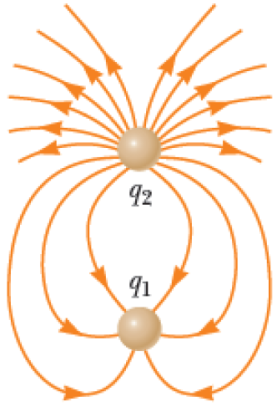
Consider the situation shown in figure. What are the signs of $q_1$ and $q_2$? If the lines are drawn in proportion to the charge, what is the ratio $\frac{\text{q}_1}{\text{q}_2}?$