Question
Explain the Doppler's effect.

Answer

Whenever there is a relative motion between a source of sound and the listener, the apparent frequencies of sound heard by the listener is different from the actual frequency of sound emitted by the source.
For sound the observed frequency v' is given by
$\text{v}'=\Big(\frac{v+v_0}{v+v_\text{s}}\Big)\text{v}$

Need a full question paper?

Generate a complete, print-ready paper with questions like this in minutes — across 16+ boards, with answer keys.
Start Generating Free

Similar questions

Two capacitors of capacitances $4.0\mu\text{F}$ and $6.0\mu\text{F}$ are connected in series with a battery of 20V. Find the energy supplied by the battery.
A coil of inductance $5.0\ mH$ and negligible resistance is connected to the oscillator of the previous problem. Find the peak currents in the circuit for $\omega=100\text{s}^{-1},500\text{s}^{-1},1000\text{s}^{-1}.$
A ball is given a speed v on a rough horizontal surface. The ball travels through a distance l on the surface and stops.
  1. What are the initial and final kinetic energies of the ball?
  2. What is the work done by the kinetic friction?
A refrigerator has to transfer an average of 263J of heat per second from temperature -10°C to 25°C. Calculate the average power consumed assuming ideal reversible cycle and no other losses.
A cylindrical wooden block of cross-section $15.0cm$? and $230$ grams is floated over water with an extra weight $50$ grams attached to its bottom. The cylinder floats vertically. From the state of equilibrium, it is slightly depressed and released. If the specific gravity of wood is $0.3$ and $g = 9.8ms^{-2}$, deduce the frequency of oscillation of the block.
Two rods A and B are of equal length. Each rod has its ends at temperatures $T_1$ and $T_2$. What are the conditions that will ensure equal rates of flow of heat through the rods A and B?
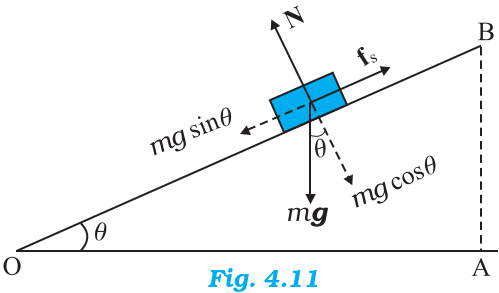
See Fig. 4.11. A mass of 4 kg rests on a horizontal plane. The plane is gradually inclined until at an angle θ = 15° with the horizontal, the mass just begins to slide. What is the coefficient of static friction between the block and the surface ?
Image
A ball of mass m, moving with a speed $2v_0$, collides inelastically $(e > 0)$ with an identical ball at rest. Show that: For head-on collision, both the balls move forward.
A wave pulse is travelling on a string of linear mass density $1.0 g / cm$ under a tension of 1 kg wt. Calculate time taken by the pulse to travel a distance of 50 cm on the string. Take $g =10 m / s ^2$.
A wire cable $10m$ long consists of $40$ strands of steel each $5 \times 10^{-6}m^2$ in cross-section. By how much does the cable stretch when it is used to lift a crate weighing $4000N$? Young's modulus of steel = $20 \times 10^{10}Nm^{-2}​​​​​​​$.