MCQ
A photocell is illuminated by a small bright source placed $d\; m$ away. When the same source of light is placed $\frac{d}{2}\;m$ away, the number of electrons emitted by photo cathode would
  • A
    Decrease by a factor of $ 2$
  • B
    Increase by a factor of $ 2$
  • C
    Decrease by a factor of $4$
  • Increase by a factor of $4$

Answer

Correct option: D.
Increase by a factor of $4$
d
(d) Number of photoelectrons $\propto$ $\frac{1}{{{{({\rm{Distance}})}^2}}}$.

Need a full question paper?

Generate a complete, print-ready paper with questions like this in minutes — across 16+ boards, with answer keys.

Start Generating Free

Similar questions

The electric field inside a hollow conducting sphere:
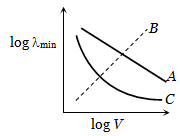
The dependence of the short wavelength limit $\lambda_{\min }$ on the accelerating potential V is represented by the curve of figure
Two inductors $L_1$ (inductance $1 \mathrm{mH}$, internal resistance $3 \Omega$ ) and $L_2$ (inductance $2 \mathrm{mH}$, internal resistance $4 \Omega$ ), and a resistor $R$ (resistance $12 \Omega$ ) are all connected in parallel across a $5 \mathrm{~V}$ battery. The circuit is switched on at time $t=0$. The ratio of the maximum to the minimum current $\left(I_{\max } / I_{\min }\right)$ drawn from the battery is
Two resistances R and 2R are connected in parallel in an electric circuit. The thermal energy developed in R and 2R are in the ratio:
Two identical balls having like charges and placed at a certain distance apart repel each other with a certain force. They are brought in contact and then moved apart to a distance equal to half their initial separation. The force of repulsion between them increases $4.5$ times in comparison with the initial value. The ratio of the initial charges of the balls is
A transistor oscillator is
$(i)$ an amplifier with positive feedback $(ii)$ an amplifier with reduced gain $(iii)$ the one in which $dc$ supply energy is converted into an output energy. Then
If a brass bar is placed on a vibrating magnet, then its time period
The photoelectric threshold wavelength for potassium (work function being $2eV$) is ........... $nm$
Sound waves in air cannot be polarized because:
The magnetic susceptibility is negative for