MCQ
The magnetic susceptibility is negative for
  • A
    Paramagnetic materials
  • Diamagnetic materials
  • C
    Ferromagnetic materials
  • D
    Paramagnetic and ferromagnetic materials

Answer

Correct option: B.
Diamagnetic materials
b
(b) The magnetic susceptibility indicates whether a material is repelled out or attracted of a magnetic field. It is negative only for diamagnetic material. It is positive for paramagnetic material and ferromagnetic material has large positive magnetic susceptibility

Need a full question paper?

Generate a complete, print-ready paper with questions like this in minutes — across 16+ boards, with answer keys.

Start Generating Free

Similar questions

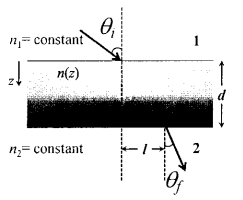
A transparent slab of thickness $d$ has a refractive index $n(z)$ that increases with $z$. Here $z$ is the vertical distance inside the slab, measured from the top. The slab is placed between two media with uniform refractive indices $n_1$ and $n_2\left(>n_1\right)$, as shown in the figure. $A$ ray of light is incident with angle $\theta_t$ from medium 1 and emerges in medium $2$ with refraction angle $\theta_f$ with a lateral displacement $l$.

Which of the following statement($s$) is(are) true?

($A$) , $n_1 \sin \theta_i=n_2 \sin \theta_f$

($B$) $n_1 \sin \theta_i=\left(n_2-n_1\right) \sin \theta_f$

($C$), $l$ is independent of $n_2$

($D$), $l$ is dependent on $n(z)$
An electron (charge = $1.6 \times {10^{ - 19}}$ $coulomb$) is accelerated through a potential of $1,00,000$ $volts$. The energy required by the electron is
If the magnification of optical instrument is negative, then the image will always be formed :
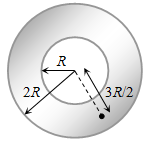
Figure shows the cross-sectional view of the hollow cylindrical conductor with inner radius 'R' and outer radius '2R', cylinder carrying uniformly distributed current along it's axis. The magnetic induction at point 'P' at a distance $\frac{3R}{2}$ from the axis of the cylinder will be
The breakdown in a reverse biased $p-n$ junction diode is more likely to occur due to.
What is the ratio of the polarization to $\varepsilon_0$ times the electric field called?
Image formed on the retina is
Let $P\left( r \right) = \frac{Q}{{\pi {R^4}}}r$ be the charge density distribution for a solid sphere of radius $R$ and total charge $Q$. For a point $P$ inside the sphere at distance $r_1$ from the centre of the sphere, the magnitude of electric field is
A shell is fired from a cannon with a velocity V at an angle $\theta$ with the horizontal direction. At the highest point in its path, it explodes into two pieces of equal masses. One of the pieces retraces its path to the cannon. The speed of the other piece immediately after the explosion is:
The cathode of a photoelectric cell is changed such that the work function changes from $W_1$ to $W_2\left(W_2>W_1\right)$. If the current before and after change are $\mathrm{I}_1$ and $\mathrm{I}_2$, all other conditions remaining unchanged, then (assuming $\mathrm{hn}>\mathrm{W}_2$ )