Question
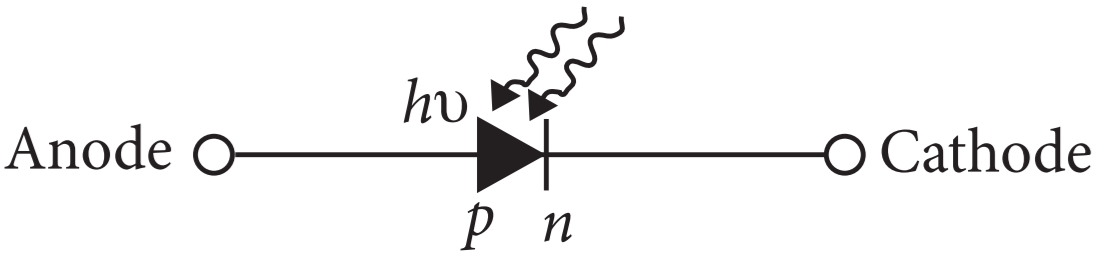
✓
Answer
- (c) 4000Â.
Explanation:
$\lambda_\text{max}=\frac{\text{hc}}{\text{E}}=\frac{6.6\times10^{-34}\times3\times10^8}{2.5\times1.6\times10^{-19}}$
= 5000Â
$\therefore\lambda=4000\widehat{\text{A}}<\lambda_\text{max}$
- (b) D2
Explanation:
Energy of incident photon, $\text{E}=\frac{\text{hc}}{\lambda}$
$=\frac{6.6\times10^{-34}\times3\times10^8}{6\times10^{-7}\times1.6\times10^{-19}}=2.06\text{eV}$
The incident radiation can be detected by a photodiode if energy of incident photon is greater than the band gap.
As D2 = 2eV, therefore D2 will detect these radiations.
- (a) Which is always operated in reverse bias.
Explanation:
Photodiode is a device which is always operated in reverse bias.
- (c) 2.48eV
Explanation:
Let Eg be the required bandwidth. Then
$\text{E}_\text{g}=\frac{\text{hc}}{\lambda}$
Here, he = 1240eV nm,
$\lambda=500\text{nm}$
$\therefore\text{E}_\text{g}=\frac{1240\text{eVnm}}{500\text{nm}}=2.48\text{eV}.$
- (a) Optical signals.
Explanation:
A photodiode is a device which is used to detect optical signals.
Need a full question paper?
Generate a complete, print-ready paper with questions like this in minutes — across 16+ boards, with answer keys.
Explore more
More "4 Marks Questions" from Semiconductor Electronic: Material, Devices And Simple Circuits→Semiconductor Electronic: Material, Devices And Simple Circuits — all question types→Physics STD 12 Science question papers→Gujarat Board STD 12 Science question papers→Gujarat Board question paper generator→
Similar questions
Explais the arrangements for conducting an experimental study of the photoelectric effect.
Ampere's law gives a method to calculate the magnetic field due to given current distribution. According to it, the circulation $\oint\vec{\text{B}}.\text{d}\vec{\text{l}}$ di of the resultant magnetic field along a closed plane curve is equal to $\mu_0$ times the total current crossing the area bounded by the closed curve provided the electric field inside the loop remains constant. Ampere's law is more useful under certain synunetrical conditions. Consider one such case of a long Straight wire with circular cross-section (radius R) carrying current f uniformly distributed across this cross-section.
→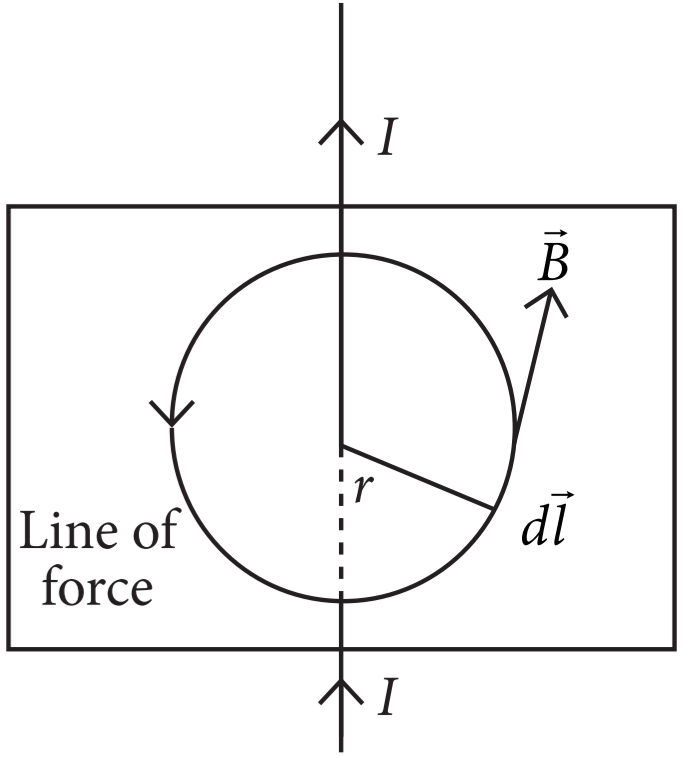
- The magnetic field at a radial distance r from the centre of the wire in the region r > R, is:
- $\frac{\mu_0\text{I}}{2\pi\text{r}}$
- $\frac{\mu_0\text{I}}{2\pi\text{R}}$
- $\frac{\mu_0\text{IR}^2}{2\pi\text{r}}$
- $\frac{\mu_0\text{Ir}^2}{2\pi\text{R}}$
- The magnetic field at a distance r in the region r < R is:
- $\frac{\mu_0\text{I}}{2\text{r}}$
- $\frac{\mu_0\text{Ir}^2}{2\pi\text{R}^2}$
- $\frac{\mu_0\text{I}}{2\pi\text{r}}$
- $\frac{\mu_0\text{Ir}}{2\pi\text{R}^2}$
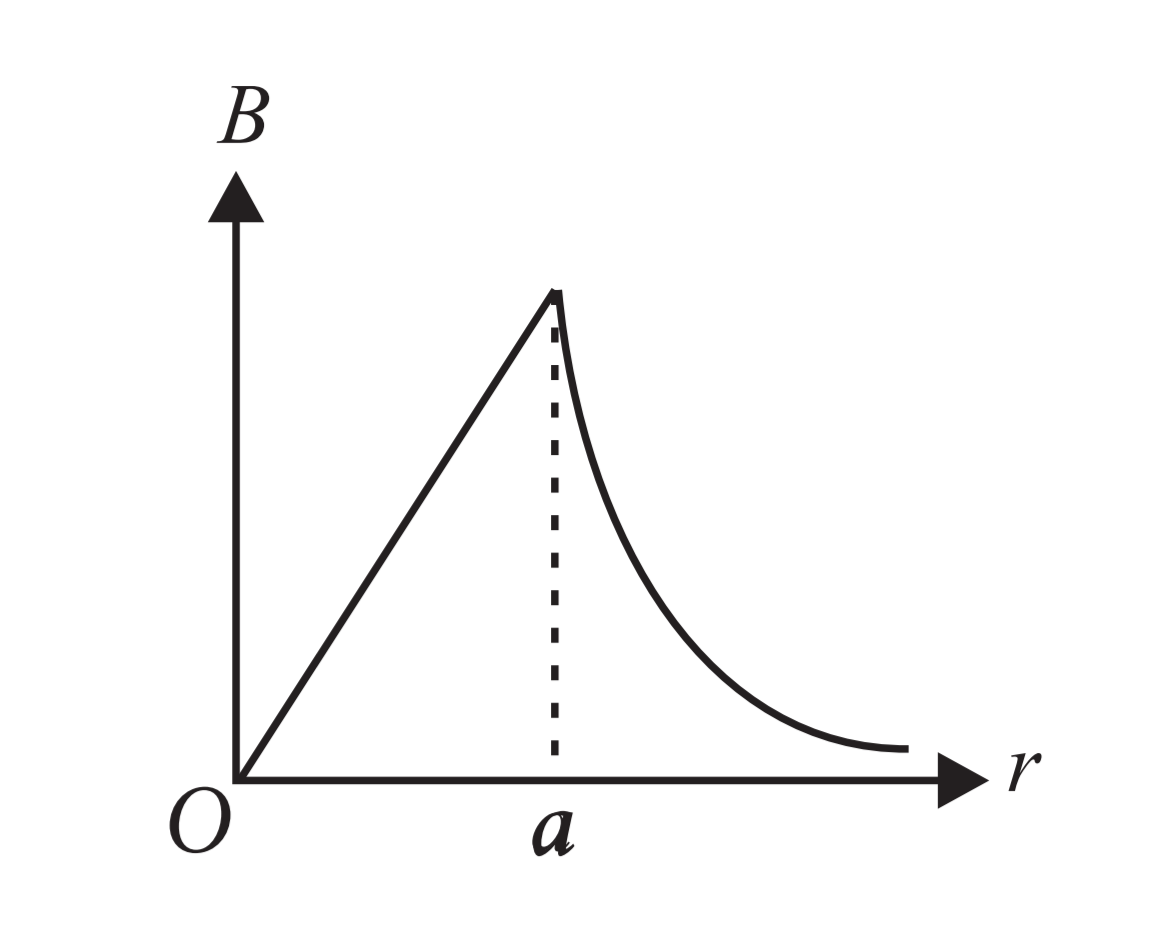
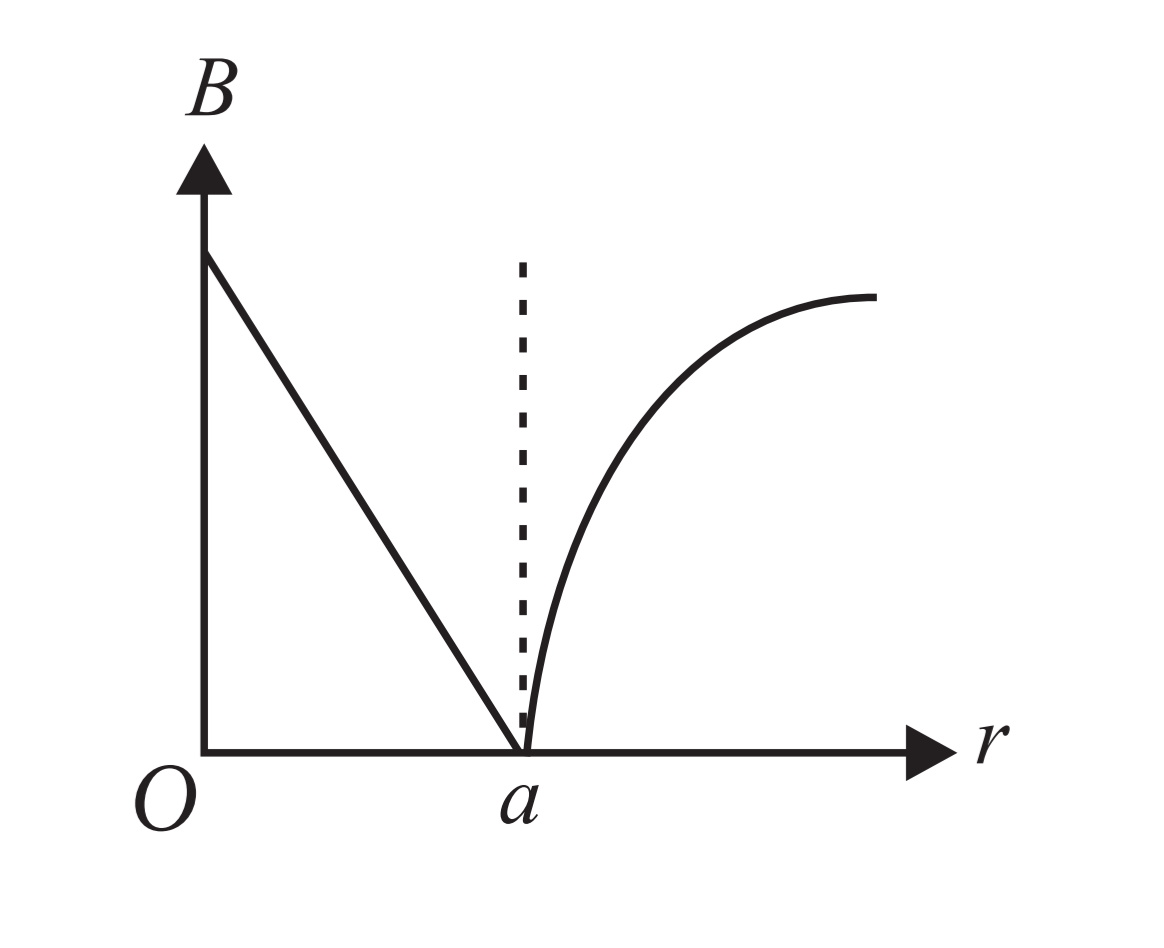
- A long straight wire of a circular cross section (radius a) carries a steady current I and the current I is uniformly distributed across this cross-section. Which of the following plots represents the variation of magnitude of magnetic field B with distance r from the centre of the wire?
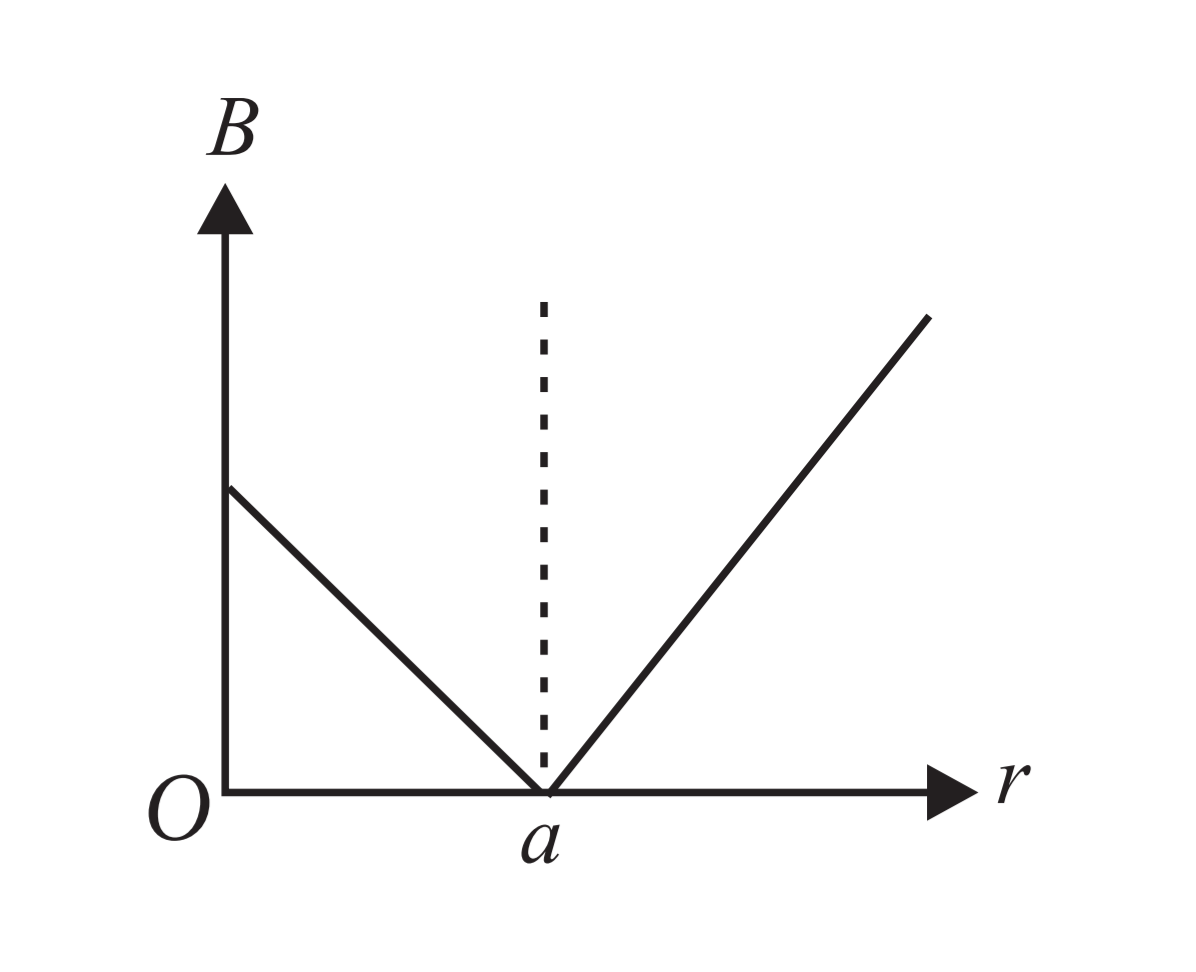
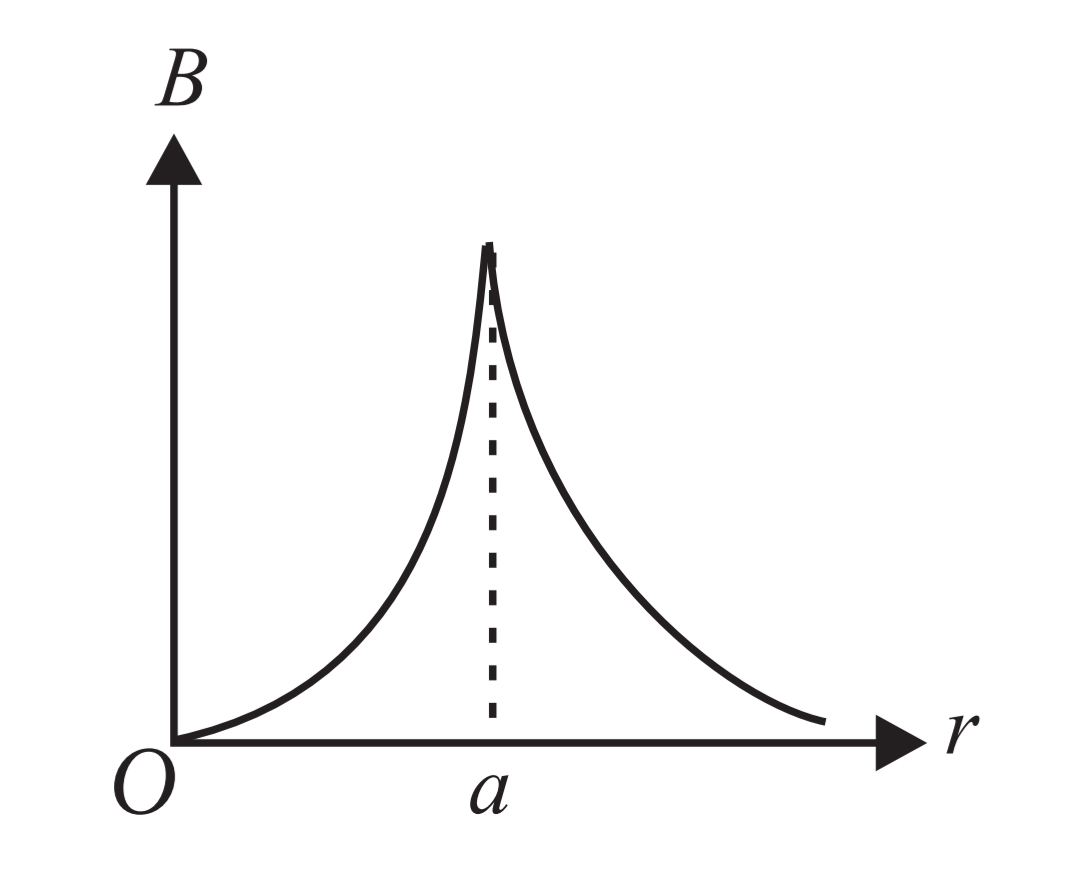
- A long straight wire of radius R carries a steady current I. The current is uniformly distributed across its cross-section. The ratio of magnetic field at $\frac{\text{R}}{2}$ and 2R is:
- $\frac{\text{1}}{\text{2}}$
- $2$
- $\frac{\text{1}}{\text{4}}$
- $1$
- A direct current I flows along the length of an infinitely long straight thin walled pipe, then the magnetic field is:
- Uniform throughout the pipe but not zero.
- Zero only along the axis of the pipe.
- Zero at any point inside the pipe.
- Maximum at the centre and minimum at the edges.
Figure shows a series LCR circuit connected to a variable frequency 230 V source.
$\begin{array}{r}
L=5.0 H \cdot C=80 \mu F, R=40 \Omega \\
R=40 \Omega
\end{array}$
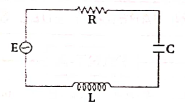
(a) Determine the source frequency which drives the circuit in resonance.
(b) Obtain the impedance of the circuit and the amplitude of current at the resonating frequency.
(c) Determine the rms potential drops across the three elements of the circuit. Show that the potential drop across the LC combination is zero at the resonating frequency.
→$\begin{array}{r}
L=5.0 H \cdot C=80 \mu F, R=40 \Omega \\
R=40 \Omega
\end{array}$
(a) Determine the source frequency which drives the circuit in resonance.
(b) Obtain the impedance of the circuit and the amplitude of current at the resonating frequency.
(c) Determine the rms potential drops across the three elements of the circuit. Show that the potential drop across the LC combination is zero at the resonating frequency.
The charge enclosed by a spherical Gaussian surface is $8.85 \times 10^{-8}$ Coulomb. Calculate (a) the electric flux emerging out of the Gaussian surface, (b) what will be the change in electric flux if the radius of the Gaussian surface is doubled?
→In the derivation of P1 - P2 = Pgz, it was assumed that the liquid is incompressible. Why will this equation not be strictly valid for a compressible liquid?
A child has near point at 10cm. What is the maximum angular magnification the child can have with a convex lens of focal length 10cm?
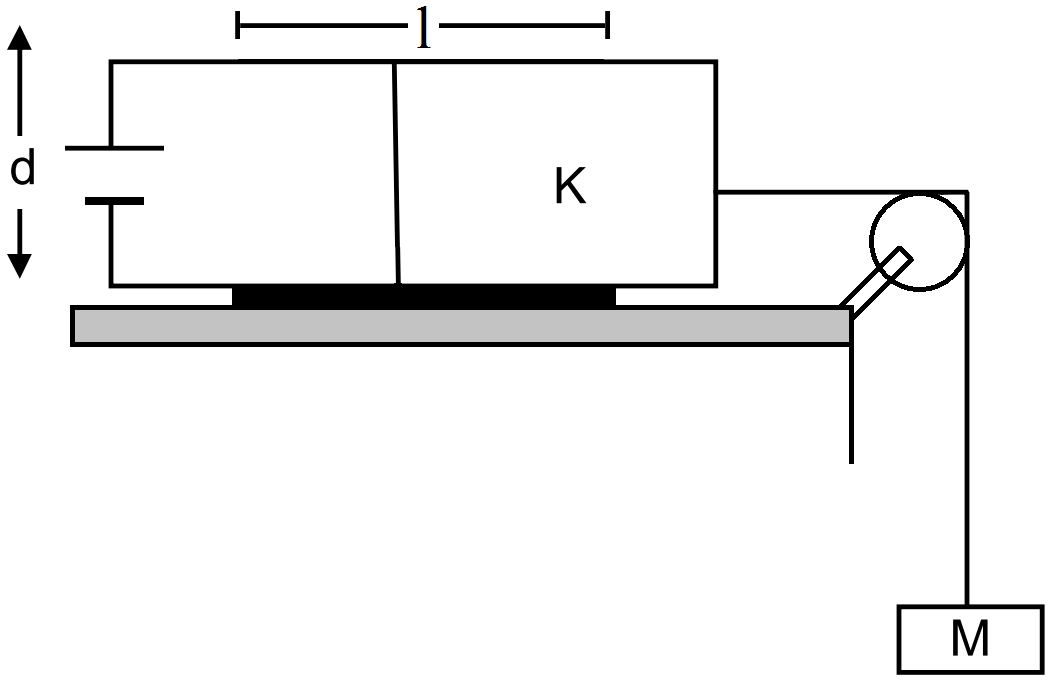
Consider the situation shown in figure. The width of each plate is b. The capacitor plates are rigidly clamped in the laboratory and connected to a battery of emf $\in.$ All surfaces are frictionless. Calculate the value of M for which the dielectric slab will stay in equilibrium.
→Consider a gravity-free hall in which an experimenter of mass 50kg is resting on a 5kg pillow, 8ft above the floor of the hall. He pushes the pillow down so that it starts falling at a speed of 8ft/s. The pillow makes a perfectly elastic collision with the floor, rebounds and reaches the experimenter's head. Find the time elapsed in the process.
Suppose you are inside the water in a swimming pool near an edge. A friend is standing on the edge. Do you find your friend taller or shorter than his usual height?