MCQ
A photoelectric material having work-function $\phi_0$ is illuminated with light of wavelength $\lambda\left(\lambda<\frac{\mathrm{hc}}{\phi_0}\right)$. The fastest photoelectron has a de Broglie wavelength $\lambda_d$. A change in wavelength of the incident light by $\Delta \lambda$ results in change $\Delta \lambda_{\mathrm{d}}$ in $\lambda_{\mathrm{d}}$. then the ratio $\Delta \lambda_{\mathrm{d}} / \Delta \lambda$ is proportional to
  • A
    $\lambda_d / \lambda$
  • B
    $\lambda_{\mathrm{d}}^2 / \lambda$
  • C
    $\lambda_d^3 / \lambda$
  • $\lambda_{\mathrm{d}}^3 / \lambda^2$

Answer

Correct option: D.
$\lambda_{\mathrm{d}}^3 / \lambda^2$
d
$\frac{\mathrm{P}^2}{2 \mathrm{~m}}=\frac{\mathrm{hc}}{\lambda}-\phi_0$

$\frac{\mathrm{h}^2}{2 \mathrm{~m} \cdot \lambda_{\mathrm{D}}^2}=\frac{\mathrm{hc}}{\lambda}-\phi_0$

$-\frac{\mathrm{h}^2}{\mathrm{~m}} \frac{1}{\lambda_{\mathrm{D}}^3} \mathrm{~d} \lambda_{\mathrm{D}}=\frac{\mathrm{hc}}{\lambda^2} \mathrm{~d} \lambda$

$\frac{\Delta \lambda_{\mathrm{D}}}{\Delta \lambda} \propto \frac{\lambda_{\mathrm{D}}^3}{\lambda^2}.$

Need a full question paper?

Generate a complete, print-ready paper with questions like this in minutes — across 16+ boards, with answer keys.

Start Generating Free

Similar questions

An electron and a proton are moving on straight parallel paths with same velocity. They enter a semi-infinite region of uniform magnetic field perpendicular to the velocity. Which of the following statement$(s)$ is/are true?

$(A)$ They will never come out of the magnetic field region.

$(B)$ They will come out travelling along parallel paths.

$(C)$ They will come out at the same time.

$(D)$ They will come out at different times.

Three equal charges $+q$ are placed at the three vertices of an equilateral triangle centred at the origin. They are held in equilibrium by a restoring force of magnitude $F(r)=k r$ directed towards the origin, where $k$ is a constant. What is the distance of the three charges from the origin?
A proton and an electron have the same de Broglie wavelength. If $K_p$ and $K_e$ be the kinetic energies of proton and electron respectively. Then choose the correct relation :
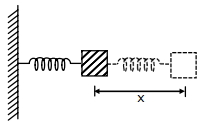
The motion of a mass on a spring, with spring constant ${K}$ is as shown in figure. The equation of motion is given by $x(t)= A sin \omega t+ Bcos\omega t$ with $\omega=\sqrt{\frac{K}{m}}$ Suppose that at time $t=0$, the position of mass is $x(0)$ and velocity $v(0)$, then its displacement can also be represented as $x(t)=C \cos (\omega t-\phi)$, where $C$ and $\phi$ are
Triple point of water is
A chain reaction is continuous due to
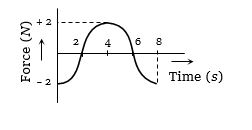
The force-time $(F -t) $ curve of a particle executing linear motion is as shown in the figure. The momentum acquired by the particle in time interval from zero to $8$ second will be  ........... $N-s$
Three identical capacitors are combined differently. For the same voltage to each combination, the one that stores the greatest energy is
If the refractive index of a material of equilateral prism is $\sqrt 3 $, then angle of minimum deviation of the prism is......$^o$
When a plane mirror is placed horizontally on a level ground at a distance of $60m$ from the foot of a tower, the top of the tower and its image in the mirror subtend an angle of $90^\circ $ at the eye. The height of the tower will be.....$m$