Question
A physical quantity is measured and the result is expressed as nu where u is the unit used and n is the numerical value. If the result is expressed in various units then:
  1. $\text{n}\propto\text{size of u}$
  2. $\text{n}\propto\text{u}^2$
  3. $\text{n}\propto\sqrt{\text{u}}$
  4. $\text{n}\propto\frac{1}{\text{u}}$
Answer

  1. $\text{n}\propto\frac{1}{\text{u}}$
Explanation:

The larger the unit used to express the physical quantity, the lesser will be the numerical value.

Example: 1kg of sugar can be expressed as 1000g or 10000mg of sugar.

Here, g (gram) is the larger quantity as compared to mg (milligram), but the numerical value used with gram is lesser than the numerical value used with milligram.

Need a full question paper?

Generate a complete, print-ready paper with questions like this in minutes — across 16+ boards, with answer keys.

Start Generating Free

Similar questions

Read the passage given below and answer the following questions from (i) to (v). There are no physical examples of absolutely pure simple harmonic motion. In practice we come across systems that execute simple harmonic motion approximately under certain conditions. Oscillations due to a spring: The simplest observable example of simple harmonic motion is the small oscillations of a block of mass m fixed to a spring, which in turn is fixed to a rigid wall. The block is placed on a frictionless horizontal surface. If the block is pulled on one side and is released, it then executes a to and fro motion about the mean position. Let x = 0, indicate the position of the centre of the block when the spring is in equilibrium. The positions marked as –A and +A indicate the maximum displacements to the left and the right of the mean position. We have already learnt that springs have special properties, which were first discovered by the English physicist Robert Hooke. He had shown that such a system when deformed is subject to a restoring force, the magnitude of which is proportional to the deformation or the displacement and acts in opposite direction. This is known as Hooke’s law. It holds good for displacements small in comparison to the length of the spring. At any time t, if the displacement of the block from its mean position is x, the restoring force F acting on the block is, F(x) = –k x The constant of proportionality, k, is called the spring constant, its value is governed by the elastic properties of the spring. A stiff spring has large k and a soft spring has small k. Equation is same as the force law for SHM and therefore the system executes a simple harmonic motion.Damped oscillations
We know that the motion of a simple pendulum, swinging in air, dies out eventually. Why does it happen? This is because the air drag and the friction at the support oppose the motion of the pendulum and dissipate its energy gradually. The pendulum is said to execute damped oscillations. In damped oscillations, the energy of the system is dissipated continuously; but, for small damping, the oscillations remain approximately periodic. The dissipating forces are generally the frictional forces. The damping force is generally proportional to velocity of the bob and acts opposite to the direction of velocity. If the damping force is denoted by $F_d$, we have $F_d = –b_v$ where the positive constant b depends on characteristics of the medium (viscosity, for example) and the size and shape of the block, is usually valid only for small velocity.
  1. Damping force is directly proportional to:
  1. Velocity
  2. Area
  3. Acceleration
  4. None of these
  1. Oscillations due to spring performs SHM for:
  1. Only small oscillations of spring
  2. Only for large oscillations of spring
  3. Both large as well as small oscillations of spring
  4. None of these
  1. Give expression for restoring force in spring while performing small SHM oscillations.
  2. Explain damped oscillations.
  3. Explain oscillations due to spring.
Certain collisions are referred to as elastic collisions. Elastic collisions are collisions in which both momentum and kinetic energy are conserved. The total system kinetic energy before the collision equals the total system kinetic energy after the collision. If total kinetic energy is not conserved, then the collision is referred to as an inelastic collision.
The coefficient of restitution, denoted by (e), is the measure of degree elasticity of collision. It is defined as the ratio of the final to inital relative speed between two objects after they collide. It normally ranges from 0 to 1 where 1 would be a perfectly elastic collision. A perfectly inelastic collision has a coefficient of 0 . In real life most of the collisions are neither perfectly elastic nor perfectly inealstic and $0< e <1$.

1. The following are the data of a collision between a truck and a car.
Mass of the car $=1000 kg$
Mass of the truck $=3000 kg$
Mass of the truck Before collision:
Speed of the car $=20 m / s$
Momentum of the car $=20000 kg m / s$
Speed of the truck $=20 m / s$
Momentum of the truck $=60000 kg m / s$
After collision:
Speed of the car $=40 m / s$ in the opposite direction
Momentum of the car $=40000 kg m / s$ in the opposite direction
Speed of the truck $=0$
Momentum of the truck $=0$
The collision is
(a) Both elastic since kinetic energy and momentum is conserved
(b) Elastic since momentum is conserved
(c) Inelastic since kinetic energy is conserved
(d) Elastic since kinetic energy is conserved
2. The coefficient of restitution is the measure of
(a) Malleability of a substance    (b) Conductivity of a substance
(c) degree of elasticity of collision    (d) Elasticity of a substance
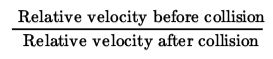
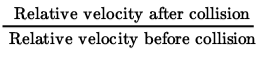
3. Coefficient of restitution is defined as
(a) 
Image
(b) Relative velocity after collision x relative velocity before collision
(c) Relative velocity after collision + relative velocity before collision
(d) 
Image
OR
In real life most of the collisions are
(a) Range of coefficient of restitution is 0 < e < 1
(b) both neither perfectly nor perfectly inelastic and range of coefficient of restitution is 0 < e < 1.
(c) neither perfectly elastic nor perfectly inelastic
(d) perfectly inelastic
4. For perfectly elastic and perfectly inelastic collision, the value of coefficient of restitution are respectively
(a) $+1,-1$    (b) 0,1    (c) $0,-1$    (d) 1,0
The weight Mg of an extended body is generally shown in a diagram to act through the centre of mass. Does it mean that the earth does not attract other particles?
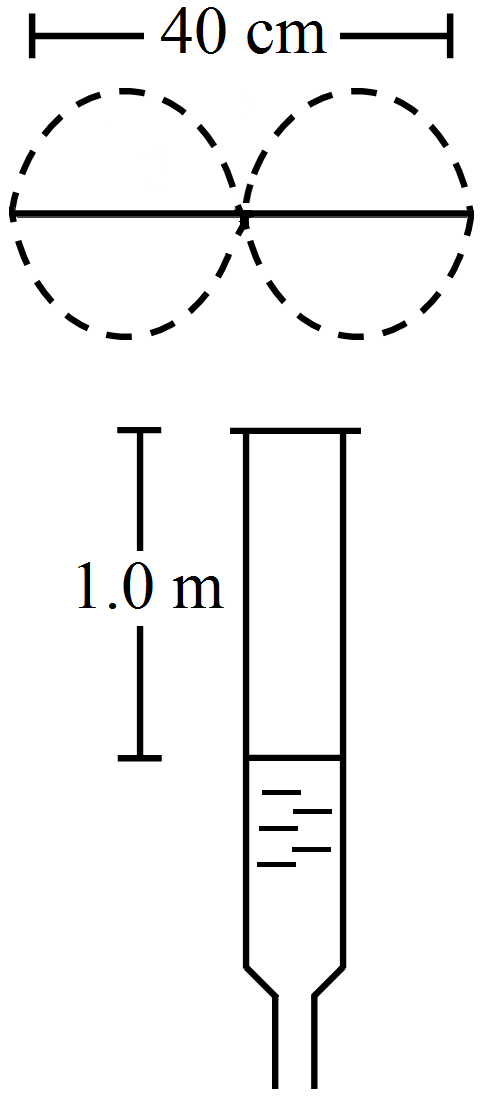
Consider the situation shown in figure. The wire which has a mass of $4.00g$ oscillates in its second harmonic and sets the air column in the tube into vibrations in its fundamental mode. Assuming that the speed of sound in air is $340m/s$, find the tension in the wire.
A police jeep is chasing a culprit going on a motorbike. The motorbike crosses a turning at a speed of $72km/h$. The jeep follows it at a speed of $90km/h$, crossing the turning ten seconds later than the bike. Assuming that they travel at constant speeds, how far from the turning will the jeep catch up with the bike?
 
Read the passage given below and answer the following questions from $(i)$ to $(v)$. All engineering phenomena deal with definite and measured quantities and so depend on the making of the measurement. We must be
clear and precise in making these measurements. To make a measurement, magnitude of the physical quantity (unknown) is compared.
The record of a measurement consists of three parts, i.e. the dimension of the quantity, the unit which represents a standard quantity and a number which is the ratio of the measured quantity to the standard quantity.
  1. A device which is used for measurement of length to an accuracy of about $10^{-5}m$, is:
  1. Screw gauge
  2. Spherometer
  3. Vernier callipers
  4. Either $(a)$ or $(b)$
  1. Which of the technique is not used for measuring time intervals?
  1. Electrical oscillator
  2. Atomic clock
  3. Spring oscillator
  4. Decay of elementary particles
  1. The mean length of an object is 5cm. Which of the following measurements is most accurate?
  1. $4.9\ cm$
  2. $4.805\ cm$
  3. $5.25\ cm$
  4. $5.4\ cm$
  1. If the length of rectangle $l = 10.5\ cm,$ breadth $b = 2.1\ cm$ and minimum possible measurement by scale$ = 0.1\ cm,$ then the area is:
  1. $22.0\ cm^2$
  2. $21.0\ cm^2$
  3. $22.5\ cm^2$
  4. $21.5\ cm^2$
  1. Age of the universe is about $10^{10}$ yr, whereas the mankind has existed for $10^6$ yr. For how many seconds would the man have existed, if age of universe were $1$ day?
  1. $9.2\ s$
  2. $10.2\ s$
  3. $8.6\ s$
  4. $10.5\ s$
Show that the magnetic field at a point due to a magnetic dipole is perpendicular to the magnetic axis if the line joining the point with the centre of the dipole makes an angle of $\tan^{-1}(\sqrt{2})$ with the magnetic axis.
A bar magnet has a length of 8cm. The magnetic field at a point at a distance 3cm from the centre in the broadside-on position is found to be $4\times10^{-6}T$. Find the pole strength of the magnet.
In a microwave oven, the food is kept in a plastic container and the microwave is directed towards the food. The food is cooked without melting or igniting the plastic container. Explain.
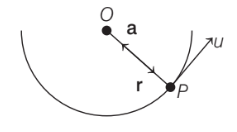
Read the passage given below and answer the following questions from (i) to (v). When an object follows a circular path at a constant speed, the motion of the object is called uniform circular motion. The word
uniform refers to the speed which is uniform (constant) throughout the motion. Although the speed does not vary, the particle is accelerating because the velocity changes its direction at every point on the circular track. The figure shows a particle P which moves along a circular track of radius r with a uniform speedu.
  1. A circular motion:
  1. Is one-dimensional motion.
  2. Is two-dimensional motion.
  3. It is represented by combination of two variable vectors.
  4. Both (b) and (c)
  1. For a particle performing uniform circular motion, choose the incorrect statement from the following.
  1. Magnitude of particle velocity (speed) remains constant.
  2. Particle velocity remains directed perpendicular to radius vector.
  3. Direction of acceleration keeps changing as particle moves.
  4. Angular momentum is constant in magnitude but direction keeps changing.
  1. Two cars A and B move along a concentric circular path of radius $r_A$ and $r_B$ with velocities $v_A$ and $v_B$ maintaining constant distance, then $\frac{\text{v}_{\text{A}}}{\text{v}_\text{B}}$ is equal to:
  1. $\frac{\text{r}_{\text{B}}}{\text{r}_\text{A}}$
  2. $\frac{\text{r}_{\text{A}}}{\text{r}_\text{B}}$
  3. $\frac{\text{r}_{\text{A}}^2}{\text{r}_\text{B}^2}$
  4. $\frac{\text{r}_{\text{B}}^2}{\text{r}_\text{A}^2}$
  1. A car runs at a constant speed on a circular track of radius 100m, taking 62.8s for every circular lap. The average velocity and average speed for each circular lap, respectively is:
  1. $0,0$
  2. $0,10ms^{-1}$
  3. $10ms^{-1}, 10ms^{-1}$
  4. $10ms^{-1}, 0$
  1. A particle is revolving at 1200 rpm in acircle of radius 30cm. Then, its acceleration is:
  1. $1600ms^{-2}$
  2. $4740ms^{-2}$
  3. $2370ms^{-2}$
  4. $5055ms^{-2}$