Question
A physical quantity which has a direction

Answer

Time, pressure, surface tension, current, etc, are some such physical quantities which have direction but are not vectors. Hence, a physical quantity having a direction may or may not be a vector.

Need a full question paper?

Generate a complete, print-ready paper with questions like this in minutes — across 16+ boards, with answer keys.
Start Generating Free

Similar questions

A block rests on a rough inclined plane making an angle of ${30^o}$ with the horizontal. The coefficient of static friction between the block and the plane is $0.8$. If the frictional force on the block is $10 \,N$, the mass of the block (in kg) is (take $g = 10\,\,m/{s^2})$
A body is released from the top of a tower of height $h$. It takes $t$ sec to reach the ground. Where will be the ball after time $t/2$ sec
A tennis ball is dropped on a horizontal smooth surface. It bounces back to its original position after hitting the surface. The force on the ball during the collision is proportional to the length of compression of the ball. Which one of the following sketches describes the variation of its kinetic energy $K$ with time $t$ most appropriately? The figures are only illustrative and not to the scale.
An electric dipole of moment $\vec p$ is kept in a uniform electric field $\vec E$. Angle between $\vec p$ and $\vec E$ is $30^o$. Calculate work done by field when angle is increased to $60^o.$
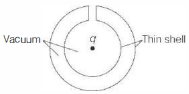
A positive charge $q$ is placed at the centre of a neutral hollow cylindrical conducting shell with its cross-section as shown in the figure below. Which one of the following figures correctly indicates the induced charge distribution on the conductor? (Ignore edge effects)
Two wires $A$ and $B$ of same length, same area of cross-section having the same Young's modulus are heated to the same range of temperature. If the coefficient of linear expansion of $A$ is $3/2$ times of that of wire $B$. The ratio of the forces produced in two wires will be
Main scale division of vernier calliper is $1\ mm$ and vernier scale division are in $A.P. ; 1^{st}$ division is $0.95\ mm$ ; $2^{nd}$ division is $0.9\ mm$ and so on. When an object is placed between jaws of vernier calliper, zero of vernier lies between $3.1\ cm$ and $3.2\ cm$ and $4^{th}$ division of vernier coincide with main scale division. Reading of vernier is  .......... $cm$
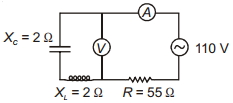
The reading of ammeter in the circuit is ............ $A$
A horizontal force of $40\,N$ is applied to a $5\, kg$ block which is at rest on the horizontal surface. If the coefficient of kinetic friction is $0.4$, then the acceleration of the block is ........ $m/s^2$ $(g = 10 \,m/s^2)$
Calculate the angle of minimum deviation for an equilateral triangular prism of refractive index $\sqrt 3$........$^o$