MCQ
A physical quantity $z$ depends on four observables $a,$ $b,$ $c$ and $d ,$ as $z =\frac{ a ^{2} b ^{\frac{2}{3}}}{\sqrt{ c } d ^{3}} .$ The percentage of error in the measurement of $a, b, c$ and $d$ are $2 \%, 1.5 \%, 4 \%$ and $2.5 \%$ respectively. The percentage of error in $z$ is$......\%$
  • A
    $12.5$
  • $14.5$
  • C
    $16.5$
  • D
    $13.5$

Answer

Correct option: B.
$14.5$
b
$\frac{\Delta Z}{Z}=\frac{2 \Delta a }{ a }+\frac{2}{3} \frac{\Delta b }{ b }+\frac{1}{2} \frac{\Delta c }{ c }+\frac{3 \Delta d }{ d }=14.5 \%$

Need a full question paper?

Generate a complete, print-ready paper with questions like this in minutes — across 16+ boards, with answer keys.

Start Generating Free

Similar questions

During constant temperature, we feel colder on a day when the relative humidity will be ....... $\%$
Two rings of radius $R$ and $nR$ having different masses and made up of same wire have the ratio of moment of inertia about an axis passing through centre as $1 : 8$. The value of $n$ is
A cylinder of $5$ litre capacity, filled with air at $N.T.P.$ is connected with another evacuated cylinder of $30$ litres of capacity. The resultant air pressure in both the cylinders will be ...... $cm$ of $Hg$
The specific heat of isothermal process is
Two vectors $\vec A$ and $\vec B$ have equal magnitudes. The magnitude of $(\vec A + \vec B)$ is $‘n’$ times the magnitude of $(\vec A - \vec B)$. The angle between $ \vec A$ and $\vec B$ is
A light and a heavy body have equal momenta. Which one has greater K.E
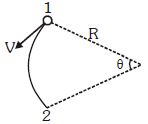
A ring of mass $m$ moves from point $1$ to point $2$ along a smooth rigid horizontal wire with a constant speed $v$. The average force acting the ring over the time of its motion from $1$ to $2$ is
The area of cross-section of a wire of length $1.1$ metre is $1$ $mm^2$. It is loaded with $1 \,kg.$ If Young's modulus of copper is $1.1 \times {10^{11}}\,N/{m^2}$, then the increase in length will be ......... $mm$ (If $g = 10\,m/{s^2})$
The amount of work done in blowing a soap bubble such that its diameter increases from $d$ to $D$ is ($T=$ surface tension of the solution)
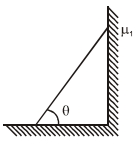
In the figure, a ladder of mass $m$ is shown leaning against a wall. It is in static equilibrium making an angle $\theta$ with the horizontal floor. The coefficient of friction between the wall and the ladder is $\mu_1$ and that between the floor and the ladder is $\mu_2$. The normal reaction of the wall on the ladder is $N_1$ and that of the floor is $N_2$. If the ladder is about to slip, then

$Image$

$(A)$ $\mu_1=0 \mu_2 \neq 0$ and $N _2 \tan \theta=\frac{ mg }{2}$

$(B)$ $\mu_1 \neq 0 \mu_2=0$ and $N_1 \tan \theta=\frac{m g}{2}$

$(C)$ $\mu_1 \neq 0 \mu_2 \neq 0$ and $N _2 \tan \theta=\frac{ mg }{1+\mu_1 \mu_2}$

$(D)$ $\mu_1=0 \mu_2 \neq 0$ and $N _1 \tan \theta=\frac{ mg }{2}$