A piece of glass is heated to a high temperature and then allowed to cool. If it cracks, a probable reason for this is the following property of glass
Easy


Download our appand get started for free
Experience the future of education. Simply download our apps or reach out to us for more information. Let's shape the future of learning together!No signup needed.*
Similar Questions
- 1View SolutionThe value of Stefan’s constant is
- 2A body cools from ${60^o}C$ to ${50^o}C$ in $10$ minutes when kept in air at ${30^o}C$. In the next $10$ minutes its temperature will beView Solution
- 3Two thermometers $A$ and $B$ are exposed in sun light. The valve of $A$ is painted black, But that of $B$ is not painted. The correct statement regarding this case isView Solution
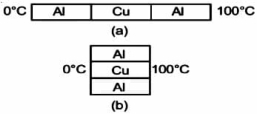
- 4The three rods shown in figure have identical dimensions. Heat flows from the hot end at a rate of $40 \,W$ in the arrangement $(a)$. Find the rates of heat flow when the rods are joined as in arrangement $(b)$ is ......... $W$ (Assume $K_al=200 \,W / m ^{\circ} C$ and $\left.K_{c u}=400 \,W / m ^{\circ} C \right)$View Solution
- 5If a liquid takes $30 \;sec$ in cooling from $80^{\circ} C$ to $70^{\circ} C$ and $70 \;sec$ in cooling from $60^{\circ} C$ to $50^{\circ} C$, then find the room temperature.View Solution
- 6One end of a copper rod of length $1.0\;m$ and area of cross-section ${10^{ - 3}}$ is immersed in boiling water and the other end in ice. If the coefficient of thermal conductivity of copper is $92\;cal/m{\rm{ - }}s{{\rm{ - }}^o}C$ and the latent heat of ice is $8 \times {10^4}cal/kg$, then the amount of ice which will melt in one minute isView Solution
- 7View SolutionWhile measuring the thermal conductivity of a liquid, we keep the upper part hot and lower part cool, so that
- 8In a certain planetary system, it is observed that one of the celestial bodies having a surface temperature of $200 \;K$, emits radiation of maximum intensity near the wavelength $12\; \mu m$. The surface temperature (in $K$) of a nearby star which emits light of maximum intensity at a wavelength $\lambda= 4800\;\mathring A$ isView Solution
- 9View SolutionOn a cold morning, a metal surface will feel colder to touch than a wooden surface because
- 10The coefficients of thermal conductivity of copper, mercury and glass are respectively $Kc, Km$ and $Kg$ such that $Kc > Km > Kg$ . If the same quantity of heat is to flow per second per unit area of each and corresponding temperature gradients are $Xc, Xm$ and $Xg$ , thenView Solution