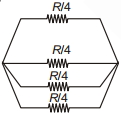
A piece of wire is cut into four equal parts and the pieces are bundled together side by side to form a thicker wire. Compared with that of the original wire, the resistance of the bundle is ..........
Easy


Download our appand get started for free
Experience the future of education. Simply download our apps or reach out to us for more information. Let's shape the future of learning together!No signup needed.*
Similar Questions
- 1View SolutionAssertion : Ohm's law is applicable for all conducting elements.
Reason : Ohm's law is a fundamental law
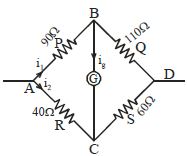
- 2In a Wheatstone bridge, $P = 90\,\Omega $, $Q = 110\,\Omega $ , $R = 40\,\Omega $ and $S = 60\,\Omega $ and a cell of $4\,V\,emf$. Then the potential difference between the diagonal along which a galvanometer is connected is ............. $V$View Solution
- 3Two batteries of different $e.m.f.'s$ and internal resistance connected in series with each other and with an external load resistor. The current is $3.0 \,A$. When the polarity of one battery is reversed, the current becomes $1.0 \,A$. The ratio of the $e.m.f.'s$ of the two batteries is ............View Solution
- 4A potentiometer having the potential gradient of $2\, mV/cm$ is used to measure the difference of potential across a resistance of $10 \,\Omega$. If a length of $50\, cm$ of the potentiometer wire is required to get the null point, the current passing through the $10 \,\Omega$ resistor is (in $mA$)View Solution
- 5Two resistors of resistance $R_1$ and $R_2$ having $R_1 > R_2$ are connected in parallel. For equivalent resistance $R$, the correct statements isView Solution
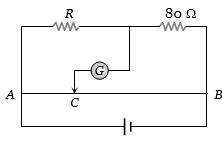
- 6$AB$ is a wire of uniform resistance. The galvanometer $G$ shows no current when the length $AC = 20\,cm$ and $CB = 80\, cm$. The resistance $R$ is equal to .............. $\Omega $View Solution
- 7If the length of the filament of a heater is reduced by $10\%$, the power of the heater willView Solution
- 8A copper rod of cross-sectional area $A$ carries a uniform current $I$ through it. At temperature $T$, if the volume charge density of the rod is $\rho $, how long will the charges take to travel a distance $d$ ?View Solution
- 9If a wire is stretched to make it $0.1 \%$ longer, its resistance willView Solution
- 10Two cells, having the same $e.m.f.$ are connected in series through an external resistance $R.$ Cells have internal resistances $r_1$ and $r_2\,\, (r_1 > r_2)$ respectively. When the circuit is closed, the potential difference across the first cell is zero. The value of $R$ isView Solution