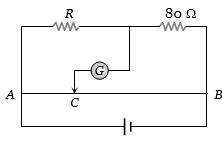
$AB$ is a wire of uniform resistance. The galvanometer $G$ shows no current when the length $AC = 20\,cm$ and $CB = 80\, cm$. The resistance $R$ is equal to .............. $\Omega $
Easy
Download our app for free and get started
By Wheatstone bridge, $\frac{R}{{80}} = \frac{{AC}}{{BC}} = \frac{{20}}{{80}}$ $ \Rightarrow $ $R = 20\,\Omega $

Download our appand get started for free
Experience the future of education. Simply download our apps or reach out to us for more information. Let's shape the future of learning together!No signup needed.*
Similar Questions
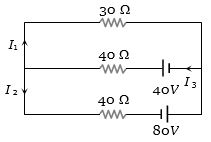
- 1In the given circuit the current $I_1$ is .............. $A$View Solution
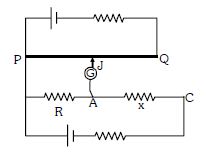
- 2Circuit for the measurement of resistance by potentiometer is shown. The galvanometer is first connected at point $A$ and zero deflection is observed at length $P J = 10\ cm$ . In second case it is connected at point $C$ and zero deflection is observed at a length $30\ cm$ from $P$ . Then the unknown resistance $X$ isView Solution
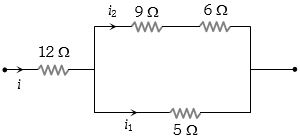
- 3In the following circuit, $5$ $\Omega$ resistor develops $45$ $J/s$ due to current flowing through it. The power developed per second across $12$ $\Omega$ resistor is ............. $W$View Solution
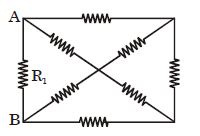
- 4As shown, the circuit is made of $8$ different resistors. It is found that when $R_1 = 4\,\,\Omega,$ the resistance between $A$ and $B$ is $2\,\,\Omega.$ Now replace $R_1$ by a $6\,\,\Omega$ resistor, what is the resistance between $A$ and $B$?View Solution
- 5With a potentiometer null point were obtained at $140\, cm$ and $180\, cm$ with cells of $emf$ $1.1 \,V$ and one unknown $X\, volts$. Unknown $emf$ is .............. $V$View Solution
- 6The length of a potentiometer wire is $1200\; \mathrm{cm}$ and it carries a current of $60 \;\mathrm{mA}$. For a cell of $emf\;5\; \mathrm{V}$ and intemal resistance of $20\; \Omega,$ the null point on it is found to be a $1000\; \mathrm{cm} .$ The resistance of whole wire is .............. $\Omega$View Solution
- 7View SolutionAssertion : A current continues to flow in superconducting coil even after switch is off.
Reason : Superconducting coils show Meissner effect
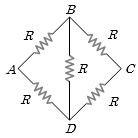
- 8Five equal resistances each of value $R$ are connected in a form shown alongside. The equivalent resistance of the networkView Solution
- 9A galvanometer of resistance, $G,$ is connected in a circuit. Now a resistance $R$ is connected in series of galvanometer. To keep the main current in the circuit unchanged, the resistance to be put in parallel with the series combination of $G$ and $R$ isView Solution
- 10View SolutionElectric current has both magnitude and direction. It is a