A piston of cross-section area $100\, cm^2$ is used in a hydraulic press to exert a force of $107\, dynes$ on the water. The cross-sectional area of the other piston which supports an object having a mass $2000 \,kg$. is
Medium
Download our app for free and get started
(c) ${P_1} = {P_2} \Rightarrow \frac{{{F_1}}}{{{A_1}}} = \frac{{{F_2}}}{{{A_2}}}$==> $\frac{{{{10}^7}}}{{{{10}^2}}} = \frac{{2000 \times {{10}^3} \times {{10}^3}}}{{{A_2}}}$
$\therefore {A_2} = 2 \times {10^4}c{m^2}$$(g = 980 \approx {10^3}cm/{s^2})$

Download our appand get started for free
Experience the future of education. Simply download our apps or reach out to us for more information. Let's shape the future of learning together!No signup needed.*
Similar Questions
- 1A flat plate of area $0.1 \,m ^2$ is placed on a flat surface and is separated from it by a film of oil $10^{-5} \,m$ thick whose coefficient of viscosity is $1.5 N \,sm s ^{-2}$. The force required to cause the plate to slide on the surface at constant speed of $1 \,mm s ^{-1}$ is ............ $N$View Solution
- 2View SolutionA liquid disturbed by stirring comes to rest after some time due to its property of
- 3We have three beakers $A, B$ and $ C $ containing glycerine, water and kerosene respectively. They are stirred vigorously and placed on a table. The liquid which comes to rest at the earliest isView Solution
- 4A tank of height $5\, m$ is full of water. There is a hole of cross sectional area $1\, cm^2$ in its bottom. The initial volume of water that will come out from this hole per second isView Solution
- 5Water from a pipe is coming at a rate of $100\, litres$ per minute. If the radius of the pipe is $5\, cm$, the Reynolds number for the flow is of the order of : (density of water $= 1000\, kg/m^3$, coefficient of viscosity of water $= 1\, mPa\, s$)View Solution
- 6A Spherical ball of radius $1 mm$ and density $10.5 g / cc$ is dropped in glycerine of coefficient of viscosity $9.8$ poise and density $1.5 g / cc$. Viscous force on the ball when it attains constant velocity is $3696 \times 10^{-x} N$. The value of $x$ is $\text { (Given, } g =9.8 m / s ^2 \text { and } \pi=\frac{22}{7} \text { ) }$View Solution
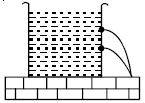
- 7In a cylindrical vessel containing liquid of density $\rho $, there are two holes in the side walls at heights of $ h_1$ and $h_2$ respectively such that the range of efflux at the bottom of the vessel is same. The height of a hole, for which the range of efflux would be maximum, will beView Solution
- 8View SolutionBernoulli's principle does not explain
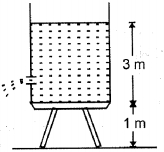
- 9Water is filled in a tank upto $3 \,m$ height. The base of the tank is at height $1 \,m$ above the ground. What should be the height of a hole made in it, so that water can be sprayed upto maximum horizontal distance on ground?View Solution
- 10A small spherical ball of radius $r$, falling through a viscous medium of negligible density has terminal velocity ' $v$ '. Another ball of the same mass but of radius $2 r$, falling through the same viscous medium will have terminal velocity:View Solution