When a rubber ball is taken to a depth of $......\,{m}$ in deep sea, its volume decreases by $0.5\, \%$
(The bulk modulus of rubber $=9.8 \times 10^{8}\, {Nm}^{-2}$ Density of sea water $=10^{3} {kgm}^{-3}$
$\left.{g}=9.8\, {m} / {s}^{2}\right)$
JEE MAIN 2021, Medium


Download our appand get started for free
Experience the future of education. Simply download our apps or reach out to us for more information. Let's shape the future of learning together!No signup needed.*
Similar Questions
- 1A $U-$ tube containing a liquid moves with a horizontal acceleration a along a direction joining the two vertical limbs. The separation between these limbs is $d$ . The difference in their liquid levels isView Solution
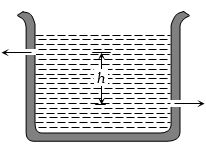
- 2There are two identical small holes of area of cross-section a on the opposite sides of a tank containing a liquid of density $\rho $. The difference in height between the holes is $h$. Tank is resting on a smooth horizontal surface. Horizontal force which will has to be applied on the tank to keep it in equilibrium isView Solution
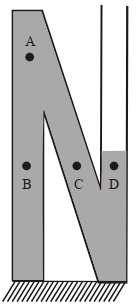
- 3Consider a mercury-filled tube as shown in the figure belowView Solution
Which of the following options about the pressures at the lettered locations $(A, B, C, D)$ is true?
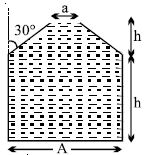
- 4The vessel shown in the figure has two sections. The lower part is a rectangular vessel with area of cross-section $A$ and height $h$. The upper part is a conical vessel of height $h$ with base area $‘A’$ and top area $‘a’$ and the walls of the vessel are inclined at an angle $30^o$ with the vertical.A liquid of density $\rho$ fills both the sections upto a height $2h$. Neglecting atmospheric pressure.View Solution
- 5View SolutionFrom amongst the following curves, which one shows the variation of the velocity v with time t for a small sized spherical body falling vertically in a long column of a viscous liquid
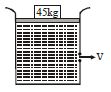
- 6A large cylindrical tank of cross-sectional area $1\ m^2 $ is filled with water. It has a small hole at a height of $1\ m $ from the bottom. $A$ movable piston of mass $5$ $kg$ is fitted on the top of the tank such that it can slide in the tank freely without friction. A load of $45$ $kg$ is applied on the top of water by piston, as shown in figure. The value of $v$ when piston is $7$ $m$ above the bottom is $(g = 10\ m/s^2)$ ....... $m/s$View Solution
- 7Water flows in a streamlined manner through a capillary of radius $'a'$, the pressure difference being $'p'$ and the rate of flow $Q$. If the radius is reduced to $'a/2'$ and the pressure increased to $'4p'$, the rate of flow becomes :-View Solution
- 8A cylindrical vessel open at the top is $20$ $cm $ high and $10$ $cm$ in diameter. A circular hole whose cross-sectional area $1$ $cm^2$ is cut at the centre of the bottom of the vessel. Water flows from a tube above it into the vessel at the rate $100$ $cm^3$ $s^{^{-1}}$. The height of water in the vessel under steady state is ....... $cm$ (Take $g$ $=$ $1000 $ $cm s^{^{-2}})$View Solution
- 9A sample of metal weighs $210 gm$ in air, $180 gm$ in water and $120 gm$ in liquid. Then relative density $(RD) $ ofView Solution
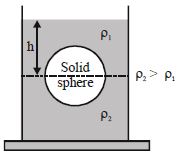
- 10A solid sphere of radius $r$ is floating at the interface of two immiscible liquids of densities $\rho_1$ and $\rho_2\,\, (\rho_2 > \rho_1),$ half of its volume lying in each. The height of the upper liquid column from the interface of the two liquids is $h.$ The force exerted on the sphere by the upper liquid is $($ atmospheric pressure $= p_0\,\,\&$ acceleration due to gravity is $g) $View Solution