Question
A plane electromagnetic wave is passing through a region. Consider (a) electric field (b) magnetic field (c) electrical energy in a small volume and (d) magnetic energy in a small volume. Construct the pairs of the quantities that oscillate with equal frequencies.
Answer

Let the electromagnetic wave be propagating in the z-direction. The vibrations of the electric and magnetic fields are given by,$\text{E}_\text{x}=\text{E}_0\sin(\text{kz}-\omega\text{t})$
$\text{B}_\text{y}=\text{B}_0\sin(\text{kz}-\omega\text{t})$
Let the volume of the region be V. The angular frequency of the vibrations of the electric and magnetic fields are same and are equal to $\omega$ Therefore, their frequency, $\text{f}=\frac{\omega}{2\pi},$ is same. The electrical energy in the region,$\text{U}_\text{E}=\Big(\frac{1}{2}\in_0\text{E}^2\Big)\times\text{V}$
It can be written as,$\text{U}_\text{E}=\Big(\frac{1}{2}\in_0\big(\text{E}^2_0\sin^2(\text{kz}-\omega\text{t})\big)\Big)\times\text{V}$
$\text{U}_\text{E}=\Bigg(\frac{1}{2}\in_0\text{E}_0^2\times\frac{\big(1-\cos2(\text{kz}-\omega\text{t})\big)}{2}\Bigg)\times\text{V}$
$\text{U}_\text{E}=\Big(\frac{1}{4}\in_0\text{E}_0^2\times(1-\cos2(\text{kz}-\omega\text{t}))\Big)\times\text{V}$
The magnetic energy in the region,$\text{U}_\text{B}=\Big(\frac{\text{B}^2}{2\mu_0}\Big)\times\text{V}$
$\text{U}_\text{B}=\bigg(\frac{\text{B}^2_0\sin^2(\text{kz}-\omega\text{t})}{2\mu_0}\bigg)\times\text{V}$
$\text{U}_\text{B}=\Bigg(\frac{\text{B}^2_0\big(1-\cos(2\text{kz}-2\omega\text{t})\big)}{4\mu_0}\Bigg)\times\text{V}$
The angular frequency of the electric and magnetic is same and is equal to $2\omega$ Therefore, their frequency,$\text{f}'=\frac{2\omega}{2\pi}=2\text{f}$
Will be same. Thus, the electric and magnetic fields have same frequencies and the electrical and magnetic energies will have same frequencies.

Need a full question paper?

Generate a complete, print-ready paper with questions like this in minutes — across 16+ boards, with answer keys.

Start Generating Free

Similar questions

Draw a ray diagram to show the formation of real image of the same size as that of the object placed in front of a converging lens. Using this ray diagram establish the relation between u, v and f for this lens.
How long can an electric lamp of 100 W be kept glowing by fusion of 2.0 kg of deuterium? Take the fusion reaction as :
${ }_1^2 H +{ }_1^2 H \rightarrow{ }_2^3 He +n+3.27 MeV$
Two identical pith balls, each carrying a charge q, are suspended from a common point by two strings of equal length l. Find the mass of each ball if the angle between the strings is $2\theta$ in equilibrium.
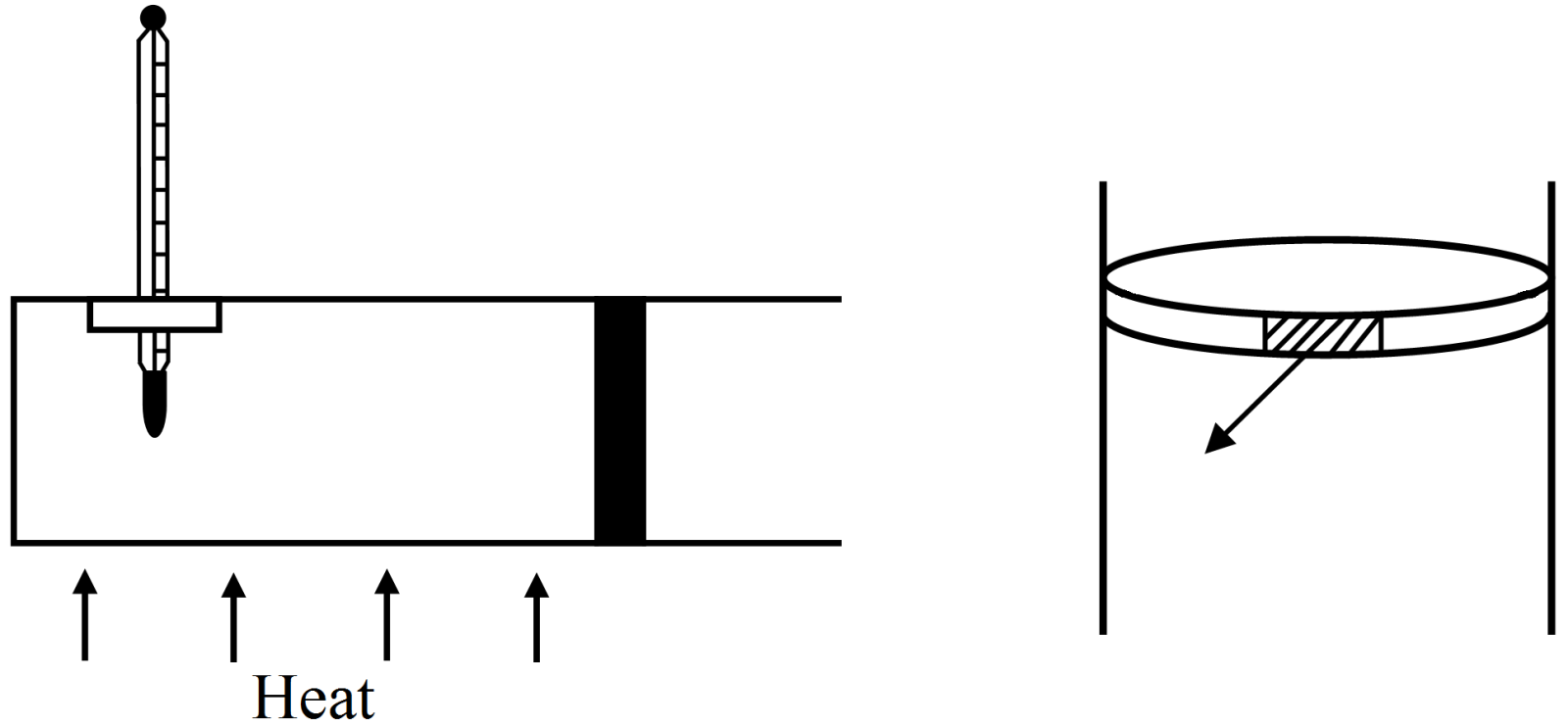
Figure. shows a cylindrical tube of radius 5cm and length 20cm. It is closed by a tight-fitting cork. The friction coefficient between the cork and the tube is 0.20. The tube contains an ideal gas at a pressure of 1 atm and a temperature of 300K. The tube is slowly heated and it is found that the cork pops out when the temperature reaches 600K Let dN denote the magnitude of the normal contact force exerted by a small length dl of the cork along the periphery (see the figure). Assuming that the temperature of the gas is uniform at any instant, calculate $\frac{\text{dN}}{\text{dl}}.$
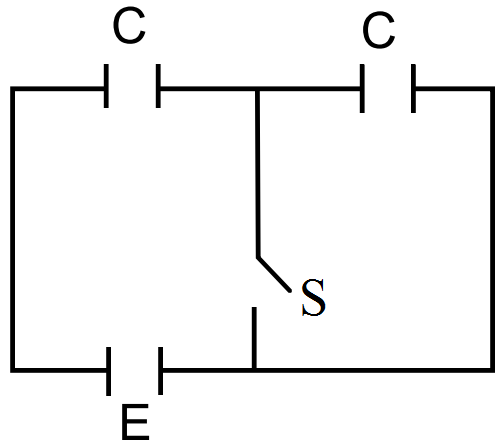
Consider the situation shown in figure. The switch S is open for a long time and then closed:
  1. Find the charge flown through the battery when the switch S is closed.
  2. Find the work done by the battery.
  3. Find the change in energy stored in the capacitors.
  4. Find the heat developed in the system.
The friction coefficient between a road and the tyre of a vehicle is $\frac{4}{3}.$ Find the maximum incline the road may have so that once hard brakes are applied and the wheel starts skidding, the vehicle going down at a speed of 36km/hr is stopped within 5m.
The difference in the frequencies of series limit of Lyman series and Balmer series is equal to the frequency of the first line of the Lyman series. Explain.
How would you set up a circuit to obtain $\text{NOT}$ gate using a transistor?
A capacitor of capacitance $8.0\mu\text{F}$ is connected to a battery of emf 6.0V through a resistance of $24\Omega.$ Find the current in the circuit (a) just after the connections are made and (b) one time constant after the connections are made.
Explain Oersted's experiment. What conclusions were drawn from it? What do you understand by magnetic field? How direction and intensity of magnetic field determined?