Question
How would you set up a circuit to obtain $\text{NOT}$ gate using a transistor?

Answer

  1.  It has only one input and only one output.
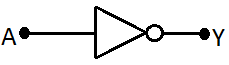
  2. Boolean expression is $Y = Ᾱ $ and is read as $ " y$ equals not $A\ " $.Logical symbol of $\text{NOT}$ gate.
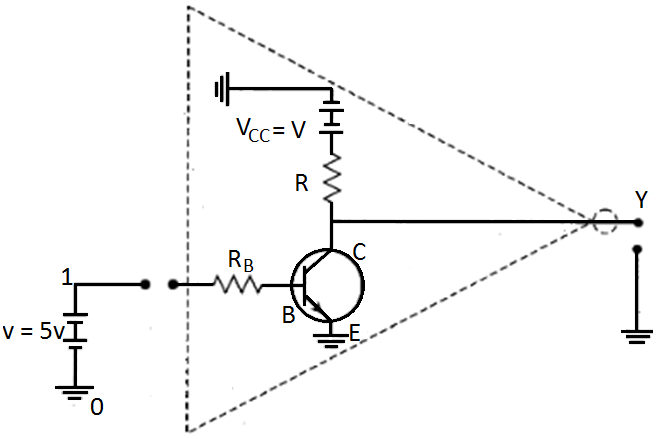
  1. Realization of $\text{NOT}$ gate: The transistor is so biased that the collector voltage $V_{CC} = V\ ($Voltage corresponding to $1$ state$).$
The resistors $R$ and $R_B$ are so chosen that if the input is low,
i.e. $0, $ the transistor is in the cut off and hence the voltage appearing at the output will be the same as applied $V = 5V$.
Hence $Y = V($or state $ I).$
If the input is high, the transistor current is in saturation and the net voltage at the output $Y$ is $0\ ($in state $0).$
  1. Truth table for not gate: 
$A$ $Y = Ᾱ$
$0$ $1$
$1$ $0$

Need a full question paper?

Generate a complete, print-ready paper with questions like this in minutes — across 16+ boards, with answer keys.
Start Generating Free

Similar questions

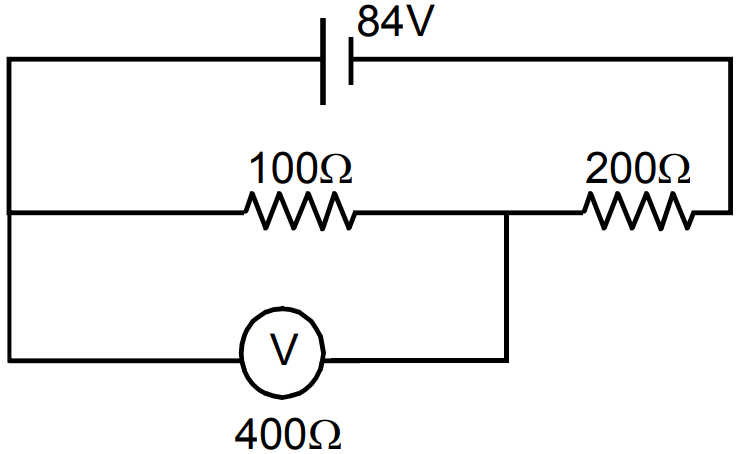
A voltmeter of resistance $400\Omega$ is used to measure the potential difference across the $100\Omega$ resistor in the circuit shown in the figure. (a) What will be the reading of the voltmeter? (b) What was the potential difference across $100\Omega$ before the voltmeter was connected?
The bob of a stationary pendulum is given a sharp hit to impart it a horizontal speed of $\sqrt{3\text{gl}}.$ Find the angle rotated by the string before it becomes slack.
The electric field associated with a light wave is given by $\text{E}=\text{E}_0\sin[(1.57\times10^7\text{m}^{-1})(\text{x}-{\text{ct}})].$ Find the stopping potential when this light is used in an experiment on photoelectric effect with the emitter having work function $1.9eV.$ 
A bulb with rating $250V, 100W$ is connected to a power supply of $220V$ situated $10m$ away using a copper wire of area of cross$-$section $5\ mm^2$. How much power will be consumed by the connecting wires? Resistivity of copper $1.7\times10^{-8}\Omega-\text{m}$.
Explain electric charge. Verify by experiment that there is repulsion between like charges and attraction between unlike charges.
A beam of white light is incident normally on a plane surface absorbing 70% of the light and reflecting the rest. If the incident beam carries 10W of power, find the force exerted by it on the surface.
Repeat the previous problem if the particle C is displaced through a distance x along the line AB.
Describe Davisson and Germer’s experiment to demonstrate the wave nature of electrons. Draw a labelled diagram of apparatus used.
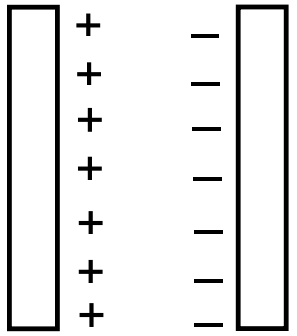
Two large conducting plates are placed parallel to each other and they carry equal and opposite charges with surface density $\sigma$ as shown in figure. Find the electric field:
  1. At the left of the plates.
  2. In between the plates.
  3. At the right of the plates.
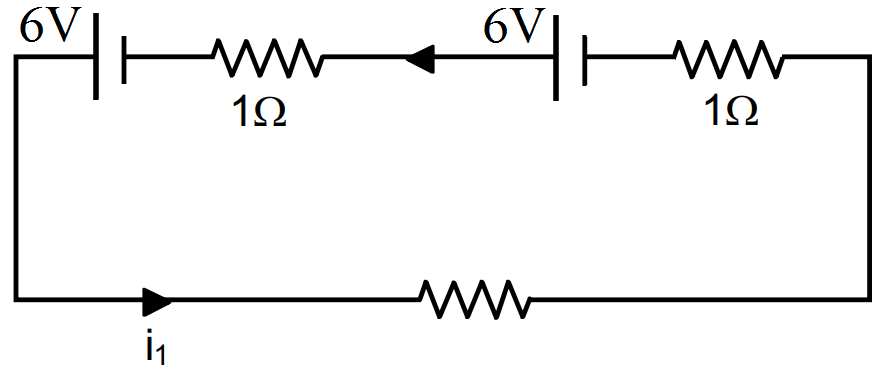
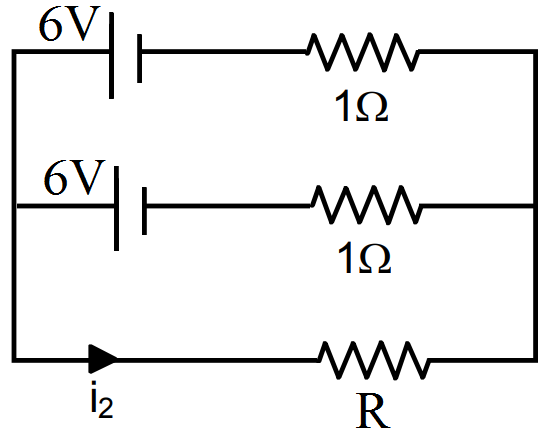
Find the value of $\frac{\text{i}_1}{\text{i}_2}$ in the figure. if (a) $\text{R}=0.1\Omega$ (b) $\text{R}=1\Omega$ and (c) $\text{R}=10\Omega.$ Note from your answers that in order to get more current from a combination of two batteries, they should be joined in parallel if the external resistance is small and in series if the external resistance is large, compared to the internal resistance.