Question
A plane electromagnetic wave with a single frequency moves in vacuum in the positive x direction. Its amplitude is uniform over the yz plane its wavelength:

Answer

  1. Same
Explanation:
The same amount of energy passes through equal areas parallel to the yz plane as the wave travels in the +x direction, so the amplitude and the intensity, which is proportional to the square of the amplitude, do not change.

Need a full question paper?

Generate a complete, print-ready paper with questions like this in minutes — across 16+ boards, with answer keys.
Start Generating Free

Similar questions

The energy of a charged capacitor is given by the expression $( q=$ charge on the conductor and $C=$ its capacity$)$
Unpolarized light of intensity $32 \ \mathrm{Wm}^{-2}$ passes through three polarizers such that transmission axes of the first and second polarizer makes and angle $30^{\circ}$ with each other and the transmission axis of the last polarizer is crossed with that of the first. The intensity of final emerging light will be
A positively charged rod is brought near an uncharged conductor. If the rod is then suddenly withdrawn, the charge left on the conductor will be:
The direction of propagation of electromagnetic wave is :
If paramagnetic susceptibility $\chi$ of a substance is 9 then its relative permeability $\mu_r$ is :
Which of the following have zero average value in a plane electromagnetic wave?
The e.m.f. of a standard cell balances across 150 cm length of a wire of potentiometer. When a resistance of 2 Ω is connected as a shunt with the cell, the balance point is obtained at 100 cm. The internal resistance of the cell is(a) 0.1 Ω(b) 1 Ω(c) 2 Ω(d) 0.5 Ω
       
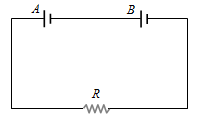
Two batteries $A$ and $B$ each of e.m.f. $2\ V$ are connected in series to an external resistance $R = 1$ ohm.  If the internal resistance of battery $A$ is $1.9$ ohms and that of$ B$ is $0.9$ ohm, what is the potential difference between the terminals of battery $A$
If the rotational velocity of dynamo armature is doubled, then induced emf will become:
Assertion   :   Two bulbs of same wattage, one having a carbon filament and the other having a metallic filament are connected in series. Metallic bulbs will glow more brightly than carbon filament bulb. 
Reason      : Carbon is a semiconductor.(a) If both assertion and reason are true and the reason is the correct explanation of the assertion.(b) If both assertion and reason are true but reason is not the correct explanation of the assertion.(c) If assertion is true but reason is false.(d) If the assertion and reason both are false.