Question
A point charge is moving along a straight line with a constant velocity u. Consider a small area A perpendicular to the direction of motion of the charge (El). Calculate the displacement current through the area when its distance from the charge is x. The value of x is not large so that the electric field at any instant is essentially given by Coulomb's law.

Answer

$\text{E}=\frac{\text{Kq}}{\text{x}^2}$ [from coulomb's law]
$\phi_\text{E}=\text{EA}=\frac{\text{KqA}}{\text{x}^2}$
$\text{l}_\text{d}=\epsilon_0\frac{\text{d}\phi\text{E}}{\text{dt}}=\epsilon_0\frac{\text{d}}{\text{dt}}\frac{\text{kqA}}{\text{x}^2}=\epsilon_0\text{KqA}=\frac{\text{d}}{\text{dt}}\text{x}^{-2}$
$=\epsilon_0\times\frac{1}{4\pi\epsilon_0}\times\text{q}\times\text{A}\times-2\times\text{x}^{-3}\times\frac{\text{dx}}{\text{dt}}=\frac{\text{qAv}}{2\pi\text{x}^3}$

Need a full question paper?

Generate a complete, print-ready paper with questions like this in minutes — across 16+ boards, with answer keys.

Start Generating Free

Similar questions

Identify the following electromagnetic radiations as per the wavelengths given below.
Write one application of each.
  1. 1$0^{–3}nm$
  2. $10^{–3} m$
  3. $1 nm$
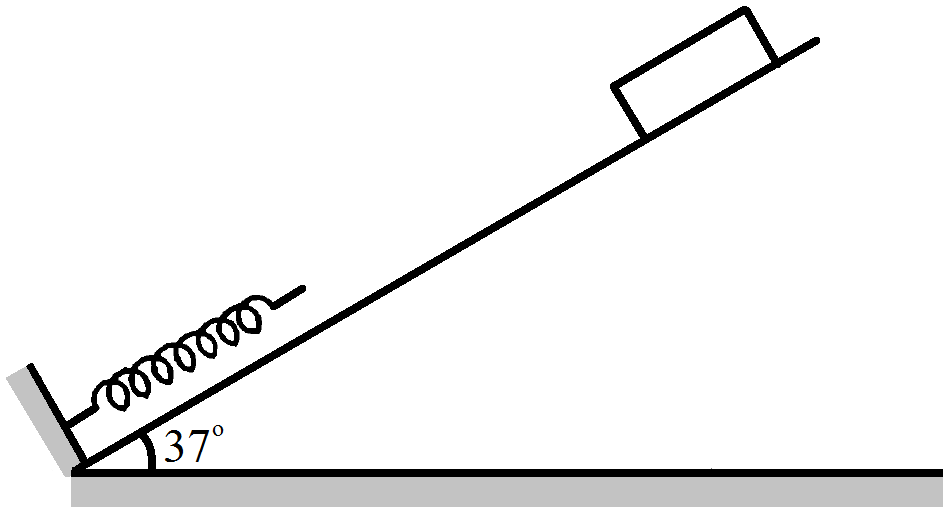
Figure shows a spring fixed at the bottom end of an incline of inclination $37^\circ$. A small block of mass $2\ kg$ starts slipping down the incline from a point $4.8\ m$ away from the spring. The block compresses the spring by $20\ cm,$ stops momentarily and then rebounds through a distance of $1\ m$ up the incline. Find.
  1. The friction coefficient between the plane and the block.
  2. The spring constant of the spring. Take $g = 10m/s^2.$
A current$-$carrying circular coil of $100$ turns and radius $5.0\ cm$ produces a magnetic field of $6.0 \times 10^{-5}\ T$ at its centre. Find the value of the current.
How does the resolving power of a compound microscope get affected on:
  1. Decreasing the diameter of its objective?
  2. Increasing the focal length of its objective?
By how much would the stopping potential for a given photosensitive surface go up if the frequency of the incident radiations were to be increased from $4 \times 10^{15}\ Hz$ to $8 \times 10^{15}\ Hz$?
Given $h = 6.4 \times 10^{-34} J-s, e = 1.6 \times 10^{-19}C$ and $c = 3 \times 10^8 ms^{-1}$.
Compare the properties of soft iron and steel.
A circular loop of radius r carrying a current i is held at the centre of another circular loop of radius R(>> r) carrying a current I. The plane of the smaller loop makes an angle of 30° with that of the larger loop. If the smaller loop is held fixed in this position by applying a single force at a point on its periphery, what would be the minimum magnitude of this force?
A charge of $3.14 \times 10^{-6}C$ is distributed uniformly over a circular ring of radius $20.0\ cm.$ The ring rotates about its axis with an angular velocity of $60.0 rad/s.$ Find the ratio of the electric field to the magnetic field at a point on the axis at a distance of $5.00\ cm$ from the centre.
Define the terms
$(i)$ 'cut$-$off voltage' and
$(ii)$ 'threshold frequency' in relation to the phenomenon of photoelectric effect.
Using Einstein's photoelectric equation show how the cut$-$off voltage and threshold frequency for a given photosensitive material can be determined with the help of a suitable plot/graph.
Draw a circuit diagram of a transistor amplifier in CE configuration. Under what condition does the transistor act as an amplifier?
Define the terms:
i. Input resistance and
ii. Current amplification factor. How are these determined using typical input and output characteristics?