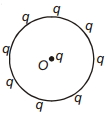
A point charge $q$ is surrounded by eight identical charges at distance $r$ as shown in figure. How much work is done by the forces of electrostatic repulsion when the point charge at the centre is removed to infinity?
Easy


Download our appand get started for free
Experience the future of education. Simply download our apps or reach out to us for more information. Let's shape the future of learning together!No signup needed.*
Similar Questions
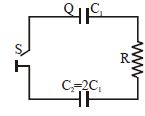
- 1Two capacitors $C_1$ and $C_2 = 2C_1$ are connected in a circuit with a switch between them as shown in the figure. Initially the switch is open and $C_1$ holds charge $Q$. The switch is closed. At steady state, the charge on each capacitor will beView Solution
- 2The insulated spheres of radii ${R_1}$ and ${R_2}$ having charges ${Q_1}$and ${Q_2}$ respectively are connected to each other. There isView Solution
- 3A parallel-plate capacitor is connected to a resistanceless circuit with a battery until the capacitor is fully charged. The battery is then disconnected from the circuit and the plates of the capacitor are moved to half of their original separation using insulated gloves. Let $V_{new}$ be the potential difference across the capacitor plates when the plates have moved. Let $V_{old}$ be the potential difference across the capacitor plates when they were connected to the battery $\frac{V_{new}}{V_{old}}=$......View Solution
- 4If three capacitors each of capacity $1\,\mu F$ are connected in such a way that the resultant capacity is $1.5\,\mu F$, thenView Solution
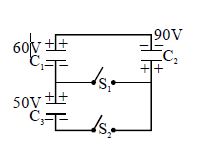
- 5Three charged capacitors, $C_1$ = $17\ μF$, $C_2$ = $34\ μF$, $C_3$ = $41\ μF$and two open switches, $S_1$ and $S_2$ are assembled into a network with initial voltages and polarities, as shown. Final status of the network is attained when the two switches, $S_1$ and $S_2$ are closed. In the figure, the final charge on capacitor $C_3$ in $mC$, is closet to:View Solution
- 6A conducting sphere of radius $10\, cm$ is charged $10\,\mu \,C$. Another uncharged sphere of radius $20\, cm$ is allowed to touch it for some time. After that if the sphere are separated, then surface density of charges, on the spheres will be in the ratio ofView Solution
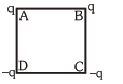
- 7Charges are placed on the vertices of a square as shown. Let $E$ be the electric field and $V$ the potential at the centre. If the charges on $A$ and $B$ are interchanged with those on $D$ and $C$ respectively, thenView Solution
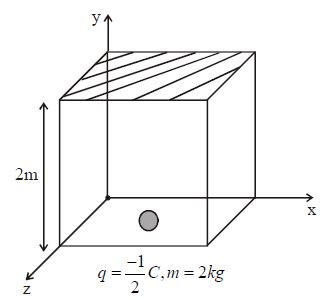
- 8Consider a gravity free container as shown. System is initially at rest and electric potential in the regon is $V = (y^3+2)\ J/C$. A ball of charge $q$ and mass $m$ is released from rest from base starts to move up due to electric field and collides with the shaded face as shown.If its speed just after collision is $1.5\ m/s$ and time for which ball is in contact with shaded face is $0.1\ sec$, find external force required to hold the container fixed in its position during collision assuming ball exerts constant force on wall during entire span of collision.......$N$View Solution
- 9Two equal charges $q$ are placed at a distance of $2a$ and a third charge $ - 2q$ is placed at the midpoint. The potential energy of the system isView Solution
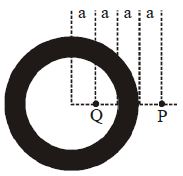
- 10A solid uncharged conducting sphere has radius $3a$ contains a hollowed spherical region of radius $2a$. A point charge $+Q$ is placed at a position a distance a from the common center of the spheres. What is the magnitude of the electric field at the position $r = 4a$ from the center of the spheres as marked in the figure by $P?$ $\left( {k = \frac{1}{{4\pi { \in _0}}}} \right)$View Solution